Iran Strait of Hormuz Stance and Energy Security Risks
Source:Indian Express ↗
Why It Matters
The Strait of Hormuz is one of the world's most critical maritime chokepoints, handling a significant portion of global oil transit. Geopolitical tensions between the US and Iran over this strait and domestic infrastructure directly impact global energy markets, affecting import-dependent nations like India. Evaluating such shifts is crucial for understanding Middle East diplomacy and its economic ramifications.
Summary
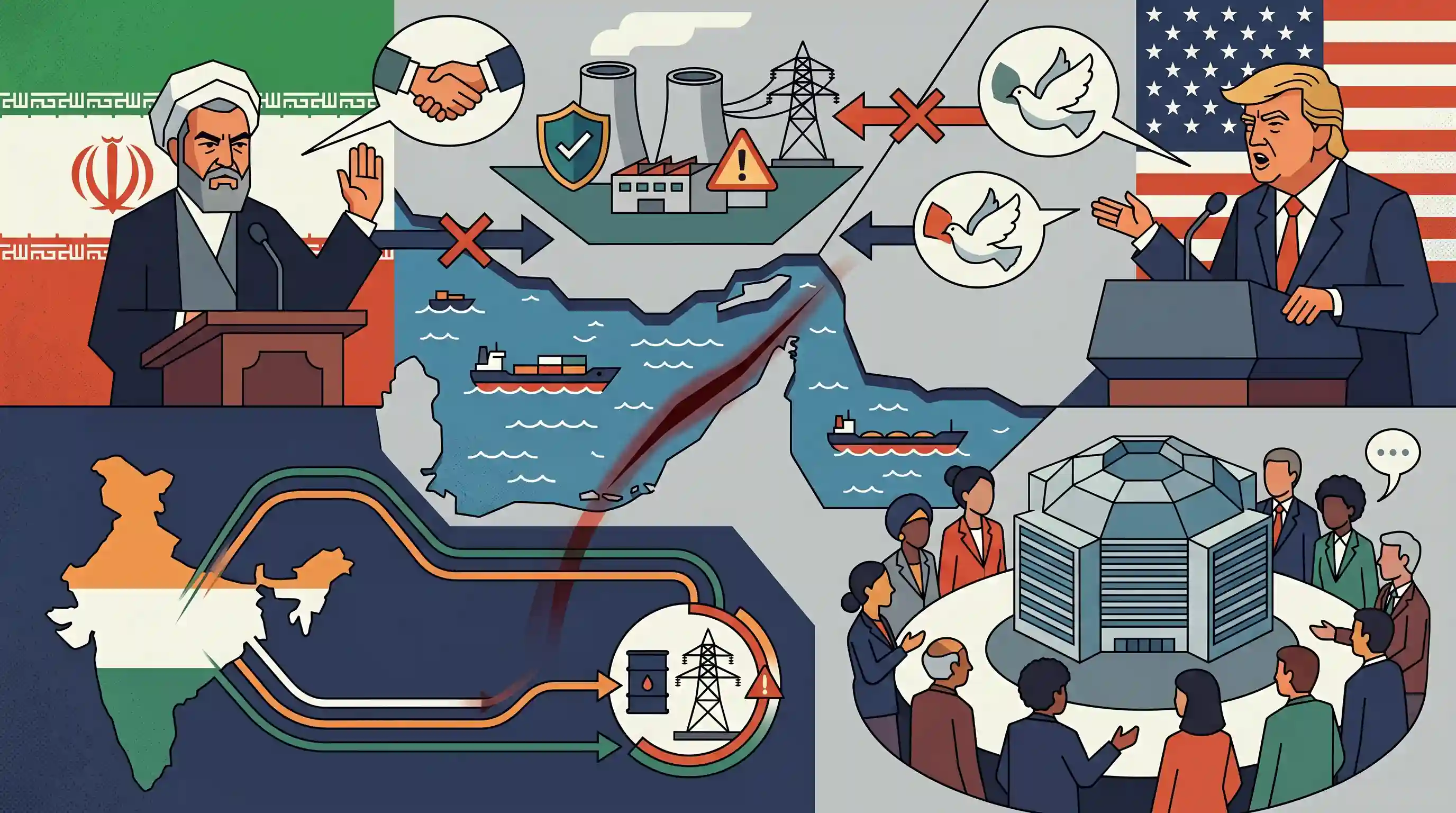
Iran has officially rejected claims made by Donald Trump regarding secret peace talks concerning the strategic Strait of Hormuz. In conjunction with these denials, Iran issued a firm warning regarding the security and protection of its power plants, signaling high geopolitical tension in the region. The developments highlight the ongoing volatility in US-Iran relations and the continuous strategic focus on the Strait of Hormuz, a critical maritime chokepoint whose stability is essential for global energy security.
Key Points
- Iran firmly denied US President-elect Donald Trump's claims that secret peace negotiations were held between the two nations regarding the Strait of Hormuz.
- The Iranian leadership issued a stern warning concerning the security of its domestic power plants, reflecting heightened alertness against potential strikes amidst escalating regional conflicts.
- The Strait of Hormuz continues to be a major geopolitical flashpoint; as a vital maritime chokepoint connecting the Persian Gulf to the Gulf of Oman, any disruption there threatens global seaborne oil trade.
- Continued friction between the US and Iran underscores the volatile security environment in the Middle East, with direct implications for global energy markets and India's energy security.
Prelims Trap
Commercial ships in the Strait of Hormuz navigate exclusively through international high seas outside state jurisdiction.
The Strait is extremely narrow. Ships must physically pass through the territorial waters of Iran and Oman, operating under UNCLOS 'Transit Passage' rights.
Static Concepts Connected
Which water bodies and nations geographically bound the Strait of Hormuz?
- Water bodies: It connects the Persian Gulf in the west to the Gulf of Oman and the Arabian Sea in the east.
- Northern border: It is bordered by Iran to the north.
- Southern border: It is bordered by Oman (via the Musandam Peninsula exclave) and the United Arab Emirates to the south.
What is 'Transit Passage' under UNCLOS for international straits?
- Transit Passage: A regime allowing continuous and expeditious transit of vessels through straits used for international navigation.
- Submarine exception: Unlike Innocent Passage in territorial seas, Transit Passage allows submarines to remain submerged while transiting.
- Non-suspendable: Coastal states cannot suspend Transit Passage, making it vital for ensuring unimpeded global trade and energy flows.
Cross-Topic Patterns
Hormuz vulnerability & India's SPRs
Supply shocks via Hormuz directly link to India's Strategic Petroleum Reserves (SPRs). Expect questions mapping Middle East instability to India's domestic SPR expansion sites like Padur and Chandikhol.
UNCLOS and Chokepoint Geopolitics
Questions often fuse pure map geography (straits) with international maritime law, testing the difference between 'transit passage' in straits and 'innocent passage' in standard territorial waters.

Map questions pairing Middle East chokepoints (Hormuz/Bab-el-Mandeb) with UNCLOS navigation rights are a high probability for 2026 Prelims.
Linked PYQs · 4
Linked PYQs · 4
- 2025MainsGS2
"Energy security constitutes the dominant kingpin of India's foreign policy, and is linked with India's overarching influence in Middle Eastern countries.” How would you integrate energy security with India's foreign policy trajectories in the coming years?
- 2017MainsGS2
The question of India's Energy Security constitutes the most important part of India's economic progress. Analyze India's energy policy cooperation with West Asian countries.
- 2024PrelimsGS1
Consider the following statements : Statement-I : Sumed pipeline is a strategic route for Persian Gulf oil and natural gas shipments to Europe. Statement-II : Sumed pipeline connects the Red Sea with the Mediterranean Sea. Which one of the following is correct in respect of the above statements?
- 2023PrelimsGS1
Consider the following pairs: Regions often mentioned in news Reason for being in news 1. North Kivu and Ituri : War between Armenia and Azerbaijan 2. Nagorno-Karabakh : Insurgency in Mozambique 3. Kherson and Zaporizhzhia : Dispute between Israel and Lebanon How many of the above pairs are correctly matched?
