Iran Ceasefire Rejection and Strait of Hormuz Energy Chokepoint
Source:The Hindu ↗
Why It Matters
The Strait of Hormuz is critical to global energy security, and its blockade directly threatens India's oil imports and macroeconomic stability. Understanding the strategic geography of the Persian Gulf (e.g., South Pars field) and the shifting alliances involving the US, Israel, Iran, and regional mediators is crucial for International Relations (GS2) and Geography (GS1).
Summary
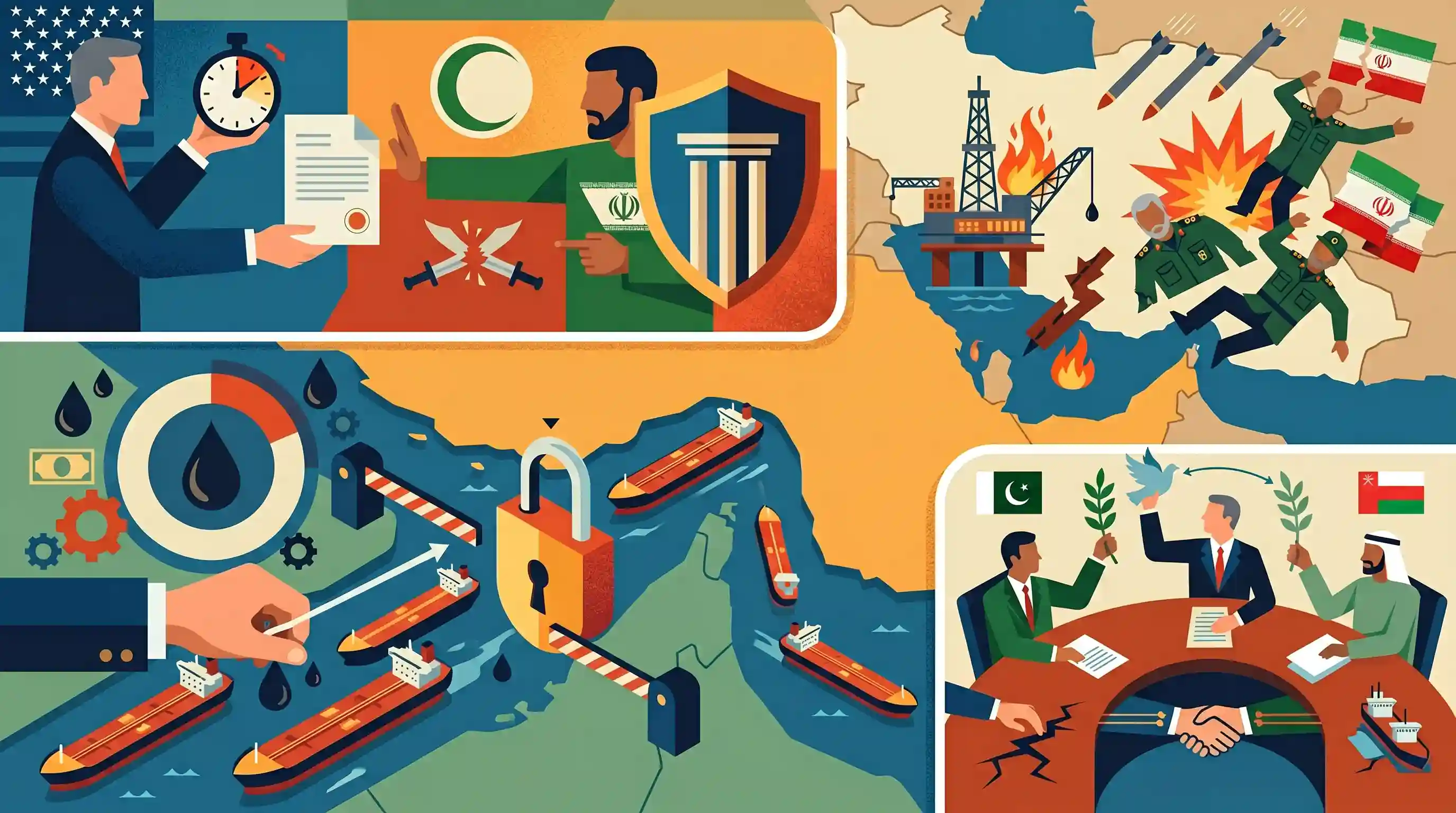
Iran has rejected a U.S. ceasefire proposal backed by an ultimatum from President Donald Trump, demanding a permanent end to the war with solid guarantees instead. The U.S. deadline centers on Tehran unconditionally unblocking the Strait of Hormuz, a vital maritime chokepoint that facilitates one-fifth of the world's oil trade. The geopolitical standoff has worsened following Israeli attacks on Iran's South Pars natural gas field and the killing of Revolutionary Guard commanders. Meanwhile, Pakistan and Oman are engaging in diplomatic efforts to manage the fallout and negotiate shipping security.
Key Points
- Iran has rejected a US ceasefire proposal, insisting on a permanent end to hostilities with firm guarantees rather than yielding to ultimatums.
- US President Donald Trump issued a deadline demanding Iran unconditionally reopen the Strait of Hormuz, a critical chokepoint for global oil trade.
- Tensions escalated following an Israeli strike on Iran's South Pars natural gas field (the world's largest, shared with Qatar) and the assassination of two Revolutionary Guard commanders.
- Regional diplomacy is active, with Pakistan mediating Iran's potential response and Omani officials working on a shipping mechanism for the Strait of Hormuz.
Important Terms
Islamic Revolutionary Guard Corps (IRGC)

An elite branch of Iran’s Armed Forces established in 1979 to protect the Islamic revolutionary system. It operates independently of the regular army and controls significant portions of Iran's economy and regional proxy networks.
UPSC context
GS-II: International Relations. Essential for analyzing Iran’s regional 'Axis of Resistance' strategy and its impact on West Asian stability and Indian interests.
Strait of Hormuz
A strategic narrow waterway between Iran and Oman connecting the Persian Gulf to the Gulf of Oman. It is the world’s most vital oil chokepoint, handling approximately 20% of global petroleum consumption.
UPSC context
GS-I: World Geography. A critical maritime chokepoint; its stability is vital for India, which imports nearly 40% of its crude oil through this route.
South Pars Gas Field
The world's largest natural gas field, located in the Persian Gulf and shared between Iran (South Pars) and Qatar (North Field). it is a primary pillar of global natural gas and LNG supplies.
UPSC context
GS-I: Geography (Natural Resources) & GS-III: Energy Security. Relevant for understanding global energy infrastructure and the impact of regional conflicts on fuel prices.
Maritime Chokepoint
Strategic narrow channels along global shipping routes, such as straits or canals, where high volumes of trade are concentrated. Their disruption can lead to massive supply chain failures and price spikes.
UPSC context
GS-III: Internal Security & GS-I: Geography. Focuses on 'freedom of navigation' and the vulnerability of global trade to geopolitical blockades.
Energy Security
The uninterrupted availability of energy sources at an affordable price. It encompasses availability, accessibility, and affordability, which are crucial for a nation's economic stability and industrial growth.
UPSC context
GS-III: Infrastructure (Energy). Tests India's strategies to mitigate import dependency (85% for oil) through source diversification and strategic petroleum reserves.
Prelims Trap
"The Strait of Hormuz is geographically bordered exclusively by Iran and the United Arab Emirates."
Oman also shares the southern coastline via its Musandam Peninsula exclave, making it a crucial co-riparian state of the strait.
Static Concepts Connected
Which water bodies and nations define the Strait of Hormuz?
- Connecting waters: It connects the Persian Gulf in the west to the Gulf of Oman and the Arabian Sea in the southeast.
- Bordering nations: Bounded by Iran to the north and Oman (via the Musandam Peninsula exclave) and the UAE to the south.
- South Pars field: Located nearby in the Persian Gulf, it is the world's largest natural gas field, shared territorially by Iran and Qatar.
What is 'Transit Passage' under the UNCLOS regime?
- Definition: The freedom of navigation and overflight solely for continuous and expeditious transit through a strait used for international navigation.
- Non-suspension: Unlike 'innocent passage' in standard territorial waters, transit passage through international straits cannot be arbitrarily suspended or blocked by coastal states.
Cross-Topic Patterns
Hormuz blockade + Macroeconomic stability
Supply shocks from a Hormuz blockade spike crude prices, directly widening India's Current Account Deficit (CAD) and fueling imported inflation, impacting RBI's monetary policy.
Chokepoints + Strategic Petroleum Reserves
Geopolitical vulnerability in the Middle East underscores India's push to expand its Strategic Petroleum Reserves (SPRs), which currently cover only a fraction of national energy needs during crises.

Middle East chokepoint mapping (Hormuz/Bab-el-Mandeb) paired with UNCLOS 'transit passage' rules will likely be a 2026 prelims question.
Linked PYQs · 3
Linked PYQs · 3
- 2025MainsGS2
"Energy security constitutes the dominant kingpin of India's foreign policy, and is linked with India's overarching influence in Middle Eastern countries.” How would you integrate energy security with India's foreign policy trajectories in the coming years?
- 2018MainsGS2
“India’s relations with Israel have, of late, acquired a depth and diversity, which cannot be rolled back.” Discuss.
- 2024PrelimsGS1
Consider the following statements : Statement-I : Sumed pipeline is a strategic route for Persian Gulf oil and natural gas shipments to Europe. Statement-II : Sumed pipeline connects the Red Sea with the Mediterranean Sea. Which one of the following is correct in respect of the above statements?
