Iranian President Signals Openness to US Dialogue Amid Tensions
Source:The Hindu ↗
Why It Matters
The evolving strategic triangle involving the U.S., Iran, and Israel dictates the security architecture of the Middle East. For India, instability in this region directly impacts energy security, trade routes (including the Chabahar Port and INSTC), and the safety of the Indian diaspora.
Summary
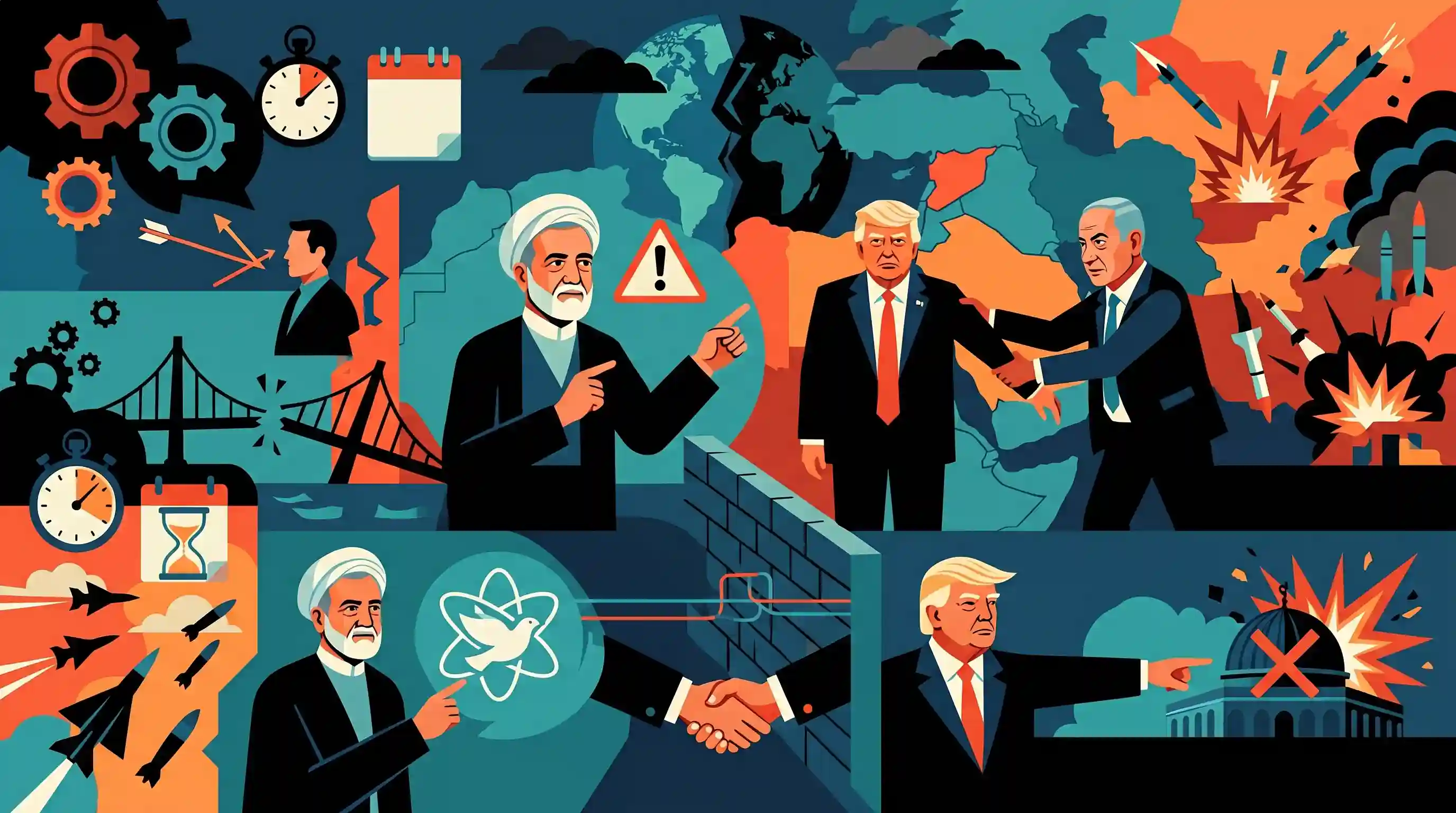
Iranian President Masoud Pezeshkian has indicated a readiness for dialogue with the U.S., while expressing deep mistrust following recent U.S. and Israeli attacks on Iran. In an interview, Pezeshkian cautioned U.S. President Donald Trump against being drawn into a regional war by Israeli Prime Minister Benjamin Netanyahu. The Iranian leader also accused Israel of a failed assassination attempt against him, an act he blamed for derailing negotiations and sparking a recent 12-day air conflict. While Trump has touted U.S. strikes as a permanent blow to Iran's nuclear capabilities, Pezeshkian maintained that Tehran has no intention of developing nuclear weapons, framing the friction as a major barrier to Middle Eastern stability.
Key Points
- Iranian President Masoud Pezeshkian signaled an openness to dialogue with the U.S. to resolve differences, though he cited significant trust issues stemming from recent U.S. and Israeli military actions.
- In an interview with Tucker Carlson, Pezeshkian warned U.S. President Donald Trump against being manipulated by Israeli PM Benjamin Netanyahu into a broader Middle Eastern war.
- Pezeshkian accused Israel of a failed assassination attempt against him, which he claims caused the collapse of ongoing talks and triggered a 12-day air conflict in June that killed top Iranian commanders and nuclear scientists.
- Despite Trump's claims that U.S. military strikes permanently set back Tehran's nuclear program, Pezeshkian reiterated that Iran does not seek a nuclear weapon.
Important Terms
Joint Comprehensive Plan of Action (JCPOA)

A 2015 agreement between Iran and world powers (P5+1) limiting Iran's nuclear activities in exchange for sanctions relief. It remains a central pillar of diplomatic discourse in West Asian security.
UPSC context
GS Paper II: International Relations. Crucial for questions on bilateral relations, global security, and India's energy interests in West Asia.
International Atomic Energy Agency (IAEA)
The world's nuclear inspectorate, an autonomous organization within the UN system that monitors compliance with nuclear safeguards and promotes peaceful atomic energy usage.
UPSC context
GS Paper II & III: International Institutions and Security. Tests knowledge of global governance and non-proliferation regimes.
Strait of Hormuz
A vital maritime chokepoint between the Persian Gulf and the Gulf of Oman, through which a significant portion of global oil exports pass.
UPSC context
GS Paper I & II: Geography and IR. Critical for questions on global energy security and maritime trade routes.
Non-Proliferation Treaty (NPT)
A landmark international treaty whose objective is to prevent the spread of nuclear weapons and weapons technology, and to promote cooperation in the peaceful uses of nuclear energy.
UPSC context
GS Paper II: International Relations. Fundamental for understanding global disarmament debates and India's unique position on nuclear treaties.
Breakout Time
The time required for a country to produce enough weapons-grade highly enriched uranium for one nuclear bomb. A key metric in nuclear arms control.
UPSC context
GS Paper III: Security. Relevant for technical understanding of nuclear proliferation risks and strategic stability.
White House
The official residence and workplace of the U.S. President, often used metonymically to refer to the executive branch of the United States government.
UPSC context
GS Paper II: IR. Important as it signifies the source of U.S. foreign policy and executive decision-making.
Prelims Trap
Chabahar Port is located in the Persian Gulf, providing India with direct maritime access to Central Asia.
Chabahar is actually located on the Gulf of Oman, outside the Persian Gulf. Access to Central Asia is indirect, requiring land transit via the INSTC through Iranian territory.
Static Concepts Connected
What are the key strategic maritime chokepoints around the Arabian Peninsula?
- Strait of Hormuz: Connects the Persian Gulf to the Gulf of Oman; crucial for the transit of roughly 20% of global oil consumption.
- Bab-el-Mandeb: Connects the Red Sea to the Gulf of Aden and the Arabian Sea; a critical node for maritime trade heading to the Suez Canal.
What is the I2U2 minilateral and its strategic utility for India?
- I2U2 Framework: A cooperative forum comprising India, Israel, the UAE, and the USA formed in 2021.
- Economic Focus: Focuses on joint investments in water, energy, transport, space, health, and food security rather than direct military alliances.
- Strategic Balancing: Allows India to deepen technological and economic ties with the US and Israel without formally antagonizing historical partners like Iran.
Cross-Topic Patterns
Energy Security & Inflation Linking
US-Iran conflicts directly threaten the Strait of Hormuz, linking West Asian geopolitics to India's macroeconomic stability, inflation targeting, and domestic fuel pricing.
INSTC viability relies on Iranian stability
Any war involving Iran disrupts the International North-South Transport Corridor (INSTC) and Chabahar port, India's strategic counters to China's Belt and Road Initiative (BRI).

Expect map-based pairings contrasting West Asian chokepoints (Hormuz, Bab-el-Mandeb) with India's connectivity projects (Chabahar, IMEC).
Linked PYQs · 4
Linked PYQs · 4
- 2018MainsGS2
In what ways would the ongoing US-Iran Nuclear Pact Controversy affect the national interest of India? How should India respond to this situation?
- 2012MainsGS2
How have the US sanctions against Iran affected India's bilateral relations with Iran?
- 2025MainsGS2
"Energy security constitutes the dominant kingpin of India's foreign policy, and is linked with India's overarching influence in Middle Eastern countries.” How would you integrate energy security with India's foreign policy trajectories in the coming years?
- 2022MainsGS2
How will I2U2 (India, Israel, UAE and USA) grouping transform India's position in global politics?
