Iran Forms Transition Council Following Supreme Leader Killing
Source:The Hindu ↗
Why It Matters
The sudden escalation of military conflict involving Iran, Israel, and the US directly threatens security and stability in West Asia. For India, this region is vital due to heavy reliance on Gulf oil imports, a large expatriate diaspora, and crucial trade routes through the Strait of Hormuz and the Persian Gulf.
Summary
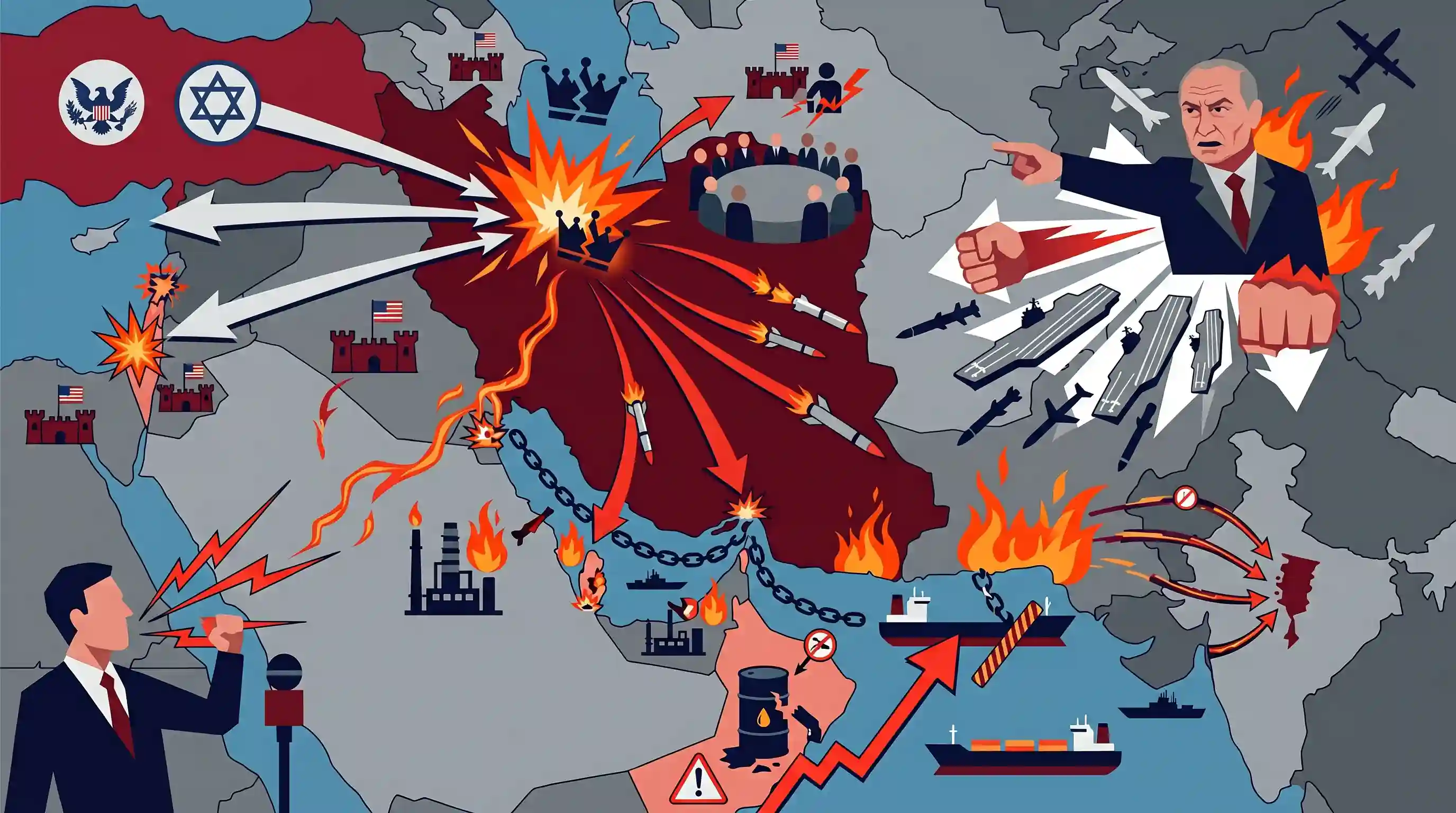
Following the assassination of Supreme Leader Ayatollah Ali Khamenei in US and Israeli strikes, Iran has established a transitional leadership council and vowed sweeping retaliation. President Masoud Pezeshkian declared the killing a "declaration of war," prompting Iranian missile and drone strikes on US bases, Israel, and several Gulf states. In response, US President Donald Trump threatened unparalleled military force. The rapidly escalating conflict threatens to plunge the Middle East into a broader regional war, presenting severe risks to global energy security and maritime trade routes in the Persian Gulf.
Key Points
- Iran has formed a new transitional leadership council, including President Masoud Pezeshkian, following the killing of Supreme Leader Ayatollah Ali Khamenei in US and Israeli strikes.
- Iranian leadership deemed the assassination a "declaration of war against Muslims" and vowed severe retaliation against the perpetrators.
- Iran launched retaliatory missile and drone strikes across the Middle East, targeting US bases and Gulf states, including Abu Dhabi and a port in Oman.
- US President Donald Trump threatened an unprecedented escalation of military force if Iran continues its retaliatory attacks.
- The escalation raises severe concerns over an all-out regional war in West Asia, threatening global energy supply lines in the Persian Gulf and the Strait of Hormuz.
Important Terms
Interim Leadership Council

A temporary body formed under Article 111 of Iran's Constitution, comprising the President, Judiciary Head, and a Guardian Council jurist, to exercise the Supreme Leader's powers during a vacancy.
UPSC context
GS Paper II: Comparison of constitutions and political systems; critical for understanding Iranian governance and power transitions during regional crises.
Supreme National Security Council (SNSC)
Iran's highest body for defense and security policy, mandated by Article 176 to coordinate intelligence, foreign affairs, and military responses under the President's chairmanship.
UPSC context
GS Paper II: IR and GS Paper III: Internal Security; tests understanding of strategic decision-making and foreign policy-making in West Asia.
Islamic Revolutionary Guard Corps (IRGC)
An elite military-ideological organization independent of Iran's regular army, reporting directly to the Supreme Leader and overseeing regional power projection through its Quds Force.
UPSC context
GS Paper II & III: IR and Security; vital for analyzing regional stability, "Axis of Resistance" influence, and maritime trade security.
Assembly of Experts
An 88-member deliberative body of Shia clerics elected to eight-year terms, primarily responsible for appointing, supervising, and possessing the authority to dismiss the Supreme Leader.
UPSC context
GS Paper II: Governance and Political Systems; essential for understanding the unique constitutional mechanisms of power succession in a theocracy.
Guardian Council
A 12-member body of clerics and jurists that vets legislation and candidates for office, ensuring they align with Islamic law and the Iranian Constitution.
UPSC context
GS Paper II: Comparison of constitutional bodies; tests knowledge of bodies that balance religious and civil authority in modern governance.
Iranian Red Crescent Society (IRCS)
A major humanitarian organization and part of the IFRC, mandated by Iranian law to lead national emergency operations and provide relief during natural or man-made disasters.
UPSC context
GS Paper II: Important International institutions and NGOs; relevant for humanitarian diplomacy and international disaster management frameworks.
Prelims Trap
The President of Iran is the supreme commander of the armed forces and holds ultimate authority.
The Supreme Leader, not the President, holds ultimate religious and political authority, including acting as the commander-in-chief of the armed forces in Iran.
Static Concepts Connected
Which countries border the Persian Gulf and the Strait of Hormuz?
- Persian Gulf Littorals: Eight nations border it: Iran, Iraq, Kuwait, Saudi Arabia, Bahrain, Qatar, UAE, and Oman. Iran possesses the longest coastline.
- Strait of Hormuz: A critical chokepoint connecting the Persian Gulf to the Gulf of Oman, bordered by Iran (north) and Oman and the UAE (south).
How does a West Asian maritime crisis impact India's macroeconomy?
- Energy Dependency: India imports roughly 50% of its crude oil and 80-85% of its LPG through the Strait of Hormuz.
- Macroeconomic Shocks: Supply disruptions cause oil price spikes, directly widening India's Current Account Deficit (CAD) and triggering imported inflation.
- Chabahar Utility: It validates India's strategic investment in Chabahar Port, located outside the Strait on the Gulf of Oman, securing regional transit.
Cross-Topic Patterns
Chabahar and Maritime Chokepoints
Escalations inside the Persian Gulf heighten the strategic premium of Chabahar Port, allowing India to bypass the volatile Strait of Hormuz entirely for Central Asian transit.
Imported Inflation & Monetary Policy
Energy supply shocks in West Asia transmit directly to India via crude prices, complicating the RBI's dual mandate of controlling inflation while supporting economic growth.

Expect a 2026 multi-statement question mapping West Asian choke points (Hormuz, Bab-el-Mandeb) with India's strategic assets like Chabahar.
Linked PYQs · 5
Linked PYQs · 5
- 2025MainsGS2
"Energy security constitutes the dominant kingpin of India's foreign policy, and is linked with India's overarching influence in Middle Eastern countries.” How would you integrate energy security with India's foreign policy trajectories in the coming years?
- 2017MainsGS2
The question of India's Energy Security constitutes the most important part of India's economic progress. Analyze India's energy policy cooperation with West Asian countries.
- 2018MainsGS2
“India’s relations with Israel have, of late, acquired a depth and diversity, which cannot be rolled back.” Discuss.
- 2024PrelimsGS1
Consider the following statements : Statement-I : Sumed pipeline is a strategic route for Persian Gulf oil and natural gas shipments to Europe. Statement-II : Sumed pipeline connects the Red Sea with the Mediterranean Sea. Which one of the following is correct in respect of the above statements?
- 2022PrelimsGS1
The term "Levant" often heard in the news roughly corresponds to which of the following regions?
