US Sanctions Relief on Iranian Oil and Global Market Impact
Source:Indian Express ↗
Why It Matters
The fluctuating dynamics of US-Iran relations directly impact global crude oil prices, which is a critical macroeconomic vulnerability for India. Understanding how major powers use sanctions and sanctions relief as geopolitical levers is essential for grasping India's energy diplomacy and its strategic autonomy imperatives.
Summary
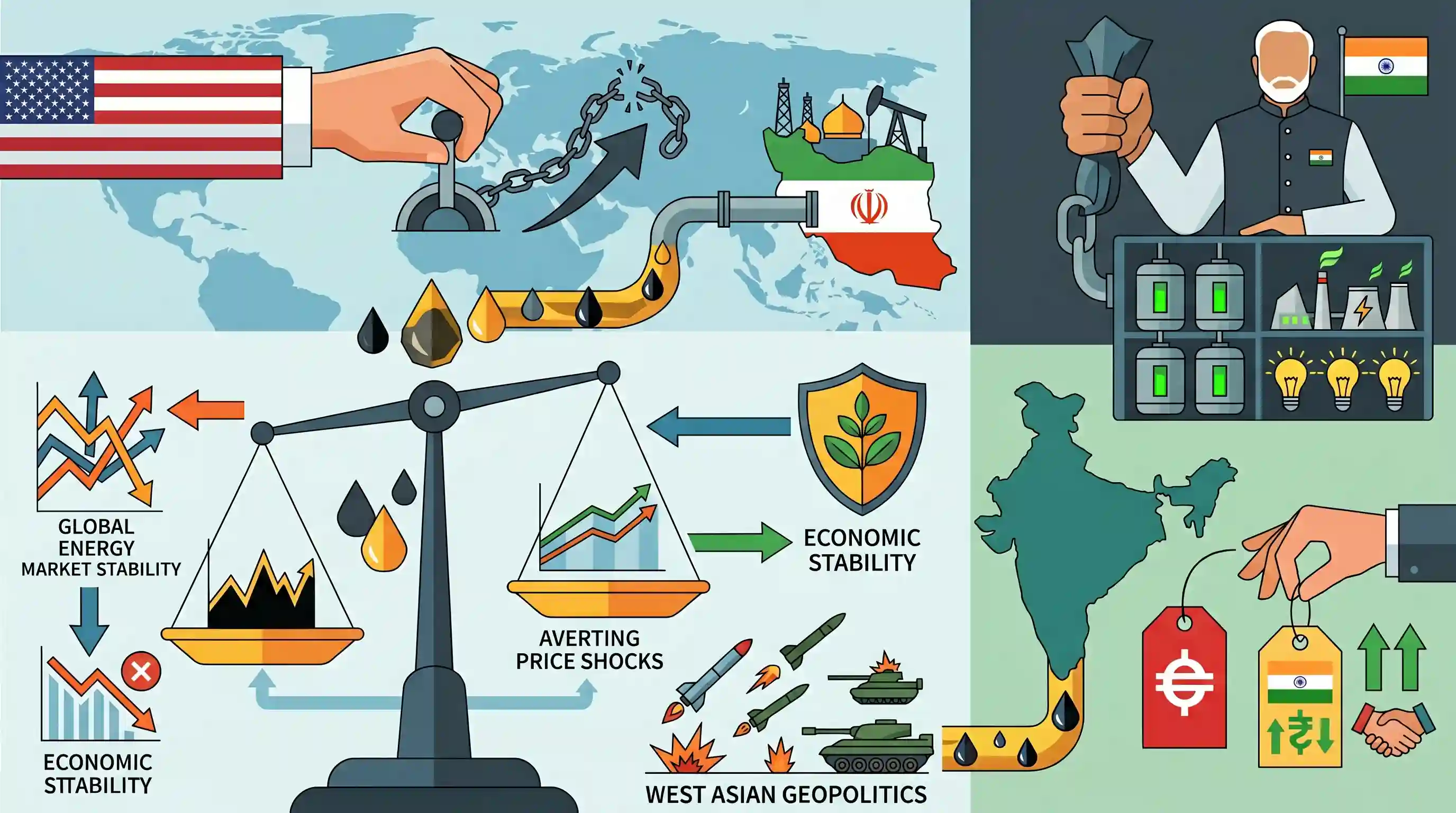
The United States has approved sanctions relief on Iranian oil exports, executing a strategic maneuver to stabilize global energy markets amid ongoing geopolitical conflicts involving Tehran. By temporarily easing the strict embargo, the US aims to prevent a global oil price shock that could trigger widespread inflation and economic instability. This development underscores the complex intersection of global energy security and West Asian geopolitics, demonstrating how economic tools like sanctions are calibrated to balance containment objectives with broader macroeconomic necessities. For heavy oil importers like India, the return of Iranian oil to the global market presents significant opportunities to enhance energy security and negotiate better crude prices.
Key Points
- The US has strategically eased sanctions on Iranian oil exports, aiming to prevent a sharp spike in global crude prices amidst ongoing conflicts involving Tehran.
- This tactical shift indicates a reprioritization of global macroeconomic stability and domestic energy costs over the "maximum pressure" strategy traditionally used against Iran.
- For global oil markets, increased Iranian crude supply provides a buffer against price volatility caused by OPEC+ production cuts or regional wars in West Asia.
- For India, which relies heavily on imported crude, the easing of sanctions on a major historical supplier like Iran offers an opportunity to diversify its energy basket and secure favorable pricing.
Important Terms
Joint Comprehensive Plan of Action (JCPOA)

A 2015 landmark agreement between Iran and world powers (P5+1) where Iran limited nuclear enrichment in exchange for lifting international economic sanctions.
UPSC context
GS Paper II (International Relations). Crucial for understanding nuclear diplomacy, non-proliferation, and West Asian geopolitical shifts affecting India's energy imports.
Countering America's Adversaries Through Sanctions Act (CAATSA)
A 2017 US federal law imposing sanctions on Iran, North Korea, and Russia, impacting third countries' ability to conduct significant defense or energy trade with them.
UPSC context
GS Paper II. Relevant to India's 'Strategic Autonomy' and challenges in maintaining bilateral ties with Russia and Iran despite US pressure.
Secondary Sanctions
Economic penalties imposed by a country (typically the US) on foreign individuals or entities that conduct business with a primary sanctioned target like Iran.
UPSC context
GS Paper II (Effect of policies of developed countries). Vital for analyzing the extraterritorial reach of US laws on Indian companies and refiners.
Energy Security
The uninterrupted availability of energy sources at an affordable price, involving long-term supply diversification and short-term market stability.
UPSC context
GS Paper III (Infrastructure and Economy). A core topic for India’s growth, focusing on oil import reliance and price volatility management.
Organization of the Petroleum Exporting Countries (OPEC)
An intergovernmental organization of 12+ oil-exporting nations that coordinates petroleum policies to stabilize global markets and ensure fair returns for producers.
UPSC context
GS Paper III (Economy). Significant for global commodity pricing, inflation control, and India’s trade balance.
Strategic Autonomy
India's foreign policy doctrine of making independent decisions in its national interest without being coerced by other global powers or alliances.
UPSC context
GS Paper II (International Relations). Tests the ability to analyze India’s balancing act between the US, Russia, and West Asian partners.
Prelims Trap
US sanctions on Iranian oil are backed by a UN Security Council resolution, making compliance mandatory under international law.
The US campaign relies on unilateral secondary sanctions, not UN sanctions. India officially adheres only to UN mandates but historically complied with US sanctions to protect its access to the US financial system.
Static Concepts Connected
What is a Rupee Vostro Account and how does it facilitate bilateral trade under sanctions?
- Mechanism: A domestic Indian bank holds an account on behalf of a foreign bank, denominated in Indian Rupees (INR) (e.g., UCO bank for Iran).
- Settlement: Indian importers deposit INR into the account for Iranian oil; Indian exporters withdraw INR for goods sent to Iran, entirely bypassing SWIFT and the US Dollar.
- Macroeconomic Benefit: This protects India's foreign exchange reserves and shields the domestic currency from external volatility caused by dollar-denominated trade.
How do global crude oil prices impact India's macroeconomic stability?
- Imported Inflation: A sharp rise in global crude prices causes a general increase in domestic price levels, known as imported inflation, as transportation and production costs surge.
- Current Account Deficit: High crude prices inflate the import bill, widening the Current Account Deficit (CAD) and straining foreign exchange reserves.
- Currency Depreciation: Increased dollar demand to pay for expensive oil imports leads to the depreciation of the Indian Rupee against the US Dollar.
Cross-Topic Patterns
INR settlement & Geoeconomic autonomy
The Rupee-Rial mechanism used for Iran directly mirrors India's recent Special Rupee Vostro Account (SRVA) push with Russia. This connects GS3 currency internationalization with GS2 strategic autonomy.
Chabahar Port + INSTC revival
Resumed economic ties with Iran provide capital and momentum for the Chabahar port and the International North-South Transport Corridor (INSTC), essential for bypassing Pakistan to access Central Asia.

Expect a multi-statement Prelims question linking US secondary sanctions (CAATSA) with the Rupee-Rial mechanism and India's CAD management.
Linked PYQs · 3
Linked PYQs · 3
- 2018MainsGS2
In what ways would the ongoing US-Iran Nuclear Pact Controversy affect the national interest of India? How should India respond to this situation?
- 2012MainsGS2
How have the US sanctions against Iran affected India's bilateral relations with Iran?
- 2025MainsGS2
"Energy security constitutes the dominant kingpin of India's foreign policy, and is linked with India's overarching influence in Middle Eastern countries.” How would you integrate energy security with India's foreign policy trajectories in the coming years?
