US Iran Military Posturing Threatens West Asian Stability
Source:Indian Express ↗
Why It Matters
The intensifying rhetoric and military posturing between the US and Iran directly threaten West Asian stability and the global oil supply chain. For India, this conflict poses a significant challenge to its energy security and geopolitical balancing in the Middle East.
Summary
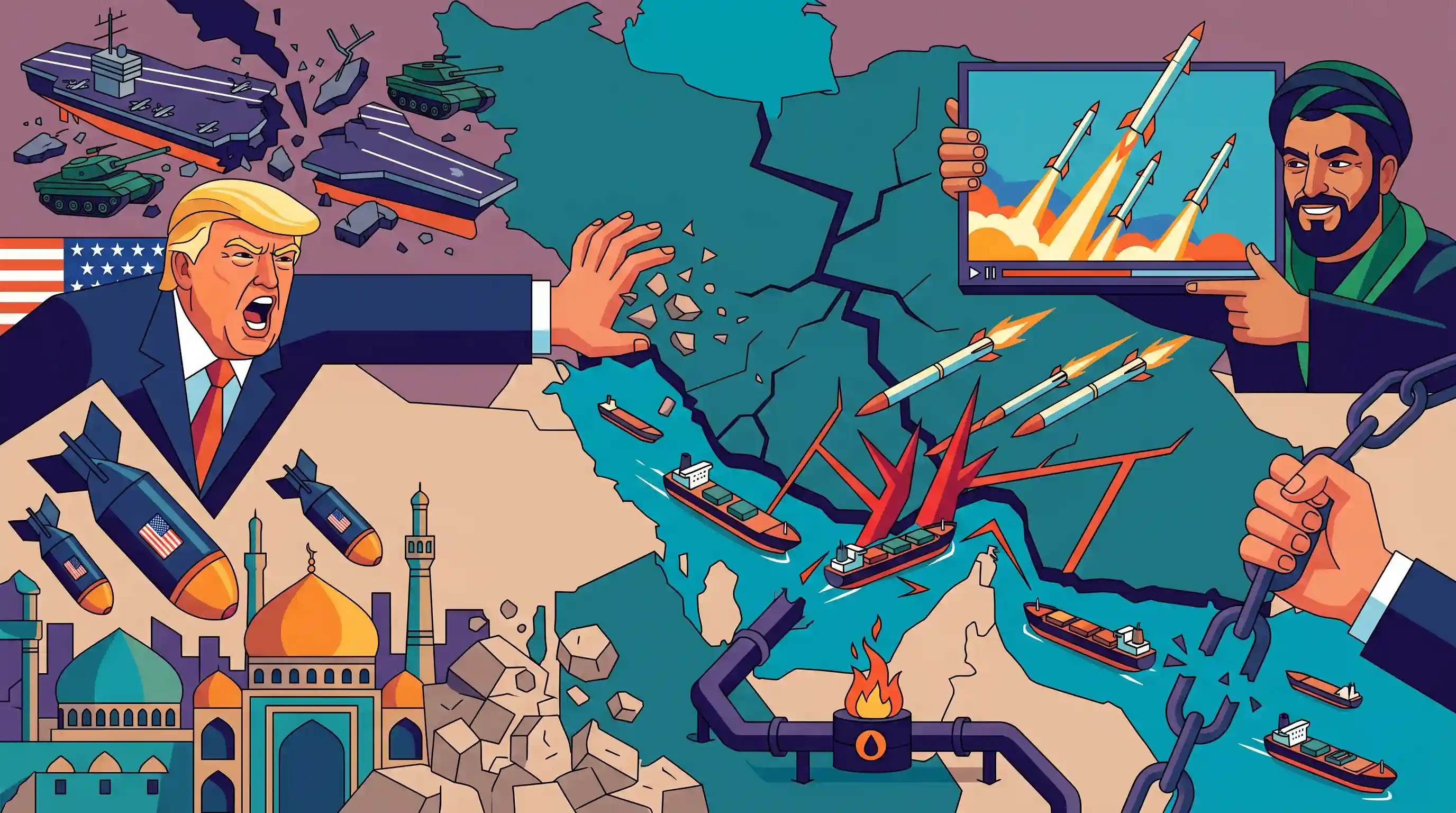
Amidst escalating geopolitical tensions, Iran publicly mocked US President Donald Trump's assertion that the US military had decimated Iranian forces during 'Operation Epic Fury'. By releasing a video of a recent missile launch, Iran demonstrated its intact capabilities and countered the aggressive rhetoric of US officials, who threatened to bomb the nation 'back to the Stone Age.' The ongoing confrontation highlights severe risks for West Asian stability and global energy security, particularly concerning the strategic Strait of Hormuz.
Key Points
- US President Donald Trump claimed that US forces destroyed Iran's navy, air force, and missile capabilities during 'Operation Epic Fury'.
- Iran mocked these claims by sharing a video of a missile launch on social media, sarcastically captioning it as a 'meteor shower from Mars'.
- US Defense Secretary Pete Hegseth escalated the aggressive rhetoric by threatening to send Iran 'back to the Stone Age'.
- The geopolitical friction heavily involves control over the Strait of Hormuz, a critical global choke point for energy trade.
- Iranian officials invoked the ancient Achaemenid Empire to project historical resilience and mock the short timeframe of US civilization.
Important Terms
Operation Epic Fury

The code name for a 2026 joint U.S.-Israeli military operation involving extensive airstrikes against Iranian nuclear facilities, missile sites, and leadership, aimed at neutralizing Tehran's regional influence and nuclear ambitions.
UPSC context
GS Paper 2 (International Relations); relevant for questions on West Asian instability, U.S. foreign policy, and regional security dynamics.
Strait of Hormuz
A vital maritime chokepoint between the Persian Gulf and the Gulf of Oman. It is the world's most critical oil transit route, carrying approximately 20% of global oil consumption.
UPSC context
GS Paper 1 (Geography) and Paper 2 (IR); tests knowledge of strategic maritime geography and India's energy dependency.
Global Energy Security
The continuous availability of energy sources at an affordable price. In geopolitics, it is often threatened by conflicts that disrupt production or transit in key regions like West Asia.
UPSC context
GS Paper 3 (Economy/Environment); tests the link between international conflict, supply chain disruptions, and domestic economic stability.
Islamic Revolutionary Guard Corps (IRGC)
The elite branch of the Iranian Armed Forces intended to protect the country's Islamic system. Its naval arm specializes in asymmetric warfare and exerts control over the Strait of Hormuz.
UPSC context
GS Paper 2 (International Relations); important for understanding non-state/state-sponsored regional influence and asymmetric military threats.
Strategic Chokepoint
A narrow geographical feature, such as a strait, that can be blocked to disrupt international shipping and trade, particularly for essential commodities like oil and gas.
UPSC context
GS Paper 1 (Geography); tests conceptual understanding of maritime trade routes and the vulnerabilities of global commerce.
Iranian Navy
The state-level maritime force of Iran, which, along with the IRGC Navy, manages coastal defense and regional power projection in the Persian Gulf and Arabian Sea.
UPSC context
GS Paper 2 (International Relations); relevant for naval diplomacy and security challenges in the Indian Ocean Region (IOR).
Prelims Trap
"The Strait of Hormuz is bordered by Iran and Saudi Arabia."
Aspirants wrongly assume Saudi Arabia borders the Strait of Hormuz due to its oil dominance. The strait is flanked only by Iran, Oman (Musandam peninsula), and the UAE.
Static Concepts Connected
What are the geographical boundaries of the Strait of Hormuz?
- Water bodies: Links the Persian Gulf to the Gulf of Oman and the broader Arabian Sea.
- Bordering nations: Flanked by Iran to the north, and the United Arab Emirates and Oman (Musandam exclave) to the south.
- Strategic significance: Acts as a critical global maritime chokepoint facilitating roughly a fifth of global oil consumption.
How did the ancient Achaemenid Empire influence Mauryan India?
- Kharosthi script: Introduced the Kharosthi script to northwestern India, which was notably written from right to left.
- Mauryan architecture: Deeply influenced the smooth, polished stone finish and the bell-shaped (inverted lotus) capitals of Ashokan pillars.
- Rock edicts: Inspired the Mauryan administrative practice of issuing royal proclamations to the public through rock edicts.
Cross-Topic Patterns
Gulf Instability & India's CAD
Disruption in the Strait of Hormuz directly threatens India's energy security, risking domestic fuel inflation and a widened Current Account Deficit due to higher crude and LNG import bills.
Chabahar Port and INSTC transit risks
Escalating US-Iran hostilities jeopardize India's strategic investments in Chabahar and the INSTC, complicating our multi-modal transit corridors aimed at bypassing Pakistan to access Eurasia.

Expect a 2026 Prelims multi-statement question pairing Strait of Hormuz geography with Achaemenid historical influences on India.
Linked PYQs · 3
Linked PYQs · 3
- 2018MainsGS2
In what ways would the ongoing US-Iran Nuclear Pact Controversy affect the national interest of India? How should India respond to this situation?
- 2025MainsGS2
"Energy security constitutes the dominant kingpin of India's foreign policy, and is linked with India's overarching influence in Middle Eastern countries.” How would you integrate energy security with India's foreign policy trajectories in the coming years?
- 2024PrelimsGS1
Consider the following statements : Statement-I : Sumed pipeline is a strategic route for Persian Gulf oil and natural gas shipments to Europe. Statement-II : Sumed pipeline connects the Red Sea with the Mediterranean Sea. Which one of the following is correct in respect of the above statements?
