Iran Reports Lack of Concrete Concessions in US Proposals
Source:The Hindu ↗
Why It Matters
The closure of the Strait of Hormuz and the collapse of US-Iran negotiations have profound implications for global energy security and macro-economic stability. For UPSC aspirants, understanding the nuances of the US-Iran nuclear dispute and the strategic importance of Middle Eastern maritime chokepoints is crucial for both Mains GS-2 (International Relations) and Prelims map-based questions.
Summary
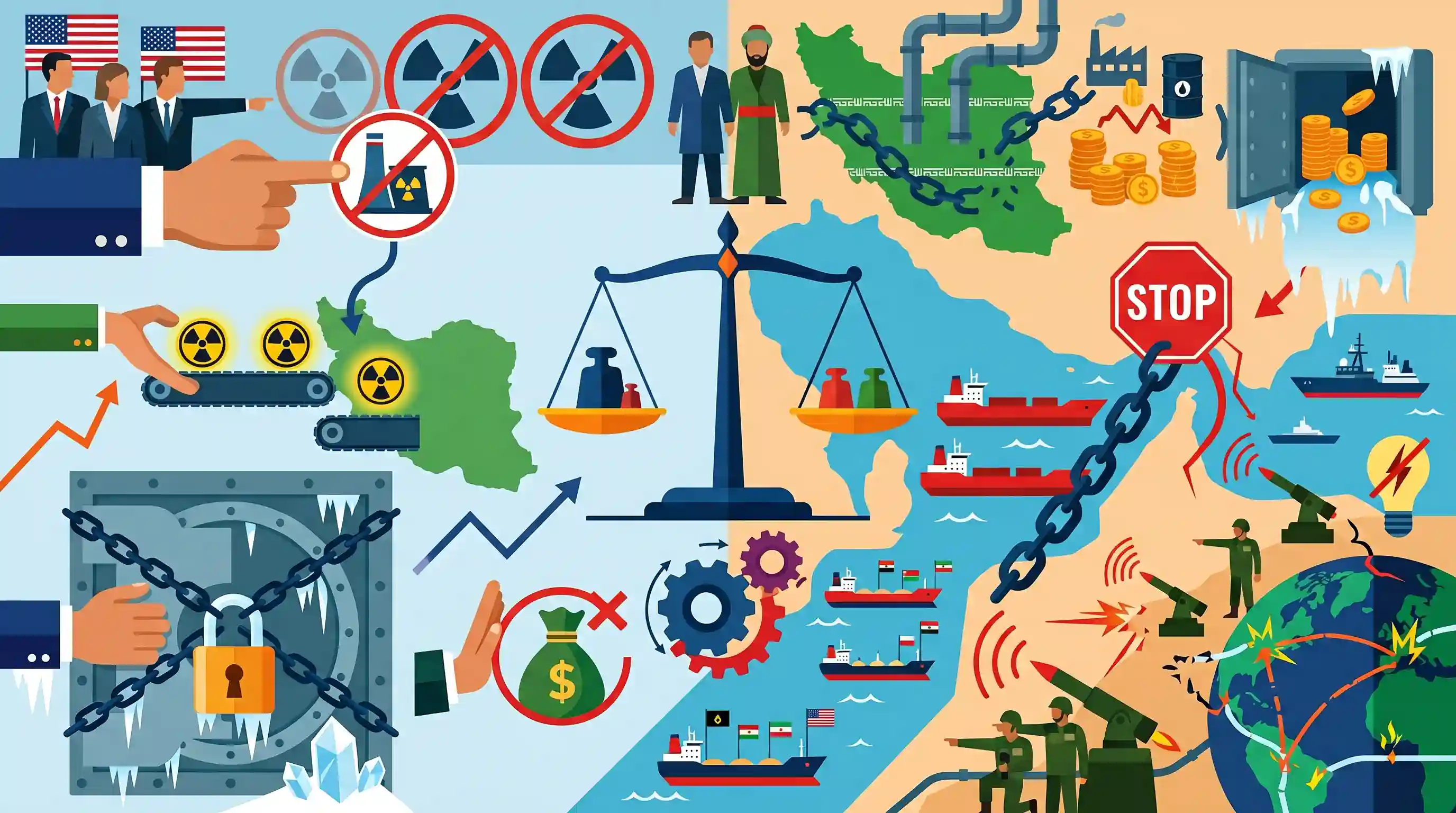
Iranian media sources claim that the recent US proposal aimed at ending the ongoing war contains no tangible concessions. The US reportedly demands that Iran retain only one nuclear site at Bushehr and surrender its highly enriched uranium, while refusing to unfreeze Iranian assets or offer war reparations. In response, Iran insists on the lifting of all sanctions, release of frozen funds, and an end to the US naval blockade. Meanwhile, Iran continues to block the Strait of Hormuz—a major chokepoint for global oil—and the IRGC has issued stark warnings about the catastrophic impact on global energy security if Iranian oil infrastructure is targeted. The stalemate underscores the intractability of the US-Iran nuclear and geopolitical dispute.
Key Points
- Iranian media asserts the recent US proposal to end the ongoing war offers no tangible concessions, keeping major economic leverage intact.
- The US proposal demands Iran consolidate to a single nuclear facility at Bushehr and hand over its highly enriched uranium, while refusing to unfreeze Iranian assets or pay war reparations.
- Iran's counter-demands include the complete lifting of US sanctions, release of frozen funds, ending the US naval blockade on Iranian ports, and ending the war on all fronts.
- Iran continues to keep the strategically vital Strait of Hormuz closed, and the IRGC has warned of severe economic repercussions for global energy markets if its oil infrastructure is attacked.
Important Terms
Islamic Revolutionary Guard Corps (IRGC)

An elite branch of the Iranian Armed Forces established in 1979 to protect the country's Islamic system. It operates independently of the regular military and wields significant political, economic, and internal security power.
UPSC context
GS Paper II (IR) & GS Paper III (Security); tests understanding of West Asian regional stability and non-state/state military actors.
Strait of Hormuz
A strategically vital maritime passage between the Persian Gulf and the Gulf of Oman. It is the world's most critical oil chokepoint, handling approximately 20% of global petroleum consumption.
UPSC context
GS Paper I (Geography) & GS Paper III (Energy Security); focuses on global trade routes and India's energy import vulnerabilities.
Enriched Uranium
Uranium in which the percentage of the fissile isotope U-235 has been increased. Low-enriched uranium (3-5%) is used for power; highly enriched uranium (>90%) is weapons-grade.
UPSC context
GS Paper III (Science & Tech); tests knowledge of nuclear fuel cycles and international non-proliferation regimes (IAEA).
Bushehr Nuclear Power Plant
Iran's first and only operational commercial nuclear power plant, located on the Persian Gulf. Built with Russian assistance, it uses light-water reactor technology for civilian electricity generation.
UPSC context
GS Paper II (International Relations); relevant for discussing Iran's nuclear program and the role of major powers (Russia/US) in the region.
Maritime Chokepoint
Narrow geographical features, such as straits or canals, that constrain maritime traffic. Their disruption can cause global energy price shocks and supply chain failures.
UPSC context
GS Paper I (Economic Geography); essential for analyzing the 'Geography of Energy' and the strategic importance of global sea lanes.
Economic Sanctions
Coercive measures—such as trade barriers, asset freezes, or financial restrictions—applied by one or more countries against another to influence policy or punish international law violations.
UPSC context
GS Paper II (International Relations); tests knowledge of diplomatic tools and their impact on global trade and bilateral ties.
Prelims Trap
"The Strait of Hormuz connects the Persian Gulf directly to the Red Sea."
Hormuz connects the Persian Gulf to the Gulf of Oman and Arabian Sea. Conflating it with Bab-el-Mandeb (Red Sea to Gulf of Aden) is a classic UPSC mapping trap.
Static Concepts Connected
What are the key maritime chokepoints of the Middle East?
- Strait of Hormuz: Connects the Persian Gulf to the Gulf of Oman; a critical transit route for ~20% of global oil.
- Bab-el-Mandeb: Links the Red Sea to the Gulf of Aden; crucial for maritime traffic heading toward the Suez Canal.
What are the grades of uranium enrichment used in nuclear technology?
- Natural Uranium: Mined uranium containing roughly 0.7% of the fissile U-235 isotope, insufficient for most reactors.
- Low-Enriched (LEU): Enriched to 3–5% U-235, which is the required concentration for civilian power reactors like Iran's Bushehr plant.
- Highly-Enriched (HEU): Exceeds 20% U-235. Weapons-grade material typically requires ~90% enrichment, posing severe international proliferation risks.
Cross-Topic Patterns
Energy chokepoints & Rupee trade
Closure of Hormuz accelerates India's push for strategic petroleum reserves and local-currency trade settlements to insulate from dollar-denominated oil price shocks.
US sanctions vs India's connectivity
US pressure on Iran continuously tests India's strategic autonomy regarding Chabahar Port operations and the International North-South Transport Corridor (INSTC), complicating Central Asian access.

Expect a hybrid question in 2026 linking Middle-East maritime chokepoints (Hormuz) with India's energy security and uranium enrichment.
Linked PYQs · 5
Linked PYQs · 5
- 2018MainsGS2
In what ways would the ongoing US-Iran Nuclear Pact Controversy affect the national interest of India? How should India respond to this situation?
- 2012MainsGS2
How have the US sanctions against Iran affected India's bilateral relations with Iran?
- 2025MainsGS2
"Energy security constitutes the dominant kingpin of India's foreign policy, and is linked with India's overarching influence in Middle Eastern countries.” How would you integrate energy security with India's foreign policy trajectories in the coming years?
- 2024PrelimsGS1
Consider the following statements : Statement-I : Sumed pipeline is a strategic route for Persian Gulf oil and natural gas shipments to Europe. Statement-II : Sumed pipeline connects the Red Sea with the Mediterranean Sea. Which one of the following is correct in respect of the above statements?
- 2022PrelimsGS1
The term "Levant" often heard in the news roughly corresponds to which of the following regions?
