Iran commemorates revolution anniversary amidst geopolitical tensions
Source:The Hindu ↗
Why It Matters
Escalating tensions between the U.S. and Iran have profound implications for global energy security, the stability of West Asia, and India's strategic interests, including its diaspora in the Middle East, energy imports, and investments like the Chabahar port.
Summary
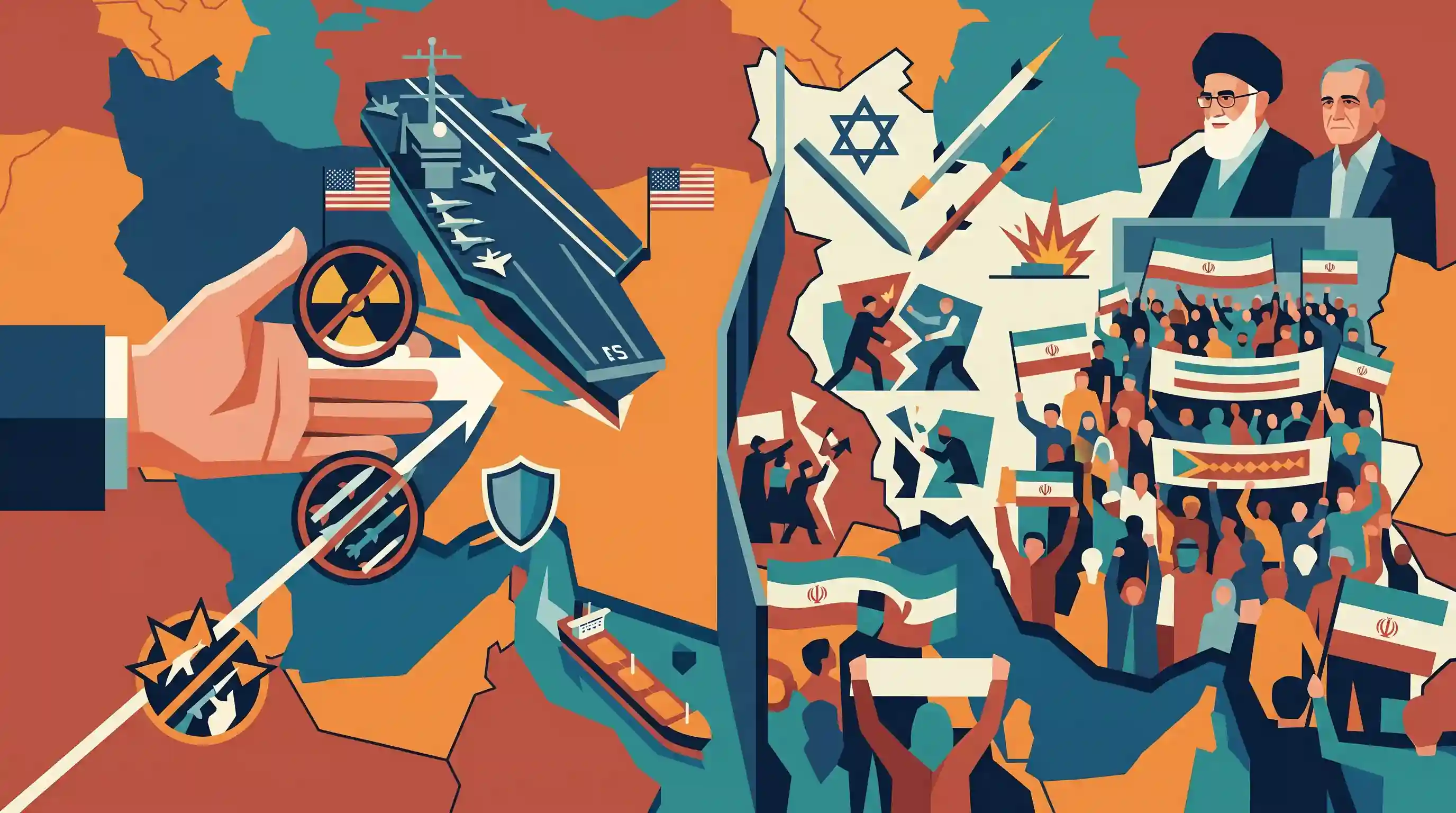
Iran marked the 47th anniversary of the 1979 Islamic Revolution with mass state-sponsored rallies amid escalating tensions and military threats from the United States. Iranian leaders, including Supreme Leader Ayatollah Ali Khamenei and President Masoud Pezeshkian, used the occasion to project national resilience against perceived enemies. This comes as U.S. President Donald Trump has issued sweeping demands that Iran cease its nuclear program, halt missile development, and stop supporting regional militias, backing these ultimatums by deploying an aircraft carrier strike group. The standoff is further complicated by recent internal anti-government protests in Iran, the fallout from Israeli airstrikes on Iranian targets, and the U.S. naval initiative 'Project Freedom' aimed at securing the Strait of Hormuz.
Key Points
- Iran commemorated the 47th anniversary of the 1979 Islamic Revolution, which established its current theocratic republic and ended the U.S.-backed Pahlavi monarchy.
- U.S. President Donald Trump has issued severe ultimatums demanding Iran abandon its nuclear program, halt ballistic missile production, and cut ties with regional militias.
- The U.S. has escalated its military posture by deploying an aircraft carrier strike group to the region, threatening direct consequences if Iran does not comply.
- The regional security environment remains volatile following recent Israeli airstrikes on Iranian targets and ongoing conflicts in the Middle East.
- The U.S. initiated 'Project Freedom' to ensure the safe passage of commercial shipping in the Strait of Hormuz, a critical chokepoint for global energy supplies.
Important Terms
Project Freedom

A 2026 U.S. naval operation involving 15,000 personnel and destroyers aimed at reopening the Strait of Hormuz following an Iranian blockade and regional military conflict.
UPSC context
GS Paper II: International Relations. Tests knowledge of maritime security, energy chokepoints, and U.S.-Iran geopolitical dynamics.
Joint Comprehensive Plan of Action (JCPOA)
The 2015 landmark deal where Iran limited nuclear enrichment for sanctions relief. Formally declared terminated in late 2025 by Iran, Russia, and China following U.S. withdrawal and renewed hostilities.
UPSC context
GS Paper II: Global groupings/agreements. Crucial for understanding nuclear non-proliferation and India’s energy security interests in West Asia.
Islamic Revolutionary Guard Corps (IRGC)
An elite branch of Iran's armed forces tasked with preserving the Islamic Republic's system. It controls significant portions of Iran's economy and regional militia networks.
UPSC context
GS Paper II/III: Security challenges and International Relations. Relevant for studying state-sponsored actors and regional stability in the Middle East.
Strait of Hormuz
A strategic waterway between the Persian Gulf and the Gulf of Oman, serving as the world’s most critical chokepoint for global oil and gas transit.
UPSC context
GS Paper I: World Geography. Vital for understanding global trade routes and resource geography impacts on India's economy.
Islamic Revolution
The 1979 popular uprising that toppled the Pahlavi monarchy and established the current theocratic Islamic Republic under Grand Ayatollah Ruhollah Khomeini.
UPSC context
GS Paper I: World History. Provides the historical foundation for contemporary West Asian political structures and anti-Western sentiment.
Prelims Trap
"The Strait of Hormuz connects the Persian Gulf to the Red Sea and borders the UAE."
The Strait of Hormuz connects the Persian Gulf to the Gulf of Oman/Arabian Sea. It lies specifically between Iran and Oman (Musandam exclave), not the UAE or Red Sea.
Static Concepts Connected
What are the key maritime chokepoints in West Asia?
- Strait of Hormuz: Connects the Persian Gulf to the Gulf of Oman and Arabian Sea, bordered by Iran and Oman. Essential for global oil transit.
- Bab-el-Mandeb: Connects the Red Sea to the Gulf of Aden, bordered by Yemen on the Arabian Peninsula, and Djibouti and Eritrea in Africa.
- Suez Canal: Artificial sea-level waterway in Egypt, connecting the Mediterranean Sea to the Red Sea, dividing Africa and Asia.
Why is Iran critical to India's geopolitical and economic interests?
- Connectivity (Chabahar): Development of Chabahar Port provides India a direct transit route to Afghanistan and Central Asia, bypassing Pakistan, forming a node for the INSTC.
- Energy Security: Any conflict involving Iran affects maritime security in the Persian Gulf, threatening India's crude oil imports and impacting domestic inflation.
- Diaspora Safety: Escalation in US-Iran tensions creates security risks for the massive Indian diaspora living and working across the broader Gulf region.
Cross-Topic Patterns
Energy Security + Current Account Deficit
A blockade in the Strait of Hormuz directly spikes crude oil prices, inflating India's import bill, widening the Current Account Deficit, and putting downward pressure on the Rupee.
Chokepoint Coalitions + Freedom of Navigation
U.S. 'Project Freedom' mirrors maritime operations like Operation Prosperity Guardian in the Red Sea, connecting UNCLOS freedom of navigation principles with targeted minilateral naval deployments.

Expect a 2026 mapping question matching West Asian chokepoints (Hormuz, Bab-el-Mandeb) with their respective international naval coalitions.
Linked PYQs · 3
Linked PYQs · 3
- 2018MainsGS2
In what ways would the ongoing US-Iran Nuclear Pact Controversy affect the national interest of India? How should India respond to this situation?
- 2012MainsGS2
How have the US sanctions against Iran affected India's bilateral relations with Iran?
- 2025MainsGS2
"Energy security constitutes the dominant kingpin of India's foreign policy, and is linked with India's overarching influence in Middle Eastern countries.” How would you integrate energy security with India's foreign policy trajectories in the coming years?
