US and Israeli strikes escalate West Asian geopolitical conflict
Source:Indian Express ↗
Why It Matters
The direct military confrontation between the US/Israel and Iran is a watershed moment in Middle Eastern geopolitics. It is highly relevant for UPSC aspirants as it directly impacts India's energy security, the safety of its diaspora, and its strategic connectivity projects like INSTC and Chabahar. This event will likely shape GS-II questions on India-West Asia relations and global geopolitical realignments.
Summary
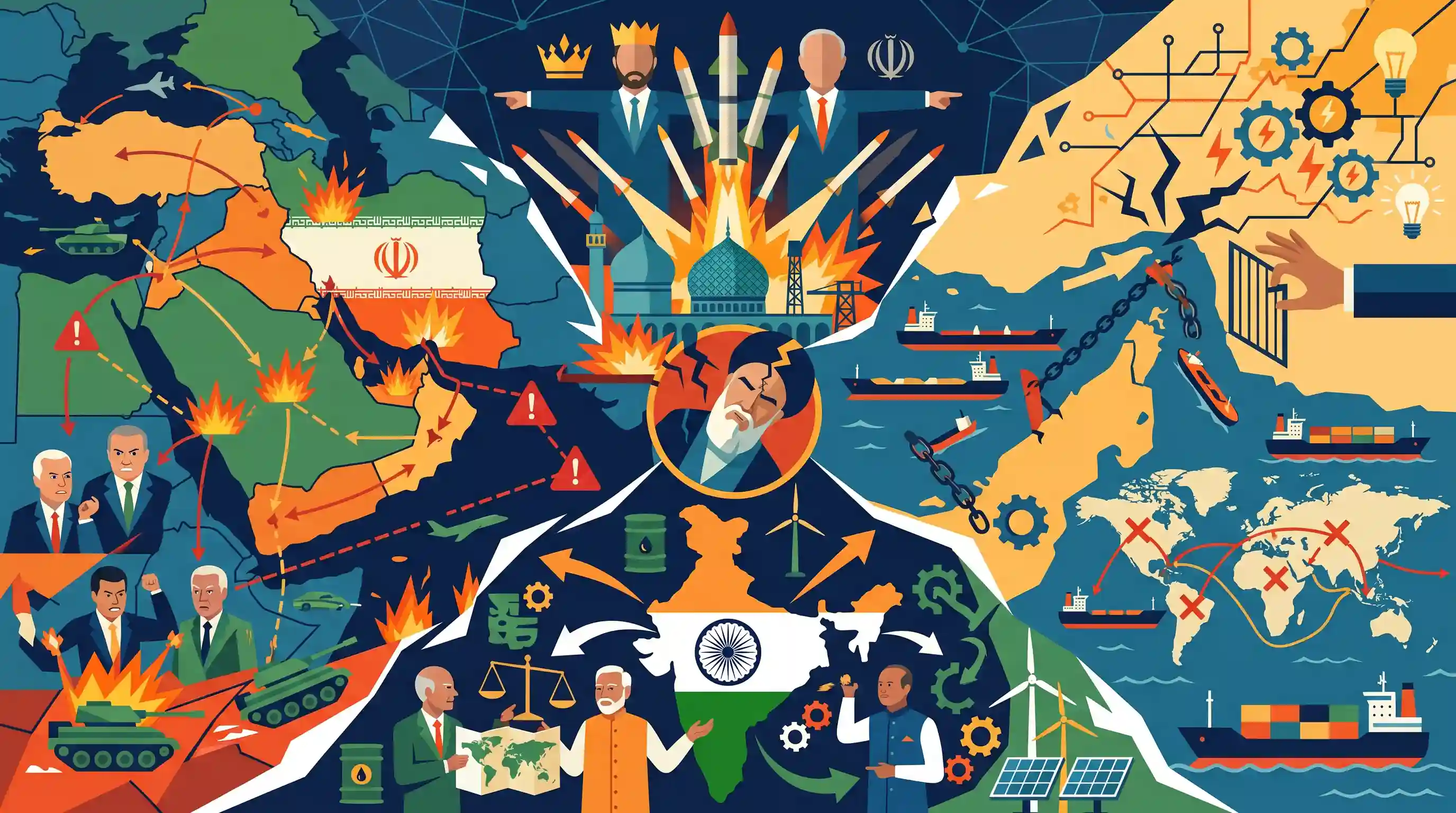
The article analyzes the severe geopolitical escalation following joint US-Israeli military strikes on Iran, which reportedly resulted in the death of Iran's Supreme Leader Ayatollah Ali Khamenei. It examines the coordinated military and diplomatic strategies of US President Donald Trump and Israeli PM Benjamin Netanyahu in targeting Iranian infrastructure. The piece explores the profound global implications of this unprecedented escalation, focusing on the potential for wider regional war, immediate threats to global energy security via the Strait of Hormuz, and the cascading impacts on international trade and diplomacy in the Middle East.
Key Points
- Joint US-Israeli military strikes on Iran have drastically escalated the conflict in West Asia, marking a shift towards direct confrontation.
- The reported death of Iran's Supreme Leader Ayatollah Ali Khamenei creates a profound power vacuum, raising fears of regime instability and aggressive regional retaliation.
- The coordinated offensive by US President Donald Trump and Israeli PM Benjamin Netanyahu indicates a hardened, maximalist approach to neutralizing Iranian influence in the region.
- The escalation poses severe risks to global energy markets and supply chains, particularly concerning the transit of oil through the critical chokepoint of the Strait of Hormuz.
- For India, this crisis challenges its delicate diplomatic balancing act in West Asia, threatening energy security, the safety of a large diaspora, and strategic connectivity investments like the Chabahar port and the INSTC.
Important Terms
INSTC (International North-South Transport Corridor)

A 7,200-km multimodal transport network connecting India to Russia via Iran, bypassing Pakistan. It reduces transit time and costs while boosting trade with Central Asia.
UPSC context
GS Paper II (IR) & III (Economy); tests strategic connectivity, bypassing traditional chokepoints, and countering China’s BRI.
Chabahar Port Agreement
Strategic 10-year pact (2024) for India to develop and operate the Shahid Beheshti terminal at Iran's Chabahar Port, facilitating access to Afghanistan and Central Asia.
UPSC context
GS Paper II (Bilateral Relations); crucial for West Asia diplomacy, energy security, and regional influence via the Makran coast.
IDF (Israel Defense Forces)
The primary military force of Israel, responsible for land, air, and sea operations. It plays a central role in the 2026 regional conflict dynamics.
UPSC context
GS Paper II (International Relations); important for understanding Middle East security architectures and military-diplomatic escalations.
United Nations (UN)
Global intergovernmental body whose Security Council (UNSC) is the primary forum for mediating West Asian conflicts and addressing threats to international peace.
UPSC context
GS Paper II (International Institutions); tests the effectiveness of multilateralism and global governance in managing large-scale regional wars.
Strait of Hormuz
Strategic waterway between the Persian Gulf and the Gulf of Oman; a global energy chokepoint through which approximately one-fifth of world oil passes.
UPSC context
GS Paper I (Geography) & II (IR); vital for energy security, global trade stability, and India’s diaspora interests.
Prelims Trap
Chabahar port is situated inside the Persian Gulf and is highly vulnerable to blockades at the Strait of Hormuz.
Chabahar port is located on the Gulf of Oman, strictly outside the Strait of Hormuz. It was specifically chosen to give India access to Iran and Central Asia without traversing the vulnerable Hormuz chokepoint.
Static Concepts Connected
Which water bodies are connected by the Strait of Hormuz?
- Persian Gulf: It acts as the critical, narrow choke point funneling petroleum from the Persian Gulf.
- Gulf of Oman: It links the Persian Gulf southeastward to the Gulf of Oman, eventually opening into the Arabian Sea and the wider Indian Ocean.
- Bordering Nations: The strait is bounded by Iran to the north and the UAE and Oman (Musandam Peninsula) to the south.
What is the strategic significance of the INSTC for India?
- Transit Route: It connects Mumbai to Moscow via Iran and the Caspian Sea, establishing a multi-modal transit network (ship, rail, and road).
- Strategic Bypass: It bypasses hostile territory (Pakistan), providing India direct overland access to Central Asia, Afghanistan, and Eurasia.
- Economic Efficiency: It significantly reduces freight time (by roughly 40%) and carriage costs compared to the traditional Suez Canal route.
Cross-Topic Patterns
Imported inflation & RBI monetary policy
A blockade at Hormuz spikes crude prices, widening India's Current Account Deficit (CAD) and complicating the RBI's ability to lower interest rates due to imported supply-side inflation.
Limits of "De-hyphenation" policy
India's traditional de-hyphenation policy faces severe stress tests when its critical defense partner (Israel) enters direct military conflict with its regional connectivity anchor (Iran).

Expect a 2026 Prelims multi-statement question mapping West Asian maritime chokepoints against India's INSTC and Chabahar supply chains.
Linked PYQs · 5
Linked PYQs · 5
- 2025MainsGS2
"Energy security constitutes the dominant kingpin of India's foreign policy, and is linked with India's overarching influence in Middle Eastern countries.” How would you integrate energy security with India's foreign policy trajectories in the coming years?
- 2018MainsGS2
“India’s relations with Israel have, of late, acquired a depth and diversity, which cannot be rolled back.” Discuss.
- 2017MainsGS2
The question of India's Energy Security constitutes the most important part of India's economic progress. Analyze India's energy policy cooperation with West Asian countries.
- 2003PrelimsGS1
Israel has common borders with
- 2022PrelimsGS1
The term "Levant" often heard in the news roughly corresponds to which of the following regions?
