Geopolitical Shifts and Leadership Dynamics in West Asia
Source:Indian Express ↗
Why It Matters
This major geopolitical event radically reshapes the security architecture of West Asia, a region vital to India's energy security, massive diaspora, and strategic connectivity projects (like Chabahar port). Understanding the US-Israel-Iran dynamics is crucial for evaluating India's foreign policy options and economic vulnerabilities.
Summary
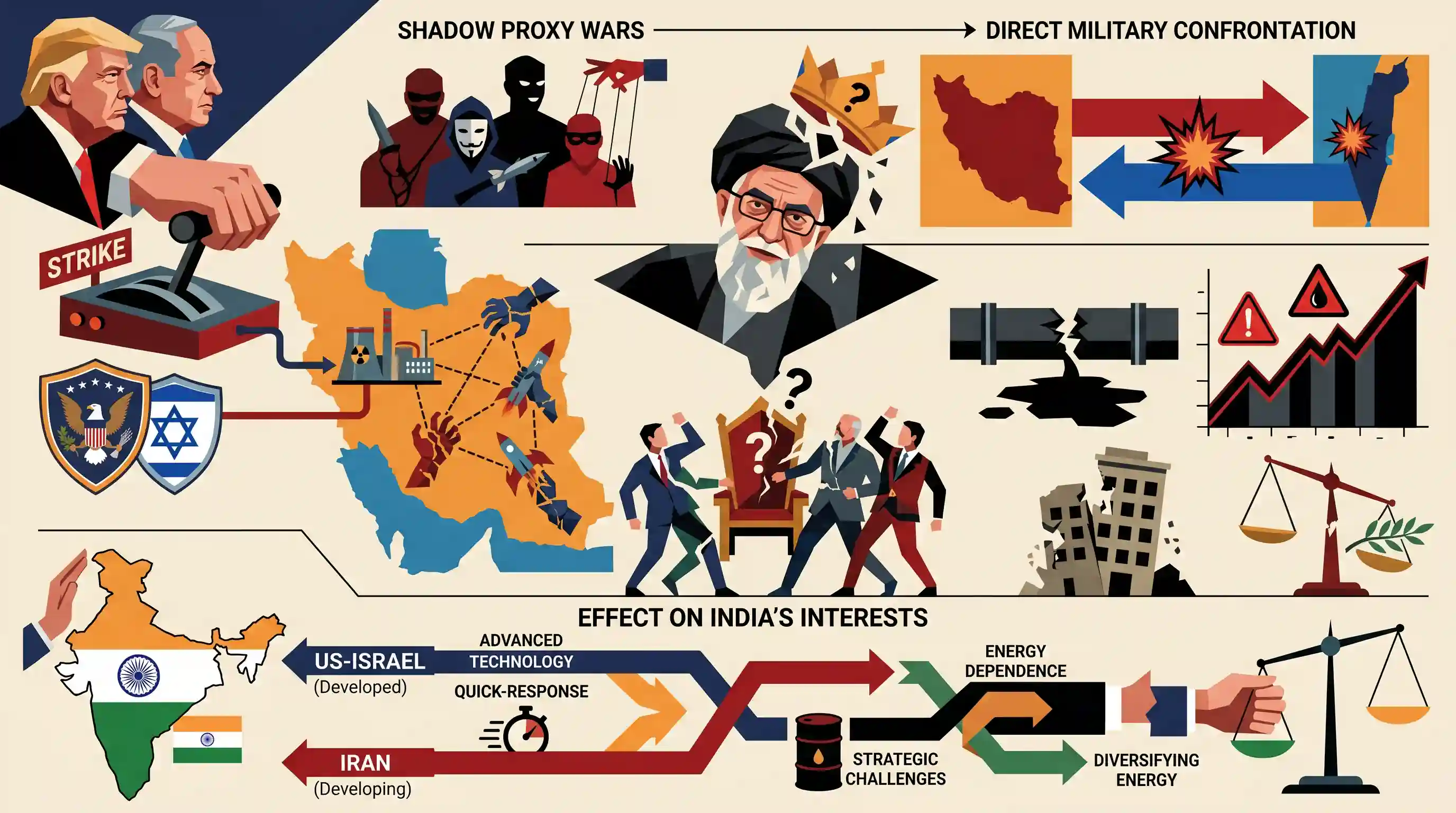
The article addresses the escalating, direct Iran-Israel war, marked by unprecedented US-Israeli military strikes on Iran and the reported death of Iran's Supreme Leader, Ayatollah Ali Khamenei. It highlights the decisive roles played by US President Donald Trump and Israeli Prime Minister Benjamin Netanyahu, who are tightly aligned in their objective to dismantle Iran's nuclear capabilities and proxy networks. Khamenei's death triggers a profound succession crisis within Iran, potentially destabilizing the regime. The conflict marks a monumental shift in Middle Eastern geopolitics, moving away from shadow proxy wars to direct military confrontation, and poses severe risks to global energy security and regional stability.
Key Points
- The conflict has escalated into a direct and severe war between Israel and Iran, heavily involving US-Israeli coordinated military strikes on Iranian soil.
- The reported death of Iran's Supreme Leader Ayatollah Ali Khamenei creates a critical power vacuum, threatening internal regime stability and sparking a succession crisis.
- Israeli Prime Minister Benjamin Netanyahu and US President Donald Trump share tight strategic alignment aimed at decisively crippling Iran's nuclear infrastructure and dismantling its proxy networks (Axis of Resistance).
- The escalation heightens the risk of a wider regional war in the Middle East, drawing in multiple state and non-state actors.
- Global energy security is severely threatened, as strikes on Iranian oil infrastructure and potential retaliatory blockades in the Strait of Hormuz could trigger massive shocks in global oil prices.
Important Terms
Islamic Revolutionary Guard Corps (IRGC)

An elite branch of Iran’s military tasked with protecting the Islamic system and managing foreign proxy operations via its Quds Force.
UPSC context
GS Paper 2: International Relations; crucial for understanding Iran's regional influence and India’s strategic interests in West Asia.
Israel Defense Forces (IDF)
The unified military organization of Israel, responsible for the country's defense and carrying out operations against regional security threats.
UPSC context
GS Paper 2: International Relations; relevant for studying Middle East security dynamics and India-Israel defense ties.
Axis of Resistance
An informal anti-Western and anti-Israeli alliance led by Iran, including groups like Hezbollah, Hamas, and the Houthis.
UPSC context
GS Paper 2: Effects of policies of countries on India's interests; tests knowledge of regional power blocs and proxy warfare.
Succession Crisis
A period of political uncertainty and potential instability following the death of a supreme leader without a clearly established successor.
UPSC context
GS Paper 2: International Relations; impacts regional stability, oil prices, and diplomatic engagement for partner nations.
Energy Security
The reliable and affordable access to energy supplies, often threatened by conflicts near maritime chokepoints like the Strait of Hormuz.
UPSC context
GS Paper 3: Economy/Security; critical for India's import-dependent economy and strategic petroleum reserves.
Proxy War
A conflict where opposing powers use third parties as substitutes for fighting each other directly to minimize risk.
UPSC context
GS Paper 2: International Relations; essential for analyzing Middle Eastern geopolitics and its impact on global peace.
Prelims Trap
Chabahar port is located inside the Persian Gulf, making it vulnerable to Strait of Hormuz blockades.
Chabahar is actually located on the Makran coast in the Gulf of Oman, strictly outside the Strait of Hormuz. This geographic distinction is the core reason it is strategically valuable.
Static Concepts Connected
What are the key maritime chokepoints in West Asia?
- Strait of Hormuz: Connects the Persian Gulf to the Gulf of Oman and Arabian Sea. Facilitates around 20% of global oil transit.
- Bab-el-Mandeb: Connects the Red Sea to the Gulf of Aden and Arabian Sea. Critical for Suez Canal-bound maritime trade.
What does India's De-hyphenation policy in West Asia mean?
- Independent Ties: Evaluating bilateral relations with Israel and West Asian/Islamic states (like Iran or Palestine) on their independent merits, not as a zero-sum game.
- Strategic Autonomy: Balancing robust defense and tech partnerships with Israel alongside critical energy, diaspora, and connectivity cooperation with nations like Iran and the UAE.
Cross-Topic Patterns
Energy chokepoints and India's CAD
A blockade in the Strait of Hormuz spikes crude prices, directly inflating India's import bill, widening the Current Account Deficit (CAD), and causing imported inflation.
INSTC and Chabahar's strategic vulnerability
Direct conflict in Iran jeopardizes the International North-South Transport Corridor (INSTC) and Chabahar investments, undermining India's strategic access to Central Asia bypassing Pakistan.

Direct US-Iran conflict makes West Asia map questions (Hormuz, Bab-el-Mandeb) and India's De-hyphenation policy highly probable in 2026.
Linked PYQs · 5
Linked PYQs · 5
- 2025MainsGS2
"Energy security constitutes the dominant kingpin of India's foreign policy, and is linked with India's overarching influence in Middle Eastern countries.” How would you integrate energy security with India's foreign policy trajectories in the coming years?
- 2018MainsGS2
“India’s relations with Israel have, of late, acquired a depth and diversity, which cannot be rolled back.” Discuss.
- 2018MainsGS2
In what ways would the ongoing US-Iran Nuclear Pact Controversy affect the national interest of India? How should India respond to this situation?
- 2017MainsGS2
The question of India's Energy Security constitutes the most important part of India's economic progress. Analyze India's energy policy cooperation with West Asian countries.
- 2012MainsGS2
How have the US sanctions against Iran affected India's bilateral relations with Iran?
