Civil Aviation Ministry Issues Advisory Amid Flight Cancellations
Source:Indian Express ↗
Why It Matters
Geopolitical conflicts in West Asia not only threaten regional stability and energy security but also directly disrupt global supply chains and civil aviation, imposing higher logistical costs and economic burdens on India.
Summary
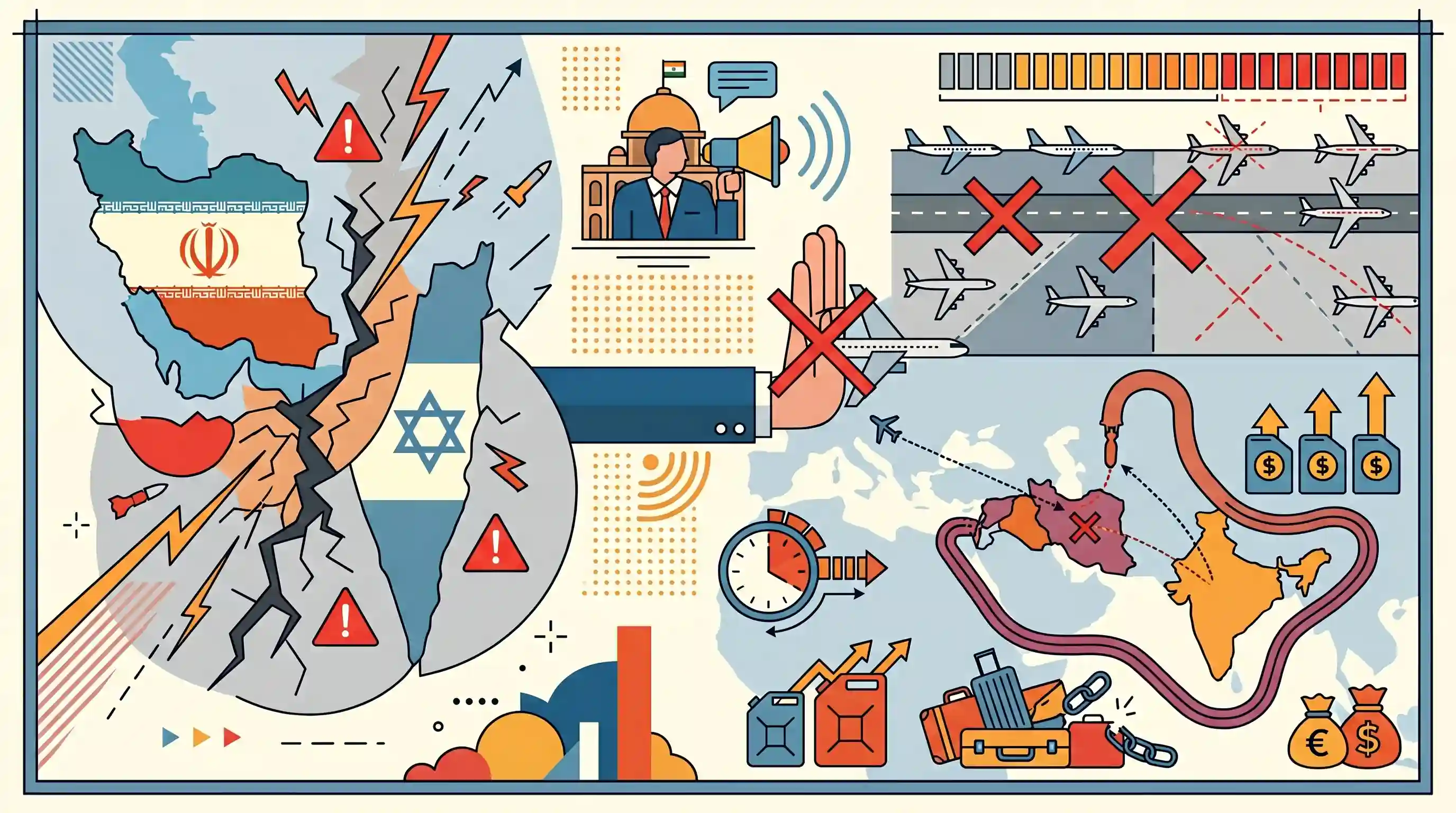
Following the escalation of the Iran-Israel conflict, the Ministry of Civil Aviation issued an advisory leading Indian airlines to cancel approximately 350 international flights. The geopolitical tensions have forced airlines to reroute flights to avoid conflict-zone airspaces, leading to increased operational costs, longer flight times, and logistical disruptions for routes connecting India to West Asia and Europe.
Key Points
- The escalating Iran-Israel conflict has prompted the Ministry of Civil Aviation to issue safety advisories for commercial air operations.
- Approximately 350 international flights by Indian airlines were cancelled, severely disrupting air connectivity between India, West Asia, and Europe.
- To ensure passenger safety, airlines are forced to reroute flights to avoid conflict-zone airspaces, which increases flight durations and operational fuel costs.
- The situation underscores the vulnerability of the civil aviation sector to geopolitical shocks and highlights the economic fallout of West Asian instability on Indian interests.
Important Terms
Ministry of Civil Aviation (MoCA)

India's nodal ministry responsible for formulating national policies and programmes for the development and regulation of civil aviation, overseeing airport facilities, air traffic services, and safety.
UPSC context
GS Paper II (Governance) and GS Paper III (Infrastructure/Economy); tests knowledge of sector-specific regulatory frameworks and policy interventions.
West Asia
A strategically critical region for India encompassing countries like Iran and Israel; vital for energy security, trade routes, and the livelihoods of over 9 million Indian diaspora members.
UPSC context
GS Paper II (International Relations); tests understanding of India's 'Link West' policy and regional stability's impact on national interests.
International Civil Aviation Organization (ICAO)
A UN specialized agency established in 1944 to manage the administration and governance of international civil aviation standards, safety, and air navigation procedures globally.
UPSC context
GS Paper II (Important International Institutions); tests familiarity with global bodies setting standards for cross-border infrastructure and safety.
NOTAM
An official alert (officially 'Notice to Air Missions') issued by aviation authorities to inform pilots of time-sensitive hazards, restrictions, or changes in airspace conditions critical for flight safety.
UPSC context
GS Paper III (Internal Security/Disaster Management); tests technical understanding of aviation safety mechanisms during geopolitical conflicts or emergencies.
Airspace Sovereignty
The international legal principle (codified in the Chicago Convention) granting every state complete and exclusive jurisdiction over the atmosphere above its territory and territorial waters.
UPSC context
GS Paper II (International Law/Bilateral Relations); relevant for issues concerning unauthorized incursions, rerouting, and geopolitical transit rights.
Civil Aviation Sector
A vital component of India's infrastructure, currently the world's third-largest domestic market, sensitive to external shocks like fuel price volatility and international conflict rerouting.
UPSC context
GS Paper III (Infrastructure and Economy); tests analysis of growth drivers and vulnerabilities in key logistics and transport industries.
Prelims Trap
The 'First Freedom of the Air' guarantees airlines an absolute right of transit over member states, even during active armed conflicts.
Under the 1944 Chicago Convention, states retain absolute and exclusive sovereignty over their territorial airspace and can legally close it unilaterally during emergencies.
Static Concepts Connected
What are the foundational principles governing international airspace?
- State Sovereignty: Every state possesses complete and exclusive sovereignty over the airspace above its territory and territorial waters.
- Freedoms of the Air: Formulated under the Chicago Convention, these dictate commercial aviation rights, starting with the right to fly across a foreign country without landing.
- NOTAMs: An official alert issued by national aviation authorities (like DGCA) to inform pilots of flight hazards or restricted zones.
How do global geopolitical shocks impact domestic airline economics?
- Major Cost Component: Aviation Turbine Fuel (ATF) makes up approximately 40% of an Indian airline's total operational expenses, making margins highly sensitive to global crude volatility.
- Dual Burden: Closing airspace forces airlines to take massive detours, increasing both the volume of fuel consumed and flight duration simultaneously.
Cross-Topic Patterns
Airspace closures & maritime chokepoints
The West Asian conflict simultaneously disrupts the airspace transit corridor and maritime trade via the Red Sea, compounding logistics costs and highlighting the strategic necessity of alternatives like IMEC.
Imported inflation via supply chains
Rising Aviation Turbine Fuel (ATF) costs coupled with longer freight routes cascade into higher logistics costs, acting as a textbook trigger for imported inflation in the Indian macro-economy.

Expect a 2026 Prelims question pairing the Chicago Convention and 'Freedoms of the Air' to test state airspace sovereignty vs transit rights.
Linked PYQs · 3
Linked PYQs · 3
- 2014MainsGS3
International civil aviation laws provide all countries complete and exclusive sovereignty over the airspace above their territory. What do you understand by 'airspace'? What are the implications of these laws on the space above this airspace? Discuss the challenges which this poses and suggest ways to contain the threat.
- 2025MainsGS2
"Energy security constitutes the dominant kingpin of India's foreign policy, and is linked with India's overarching influence in Middle Eastern countries.” How would you integrate energy security with India's foreign policy trajectories in the coming years?
- 2023PrelimsGS1
Consider the following statements: Statement-I: Israel has established diplomatic relations with some Arab States. Statement-II: The 'Arab Peace Initiative' mediated by Saudi Arabia was signed by Israel and Arab League. Which one of the following is correct in respect of the above statements?
