Strait of Hormuz Ship Attacks Threaten Global Energy Security
Source:The Hindu ↗
Why It Matters
The Strait of Hormuz is a vital maritime choke point for global oil and gas supplies. Escalations in West Asia directly threaten India's macro-economic stability (energy security) and the safety of the large Indian diaspora residing in the Gulf countries, making it a critical geopolitical issue.
Summary
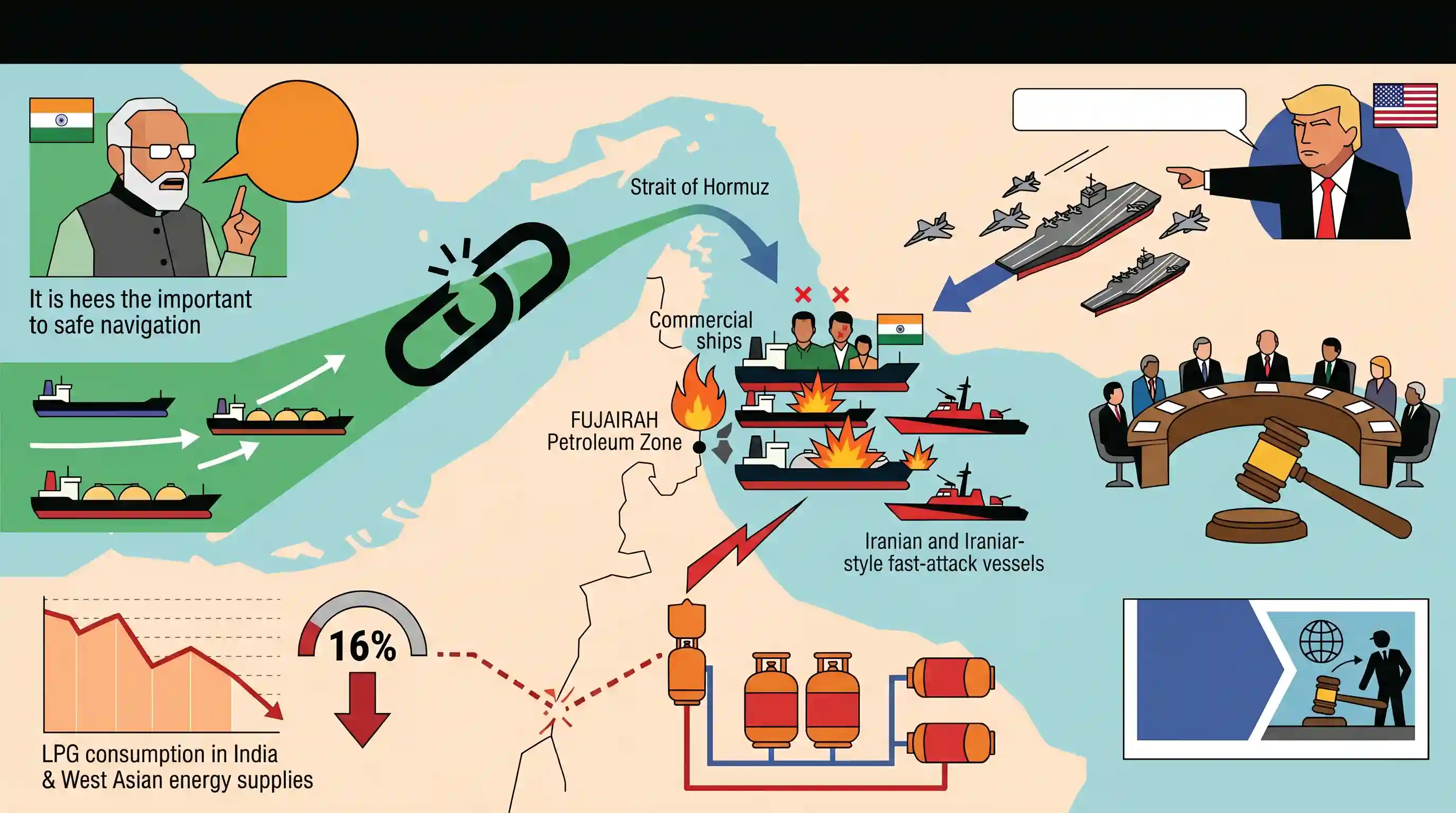
Amidst the escalating Iran-Israel war on May 5, 2026, Iran attacked commercial ships near the UAE's Fujairah Petroleum Zone, injuring three Indian nationals. The disruption at the critical Strait of Hormuz choke point prompted U.S. President Donald Trump to launch 'Project Freedom' and push for a UN Security Council resolution under Chapter 7. Indian PM Narendra Modi condemned the strikes, stressing the necessity of safe navigation for global energy security. The conflict has directly impacted India's economy, causing a 16% drop in LPG consumption in April due to disrupted West Asian supplies.
Key Points
- Escalation of the Iran-Israel war led to Iranian drone strikes on commercial ships near the UAE's Fujairah Petroleum Zone in the Strait of Hormuz.
- Three Indian nationals were injured in the attacks, highlighting the safety risks for the Indian diaspora in the Gulf region.
- U.S. President Donald Trump launched 'Project Freedom' to safeguard maritime routes and proposed a UN Security Council resolution under Chapter 7 for humanitarian and shipping corridors.
- India's domestic economy felt the impact as LPG consumption dropped by 16% in April due to West Asian supply chain disruptions.
- PM Narendra Modi condemned the attacks and stressed the geostrategic necessity of maintaining freedom of navigation in the Strait of Hormuz for global energy security.
Important Terms
Strait of Hormuz

A narrow waterway between the Persian Gulf and Gulf of Oman. It is the world's most critical maritime chokepoint for global oil and liquefied natural gas (LNG) shipments.
UPSC context
GS Paper 1 (Geography) & GS Paper 3 (Energy Security); tests understanding of global trade routes and energy supply vulnerabilities.
Chapter 7 of the UN Charter
A section of the UN Charter that allows the Security Council to determine threats to peace and take enforcement actions, including sanctions or military force.
UPSC context
GS Paper 2 (International Relations); essential for understanding international law and the UN's power to intervene in global conflicts.
UN Security Council (UNSC)
A principal UN organ charged with maintaining international peace and security. It has the power to pass legally binding resolutions for its member states.
UPSC context
GS Paper 2 (International Institutions); focuses on global governance, India’s quest for permanent membership, and international security dynamics.
Project Freedom
In this context, a U.S.-led policy or military initiative (proposed by Trump) aimed at ensuring freedom of navigation and protecting commercial shipping in volatile maritime zones.
UPSC context
GS Paper 2 (Bilateral Relations); tests analysis of U.S. foreign policy and its direct impact on India’s maritime and economic interests.
Energy Security
The continuous availability of energy sources at an affordable price. It involves securing supply chains, particularly maritime routes like the Strait of Hormuz, from geopolitical disruptions.
UPSC context
GS Paper 3 (Economy/Infrastructure); explores India's strategies for mitigating supply shocks and ensuring stable economic growth through resource management.
Fujairah Petroleum Zone
A strategic oil storage and refueling hub in the UAE, located outside the Strait of Hormuz. It serves as a vital alternative port for global energy logistics.
UPSC context
GS Paper 2 (West Asia Geopolitics); significant for India’s energy diplomacy and strategic petroleum reserves partnership with the UAE.
Prelims Trap
"All emirates of the UAE, including Fujairah, share a coastline exclusively with the Persian Gulf."
Aspirants often assume the entire UAE lies inside the Persian Gulf. Fujairah is uniquely located on the Gulf of Oman to bypass the Strait of Hormuz.
Static Concepts Connected
How do Chapter VI and Chapter VII of the UN Charter differ?
- Chapter VI: Focuses on the peaceful settlement of disputes. Resolutions passed under this chapter are generally considered non-binding recommendations.
- Chapter VII: Empowers the UNSC to take binding enforcement action, including economic sanctions or military force, to restore international peace and security.
What is the geographical layout of the Strait of Hormuz?
- Connectivity: It is a vital maritime chokepoint connecting the Persian Gulf in the west to the Gulf of Oman and the Arabian Sea in the southeast.
- Bordering Nations: It is bordered by Iran to the north and the Musandam Peninsula (an exclave of Oman) and the UAE to the south.
- Strategic Value: It facilitates approximately 20% of global oil consumption transit, making it a critical node for Asian energy-importing economies like India.
Cross-Topic Patterns
Geopolitics driving domestic inflation
Disruptions in the Strait of Hormuz directly spike India's imported inflation, forcing the RBI to balance imported supply-side fuel shocks with domestic monetary policy and inflation targeting.
West Asian shocks & India's SPR
Recurring vulnerabilities at Gulf chokepoints highlight the urgency for India to expand its Strategic Petroleum Reserves (ISPRL) capacity and commercialize Phase II storage facilities.

Map questions combining Gulf of Oman bypass ports (Fujairah, Duqm, Jask) and UN Chapter 7 enforcement are highly probable in Prelims 2026.
Linked PYQs · 3
Linked PYQs · 3
- 2017MainsGS2
The question of India's Energy Security constitutes the most important part of India's economic progress. Analyze India's energy policy cooperation with West Asian countries.
- 2025MainsGS2
"Energy security constitutes the dominant kingpin of India's foreign policy, and is linked with India's overarching influence in Middle Eastern countries.” How would you integrate energy security with India's foreign policy trajectories in the coming years?
- 2023MainsGS2
‘Sea is an important Component of the Cosmos’ Discuss in the light of the above statement the role of the IMO (International Maritime Organisation) in protecting environment and enhancing maritime safety and security.
