US Naval Blockade Escalates Conflict in Strait of Hormuz
Source:The Hindu ↗
Why It Matters
The blockade of the Strait of Hormuz presents a classic geopolitical chokepoint crisis, offering UPSC aspirants a real-world case study on energy security, freedom of navigation under international law, and the macroeconomic impacts of oil price shocks on developing economies like India.
Summary
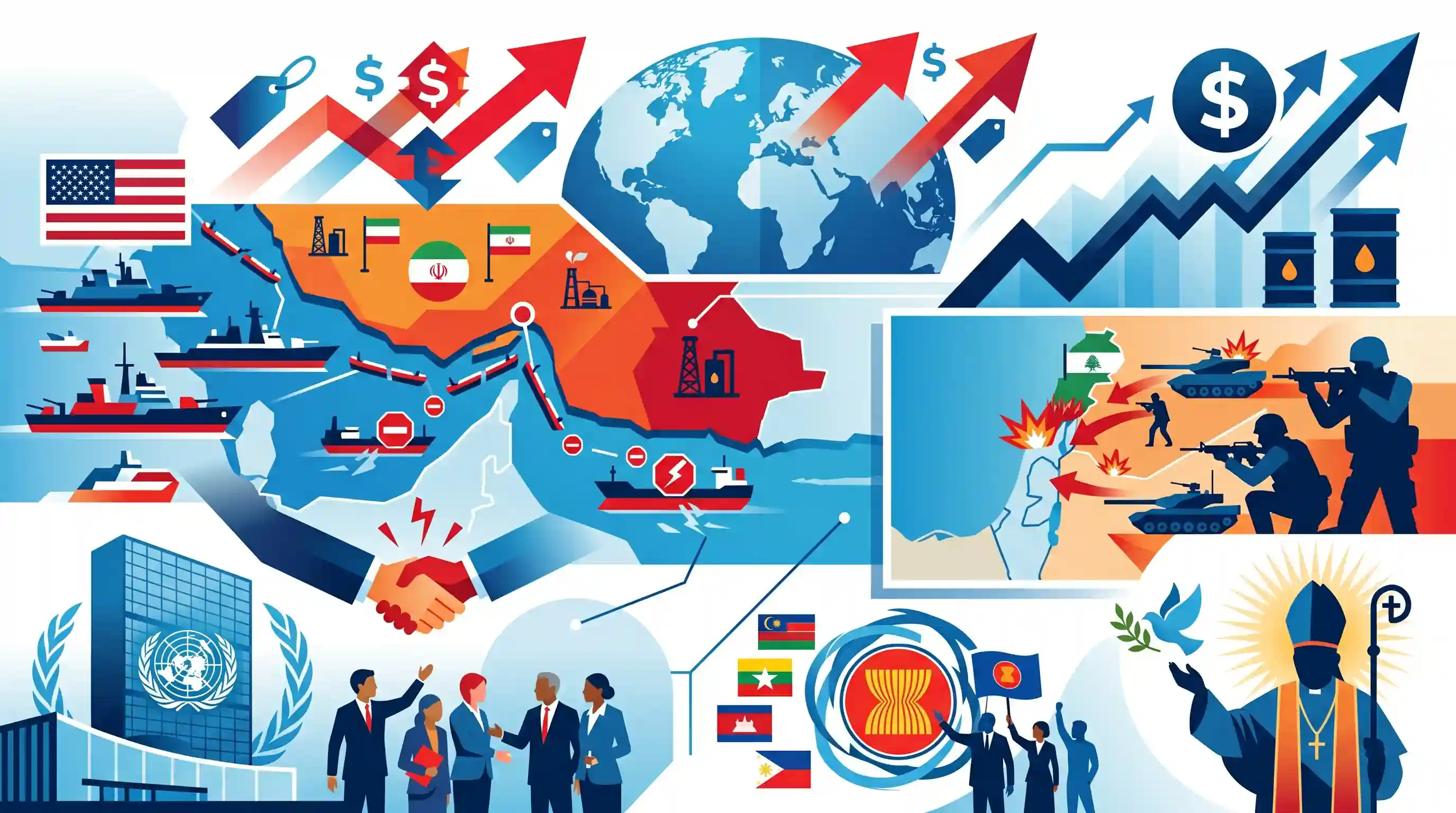
The ongoing conflict involving the US, Israel, and Iran has escalated significantly with the US announcing a naval blockade on all Iranian ports and the strategic Strait of Hormuz. Following the collapse of peace talks in Pakistan, the US blockade threatens to choke off critical global energy supplies, sending oil prices soaring above $100 per barrel and stoking fears of global inflation. The move has drawn widespread international concern over maritime security and the right to freedom of navigation, with the UN, ASEAN, and several nations urging a peaceful resolution. Concurrently, the conflict has widened as Israeli forces advance against Hezbollah in southern Lebanon, while global leaders including Pope Leo XIV have condemned the escalating violence.
Key Points
- The United States announced a naval blockade of Iranian ports and the strategic Strait of Hormuz following the collapse of peace talks in Pakistan.
- The blockade threatens to choke off approximately a fifth of global seaborne oil shipments, driving oil prices above $100 a barrel and raising global inflation fears.
- International bodies including the UN and ASEAN, along with several nations, have condemned the blockade for violating the freedom of navigation in international straits.
- The conflict involves multiple fronts, with Israeli forces simultaneously advancing against Hezbollah in southern Lebanon.
- Pope Leo XIV and other global leaders have strongly criticized the escalating U.S.-Israeli military actions against Iran.
Important Terms
UNCLOS

A 1982 international treaty establishing the legal framework for marine activities, defining maritime zones like territorial waters, Exclusive Economic Zones (EEZs), and the high seas.
UPSC context
GS II (International Relations); foundational for disputes over maritime sovereignty, freedom of navigation, and India's maritime security strategy.
Strait of Hormuz
A strategic maritime chokepoint between Iran and Oman connecting the Persian Gulf to the Arabian Sea; it facilitates approximately 20% of global oil transit.
UPSC context
GS I/II (Geography & Geopolitics); critical for global energy security and India's dependence on West Asian crude oil imports.
Hezbollah
A Lebanon-based Shia militant group and political party, designated as an Iranian proxy, playing a central role in the regional conflict against Israel.
UPSC context
GS II (International Relations); examines the influence of non-state actors and regional power dynamics in the Middle East.
ASEAN
A regional organization of ten Southeast Asian nations promoting economic growth and security through diplomatic neutrality and the principle of 'ASEAN Centrality.'
UPSC context
GS II (Regional Groupings); vital for India's 'Act East Policy' and maintaining a multi-aligned foreign policy.
Freedom of Navigation
The legal principle that ships from any sovereign state shall not suffer interference from other states while navigating international waters or straits.
UPSC context
GS II (Global Governance); essential for upholding a rule-based international order and protecting global trade routes.
Naval Blockade
The military act of preventing all vessels from entering or leaving a coastal area; it is governed by the laws of armed conflict and UNCLOS.
UPSC context
GS II (International Law); tests the boundaries of maritime law, neutrality, and international security protocols.
Energy Security
The uninterrupted availability of energy sources at an affordable price, often jeopardized by volatility in oil-producing regions and maritime chokepoints.
UPSC context
GS III (Economic Development); fundamental for India's fiscal stability and resilience against global inflationary shocks.
Prelims Trap
"Under UNCLOS, coastal states can temporarily suspend transit passage through international straits for security."
While 'innocent passage' through territorial seas can be temporarily suspended for security reasons, 'transit passage' through international straits (like Hormuz) cannot be suspended under UNCLOS.
Static Concepts Connected
What are West Asia's crucial maritime chokepoints?
- Strait of Hormuz: Connects the Persian Gulf to the Gulf of Oman and Arabian Sea. Bordered by Iran and Oman (Musandam Peninsula).
- Bab el-Mandeb: Connects the Red Sea to the Gulf of Aden. Bordered by Yemen on the Arabian Peninsula, and Djibouti and Eritrea in the Horn of Africa.
- Suez Canal: Artificial sea-level waterway in Egypt connecting the Mediterranean Sea to the Red Sea, separating the African continent from Asia.
How do global crude oil shocks impact India's macroeconomic stability?
- Twin Deficits: A higher import bill significantly widens the Current Account Deficit (CAD) and puts pressure on the fiscal deficit due to potential subsidy burdens.
- Imported Inflation: Costlier oil increases domestic transport and production costs, directly pushing up both Wholesale Price Index (WPI) and Consumer Price Index (CPI) inflation.
- Currency Depreciation: Increased demand for US Dollars to pay for more expensive crude oil imports exerts downward pressure, leading to Rupee depreciation.
Cross-Topic Patterns
West Asia conflicts + India's SPR
Oil supply threats from chokepoint blockades regularly trigger UPSC questions on India's Strategic Petroleum Reserves (ISPRL), testing locations like Padur, Mangaluru, and Chandikhol.
Litani River + UNSC Resolution 1701
The Israel-Hezbollah conflict puts a spotlight on the Litani River as a buffer zone, mirroring recent UPSC trends of asking specific river-border contexts in international conflict zones.

Expect a composite 2026 Prelims question pairing West Asian chokepoints (Hormuz vs Bab el-Mandeb) with UNCLOS 'transit passage' rules.
Linked PYQs · 3
Linked PYQs · 3
- 2024PrelimsGS1
Consider the following statements : Statement-I : Sumed pipeline is a strategic route for Persian Gulf oil and natural gas shipments to Europe. Statement-II : Sumed pipeline connects the Red Sea with the Mediterranean Sea. Which one of the following is correct in respect of the above statements?
- 2014MainsGS2
With respect to the South China sea, maritime territorial disputes and rising tension affirm the need for safeguarding maritime security to ensure freedom of navigation and over flight throughout the region. In this context, discuss the bilateral issues between India and China.
- 2018MainsGS2
“India’s relations with Israel have, of late, acquired a depth and diversity, which cannot be rolled back.” Discuss.
