Iran Warns Against Strikes on Nuclear Facilities Amid Standoff
Source:Indian Express ↗
Why It Matters
Tensions over Iran's nuclear program and the broader Israel-Iran conflict are pivotal to West Asian geopolitics. Escalation directly impacts global energy security, tests international non-proliferation frameworks (IAEA safeguards), and profoundly affects India's economic and strategic interests in the Middle East.
Summary
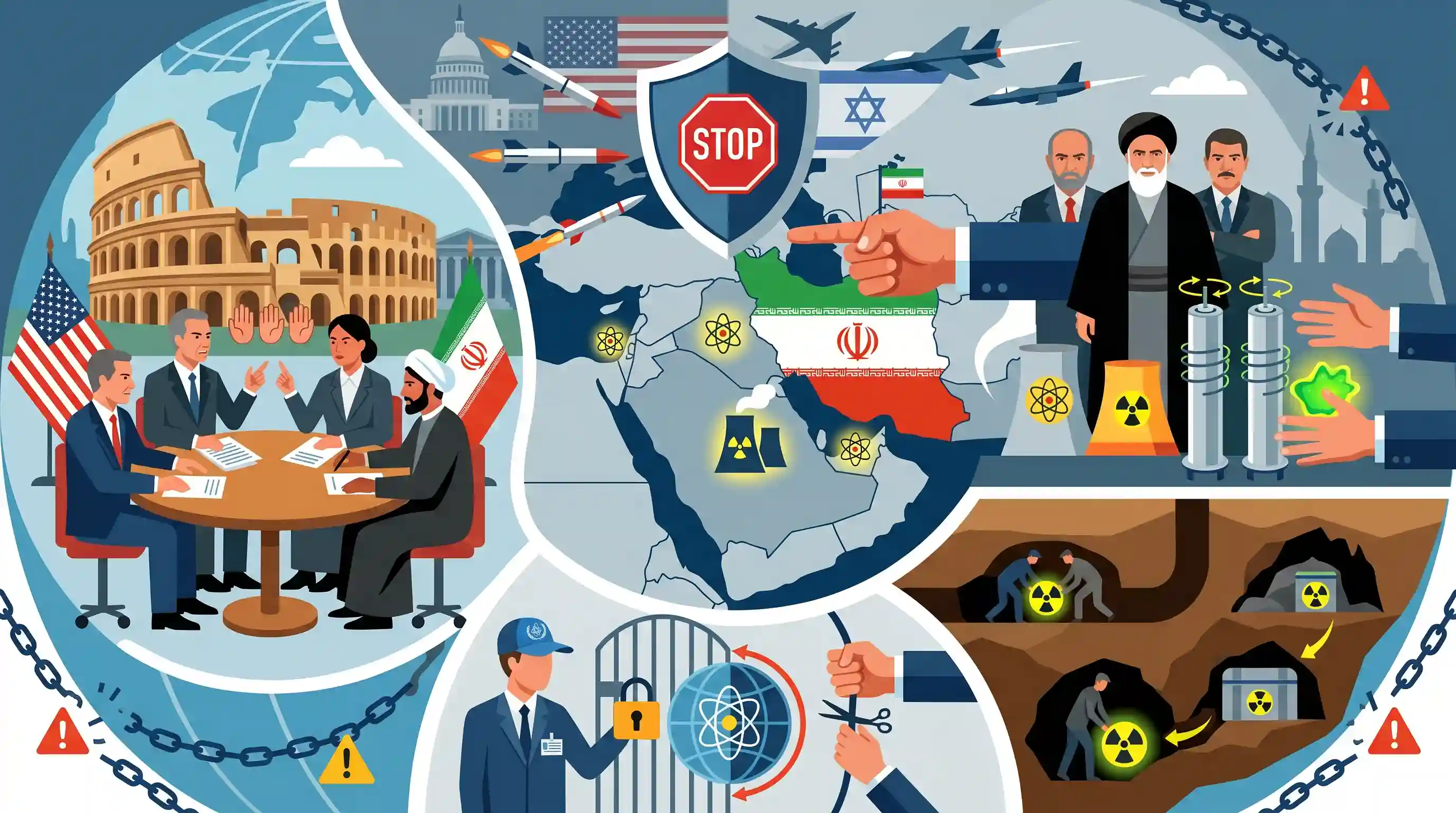
Amid heightened tensions in the Middle East, Iran has sternly warned the US and Israel against targeting its nuclear facilities. Foreign Minister Abbas Araqchi emphasized that the US would be held legally responsible for any Israeli military action against Iranian nuclear sites. These tensions occur simultaneously with the fifth round of US-Iran nuclear talks in Rome, where Iran's leadership continues to resist Western demands to halt uranium enrichment. If threatened, Iran warned it could suspend cooperation with the International Atomic Energy Agency (IAEA) or conceal its enriched nuclear materials, raising concerns about regional stability and global nuclear non-proliferation efforts.
Key Points
- Iran has warned the US and Israel against attacking its nuclear facilities, asserting the US would bear legal responsibility for any Israeli strike.
- The warnings come amid a fifth round of US-Iran nuclear talks in Rome focused on resolving the standoff over uranium enrichment.
- Iran's Supreme Leader Ayatollah Ali Khamenei dismissed US demands to halt uranium enrichment as excessive and outrageous.
- In response to potential threats, Iran warned it could suspend cooperation with the International Atomic Energy Agency (IAEA) and relocate enriched nuclear material to undisclosed sites.
- The situation exacerbates ongoing regional tensions following direct military exchanges between Israel and Iran earlier in the year.
Important Terms
Joint Comprehensive Plan of Action (JCPOA)

A 2015 landmark agreement between Iran and P5+1 powers (US, UK, France, China, Russia, and Germany) to limit Iran's nuclear program in exchange for sanctions relief.
UPSC context
GS II: Global groupings/agreements affecting India's interests; tests understanding of diplomatic negotiations and sanctions.
International Atomic Energy Agency (IAEA)
An autonomous international organization established in 1957 to promote peaceful nuclear energy use and ensure it is not diverted for military purposes through global safeguards.
UPSC context
GS II: Important International institutions and their mandate; critical for nuclear energy and non-proliferation topics.
Uranium Enrichment
The process of increasing the concentration of the fissile isotope U-235 in uranium. While 3-5% is for power, 90%+ is weapons-grade; Iran's 60% enrichment exceeds civilian needs.
UPSC context
GS III: Science & Technology and Internal Security; tests technical knowledge of nuclear cycles and proliferation risks.
West Asia Geopolitics
Regional power dynamics involving Iran, Israel, and Saudi Arabia. It is vital for India’s energy security, trade (Chabahar Port), and the welfare of its 9-million-strong diaspora.
UPSC context
GS II: Effect of foreign policies on India's interests; essential for regional stability and energy security questions.
Nuclear Non-Proliferation
The global effort to prevent the spread of nuclear weapons. It is primarily governed by the NPT, focusing on non-proliferation, disarmament, and peaceful nuclear technology.
UPSC context
GS II: International relations and treaties; tests awareness of global security frameworks and India’s nuclear doctrine.
Prelims Trap
"Like India and Israel, Iran is not a signatory to the Nuclear Non-Proliferation Treaty (NPT)."
Iran IS a signatory to the NPT. Aspirants often confuse it with non-signatories (India, Israel, Pakistan). The crisis is over safeguard compliance, not NPT membership.
Static Concepts Connected
What distinguishes IAEA Comprehensive Safeguards from the Additional Protocol?
- Comprehensive Safeguards: Mandatory for NPT non-nuclear-weapon states; requires countries to declare nuclear facilities for the IAEA to verify their peaceful use.
- Additional Protocol: A voluntary, expanded agreement granting the IAEA broader access, including short-notice inspections of undeclared sites.
How is uranium enrichment classified for civilian versus military applications?
- Low Enriched Uranium: Contains less than 20% U-235. It is primarily used for commercial nuclear power generation and medical research.
- Highly Enriched Uranium: Contains 20% or more U-235. Weapons-grade uranium is a highly concentrated subset, typically enriched to around 90%.
Cross-Topic Patterns
Chabahar and INSTC Vulnerability
US-Israel-Iran escalations directly threaten India's strategic connectivity to Central Asia and Eurasia via the Chabahar Port and the International North-South Transport Corridor (INSTC).
Energy Security vs Current Account Deficit
Any strike on Iranian infrastructure risks choking the Strait of Hormuz, spiking global crude prices and widening India's Current Account Deficit (CAD) and imported inflation.

Expect a 2026 Prelims multi-statement question intertwining IAEA's Additional Protocol, JCPOA provisions, and Iran's NPT signatory status.
Linked PYQs · 4
Linked PYQs · 4
- 2025MainsGS2
"Energy security constitutes the dominant kingpin of India's foreign policy, and is linked with India's overarching influence in Middle Eastern countries.” How would you integrate energy security with India's foreign policy trajectories in the coming years?
- 2018MainsGS2
“India’s relations with Israel have, of late, acquired a depth and diversity, which cannot be rolled back.” Discuss.
- 2018PrelimsGS1
In the Indian context, what is the implication of ratifying the 'Additional Protocol' with the 'International Atomic Energy Agency (IAEA)'?
- 2020PrelimsGS1
In India, why are some nuclear reactors kept under "IAEA Safeguards" while others are not?
