India expresses Concern over West Asian Conflict and Diaspora
Source:The Hindu ↗
Why It Matters
West Asia is a critical region for India due to energy security, trade routes, and the massive Indian diaspora. Understanding India's diplomatic balancing act during Middle Eastern crises is essential for GS Paper 2 (International Relations).
Summary
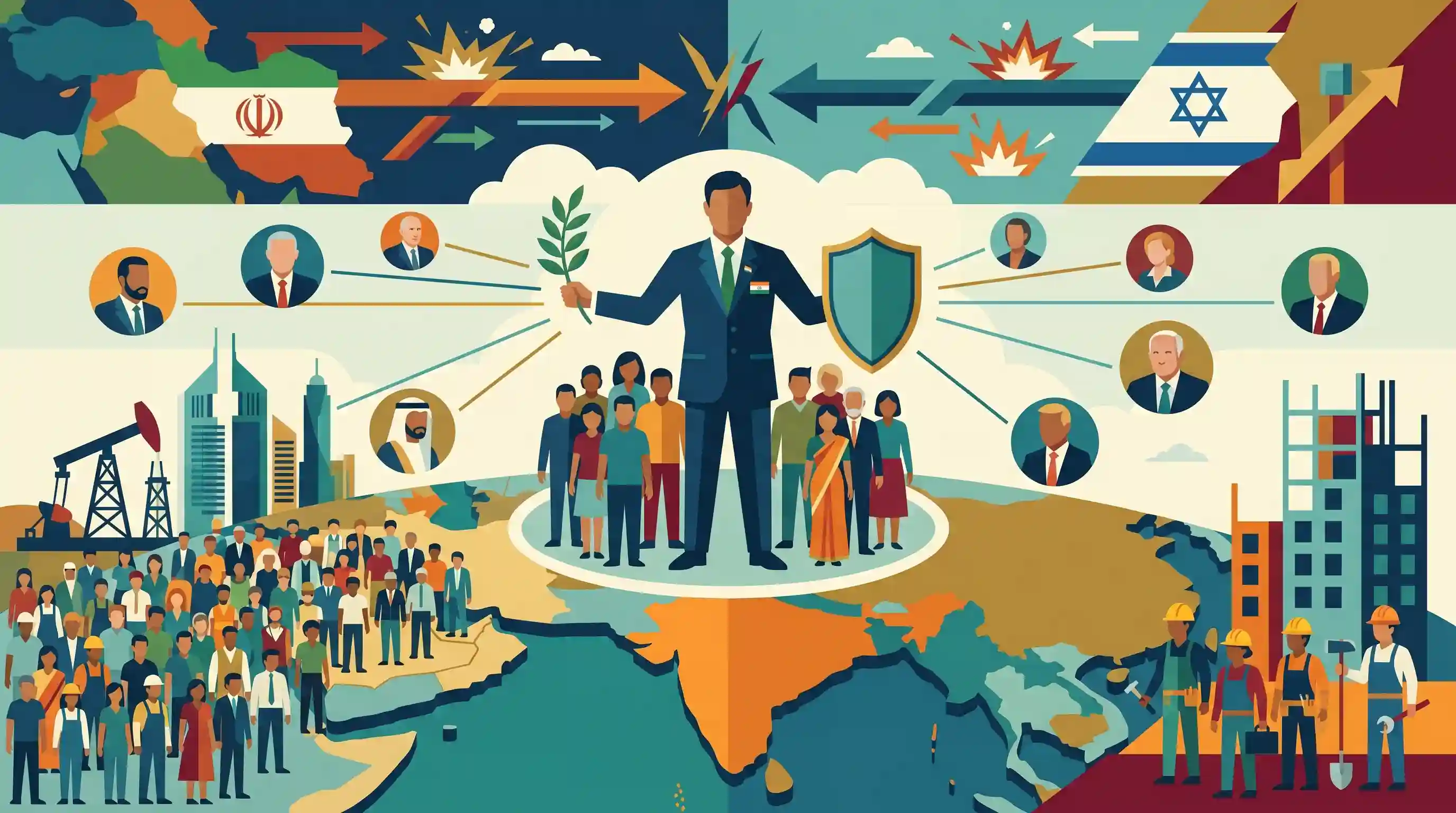
In response to the escalating conflict between Iran and Israel, India has issued a diplomatic statement urging restraint, dialogue, and respect for territorial sovereignty. The Ministry of External Affairs (MEA) emphasized the protection of civilians as a priority. Beyond geopolitical stability and energy security, India's most pressing concern is the safety of its massive diaspora—over 10 million workers in GCC countries and around 50,000 Indian workers in Israel's construction sector. External Affairs Minister S. Jaishankar has been proactively consulting with key regional players to monitor and manage the fallout of the crisis on Indian interests.
Key Points
- The MEA issued a statement expressing deep concern over the escalating Iran-Israel conflict and its potential expansion in West Asia.
- India reiterated its call for dialogue, diplomacy, protection of civilians, and respect for sovereignty and territorial integrity.
- A major immediate concern for India is the safety of over 10 million Indian expatriates working in GCC countries.
- The conflict also poses risks for approximately 50,000 Indian workers engaged in Israel's construction sector following a bilateral agreement.
- External Affairs Minister S. Jaishankar has been actively engaged in diplomatic discussions with counterparts across the Middle East to navigate the crisis.
Important Terms
Ministry of External Affairs (MEA)

India's central executive agency for managing foreign relations, diplomatic missions, and international treaties. It protects national interests, promotes trade, and ensures the welfare of Indian citizens and the diaspora abroad.
UPSC context
GS Paper 2: International Relations; crucial for understanding foreign policy frameworks, diplomatic strategies, and institutional mechanisms for global engagement.
Gulf Cooperation Council (GCC)
A regional intergovernmental political and economic union consisting of Bahrain, Kuwait, Oman, Qatar, Saudi Arabia, and the UAE. It is India's largest regional trading partner and a key energy supplier.
UPSC context
GS Paper 2: Bilateral, Regional and Global Groupings; tests knowledge of regional alliances affecting India’s energy security, trade, and diaspora welfare.
West Asia
A strategic region including the Persian Gulf and Levant. For India, it is an "extended neighborhood" critical for energy imports, maritime trade routes, and hosting a massive expatriate workforce.
UPSC context
GS Paper 2: India and its Neighborhood; relevant for geopolitical balancing, regional stability, and the "Link West" policy.
Indian Diaspora
The global community of Persons of Indian Origin (PIOs) and Non-Resident Indians (NRIs). In West Asia, they contribute over 50% of India's total remittances, supporting foreign exchange stability.
UPSC context
GS Paper 2: Effect of policies and politics of countries on India's interests; highlights diaspora's role in foreign policy and economic resilience.
Energy Security
The reliable and affordable supply of energy necessary for economic growth. India's security is tied to West Asia, which provides nearly 50% of its crude oil and 70% of natural gas imports.
UPSC context
GS Paper 3: Infrastructure and Energy; tests understanding of strategic petroleum reserves, import diversification, and geopolitical risks to domestic inflation.
Territorial Sovereignty
The supreme and exclusive authority of a state over its defined territory and domestic affairs. It is a cornerstone of the UN Charter and fundamental to India's diplomatic stance.
UPSC context
GS Paper 2: International Relations; tests knowledge of global order principles and India's advocacy for a rules-based international system.
Prelims Trap
India's 'de-hyphenation' policy involves pausing diplomatic ties with conflicting nations to maintain strict neutrality.
De-hyphenation actually means maintaining strong, independent, and simultaneous bilateral relationships with antagonistic nations (like Israel and Iran) without letting one relationship dictate the other.
Static Concepts Connected
What is India's 'De-hyphenation' policy in the context of West Asia?
- Independent Ties: Treating relations with mutually antagonistic nations independently, rather than viewing them through the lens of their bilateral conflict.
- Strategic Autonomy: Engaging with all regional players based on India's mutual interests, allowing simultaneous partnerships without zero-sum calculations.
- Practical Application: It allows India to deeply engage with Israel on defence and technology while maintaining robust energy and diaspora ties with Arab states and Iran.
How does West Asian instability directly impact India's macroeconomic indicators?
- Imported Inflation: Spikes in global crude prices directly increase domestic fuel, transport, and manufacturing costs, driving up headline inflation.
- Widening CAD: Higher oil import bills, coupled with potential drops in GCC remittances (which form ~30% of inward flows), widen the trade gap.
- Rupee Depreciation: A widening Current Account Deficit and the flight of global capital to safe-haven assets put severe downward pressure on the INR.
Cross-Topic Patterns
Energy Security + Strategic Petroleum Reserves
Geopolitical supply shocks in West Asia elevate the strategic urgency of expanding India's Strategic Petroleum Reserves (SPRs) to cushion against crude price volatility and ensure energy security.
Diaspora Remittances + Current Account Deficit
The massive reliance on GCC remittances creates external sector vulnerabilities, linking the physical safety of the Indian diaspora directly to RBI's management of the balance-of-payments.
Bilateral Mobility Pacts + Labour Protection
Deploying Indian construction workers to Israeli conflict zones tests the ethical limits of recent bilateral mobility pacts, bridging international diplomacy with global labour rights frameworks.

Expect a Mains question linking West Asian instability directly to India's macroeconomic stability (remittances, inflation, CAD) in 2026.
Linked PYQs · 2
Linked PYQs · 2
- 2018MainsGS2
“India’s relations with Israel have, of late, acquired a depth and diversity, which cannot be rolled back.” Discuss.
- 2025MainsGS2
"Energy security constitutes the dominant kingpin of India's foreign policy, and is linked with India's overarching influence in Middle Eastern countries.” How would you integrate energy security with India's foreign policy trajectories in the coming years?
