Direct Missile Strikes Escalates Iran Israel Military Conflict
Source:The Hindu ↗
Why It Matters
The direct military confrontation between Iran and Israel marks a critical flashpoint in West Asian geopolitics. It has profound implications for global energy markets, nuclear non-proliferation efforts, and tests India's strategic foreign policy balancing between its vital partnerships with both nations.
Summary
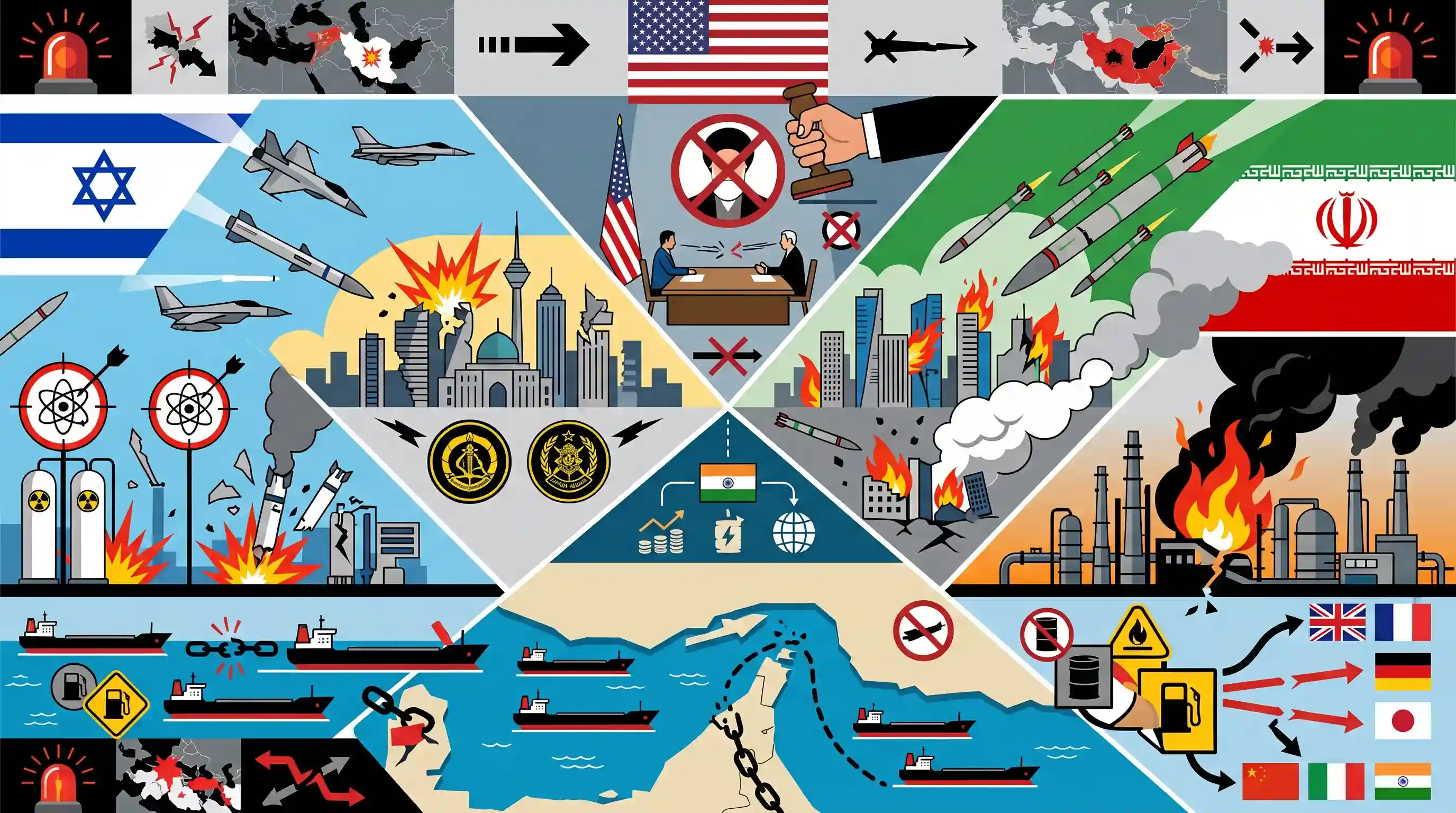
The ongoing Iran-Israel conflict escalated dramatically in June 2025, culminating in direct, massive military confrontations. Israel executed comprehensive aerial strikes across Tehran, dismantling a third of Iran's missile launchers, Quds Force command centers, and deliberately targeting nuclear enrichment sites and scientists to thwart Iran's nuclear ambitions. In retaliation, Iran fired hundreds of missiles into densely populated Israeli areas, including Tel Aviv. The mutual bombardment has caused significant civilian casualties and destruction of critical infrastructure, notably oil refineries. US President Donald Trump indicated a push for diplomatic negotiations while vetoing the targeted assassination of Iran's Supreme Leader. This intense escalation poses severe risks to Middle Eastern regional stability and global energy security, particularly concerning oil transit through the Strait of Hormuz.
Key Points
- Israel launched a massive aerial assault on Iran, claiming aerial superiority and destroying over 120 surface-to-surface missile launchers and 10 Quds Force command centers.
- The strikes directly targeted Iranian nuclear scientists and uranium enrichment sites, aiming to halt Iran's pursuit of nuclear weapons.
- Iran retaliated by firing a barrage of over 100 missiles into Israeli territory, bringing the total to nearly 470 missiles and hundreds of drones in the current wave.
- Civilian casualties are mounting, with rights groups reporting around 400 deaths in Iran and at least 24 killed in Israel.
- Critical economic infrastructure, including oil refineries and government buildings, has been hit, raising alarms for global energy security and oil supply lines.
- US President Donald Trump hinted at a potential diplomatic deal, having reportedly vetoed a plan to assassinate Iran's Supreme Leader.
Important Terms
Quds Force

The elite wing of Iran's Islamic Revolutionary Guard Corps (IRGC) specializing in unconventional warfare and extraterritorial operations, supporting non-state actors like Hezbollah and Hamas to project regional influence.
UPSC context
GS Paper 2: West Asia Geopolitics; essential for understanding Iran's "forward defense" strategy and asymmetric regional influence.
Islamic Revolutionary Guard Corps (IRGC)
A parallel military branch established in 1979 to protect Iran’s Islamic system; it maintains its own army, navy, and air force and reports directly to the Supreme Leader.
UPSC context
GS Paper 2 & 3: Security challenges and international relations; tests knowledge of Iran’s dual military structure and regional security.
Strait of Hormuz
A vital maritime chokepoint between the Persian Gulf and the Gulf of Oman through which approximately 20% of the world's total oil consumption passes daily.
UPSC context
GS Paper 3: Energy Security; critical for India's crude oil supply and economic stability due to reliance on West Asian imports.
Supreme Leader of Iran
The highest political and religious authority (Rahbar) in Iran, exercising ultimate command over the armed forces, judiciary, and state media under the doctrine of Velayat-e Faqih.
UPSC context
GS Paper 2: International Relations; crucial for understanding Iran's decision-making hierarchy and foreign policy pivots.
Nuclear Enrichment
The physical process of increasing the concentration of uranium-235 for use in nuclear reactors or weapons; a central flashpoint in international diplomacy and non-proliferation efforts.
UPSC context
GS Paper 2: International Treaties (JCPOA) and Paper 3: Science & Technology/Security; tests understanding of nuclear proliferation risks.
Proxy Warfare
A conflict where major powers use third parties—typically non-state actors or smaller states—to fight on their behalf to reduce risks of direct total war.
UPSC context
GS Paper 2: West Asia dynamics; essential for analyzing the roles of groups like Hezbollah and Hamas in the Iran-Israel rivalry.
Energy Security
The uninterrupted availability of energy sources at an affordable price, encompassing physical availability, economic accessibility, and environmental sustainability of oil and gas imports.
UPSC context
GS Paper 3: Infrastructure and Energy; a core pillar of Indian economic policy and strategic foreign engagement.
Human Rights Activists in Iran
Civil society groups and organizations, such as HRANA, that monitor and report on civil liberties, political imprisonment, and judicial transparency within the Islamic Republic.
UPSC context
GS Paper 2: International Relations & Human Rights; relevant to global sanctions regimes and the "human rights" dimension of foreign policy.
Prelims Trap
"India's Chabahar port is located inside the Persian Gulf and relies on the Strait of Hormuz for maritime access."
Chabahar is strategically located in the Gulf of Oman, *outside* the Strait of Hormuz. This is exactly why it is vital for India—it bypasses the vulnerable chokepoint entirely.
Static Concepts Connected
What are the critical maritime chokepoints in West Asia?
- Strait of Hormuz: Connects the Persian Gulf to the Gulf of Oman and Arabian Sea. Bordered by Iran, Oman, and the UAE. Critical for global oil transit.
- Bab-el-Mandeb: Connects the Red Sea to the Gulf of Aden. Bordered by Yemen on the Arabian Peninsula, and Djibouti and Eritrea in the Horn of Africa.
What was the core framework of the JCPOA (Iran Nuclear Deal)?
- Enrichment Caps: Restricted Iran's stockpile of low-enriched uranium and capped enrichment levels at 3.67%, well below weapons-grade (90%).
- IAEA Inspections: Mandated stringent, regular inspections of Iranian nuclear facilities like Natanz by the International Atomic Energy Agency (IAEA).
- Sanctions Relief: In exchange for nuclear compliance, the US, EU, and UN agreed to lift crippling nuclear-related economic sanctions on Iran.
Cross-Topic Patterns
Energy shocks and imported inflation
Disruption in the Strait of Hormuz drives up crude prices, inflating India's import bill, widening the Current Account Deficit (CAD), and exacerbating "imported inflation" pressures on the RBI.
INSTC vulnerability to secondary US sanctions
Direct Iran clashes and subsequent secondary US sanctions jeopardize Indian investments in the Chabahar port and the broader International North-South Transport Corridor (INSTC), shifting focus to the IMEC.

Map questions linking West Asian chokepoints (Hormuz/Bab-el-Mandeb) with India's connectivity projects (Chabahar/INSTC) are highly likely.
Linked PYQs · 3
Linked PYQs · 3
- 2025MainsGS2
"Energy security constitutes the dominant kingpin of India's foreign policy, and is linked with India's overarching influence in Middle Eastern countries.” How would you integrate energy security with India's foreign policy trajectories in the coming years?
- 2017MainsGS2
The question of India's Energy Security constitutes the most important part of India's economic progress. Analyze India's energy policy cooperation with West Asian countries.
- 2018MainsGS2
“India’s relations with Israel have, of late, acquired a depth and diversity, which cannot be rolled back.” Discuss.
