Iran IRGC issues retaliatory threats against major US technology firms
Source:Indian Express ↗
Why It Matters
State-sponsored cyber threats against major corporations demonstrate the evolving nature of cross-border warfare. For UPSC aspirants, this illustrates the intersection of GS2 (International Relations) and GS3 (Internal Security/Cybersecurity), showing how geopolitical tensions manifest as threats to global technology infrastructure.
Summary
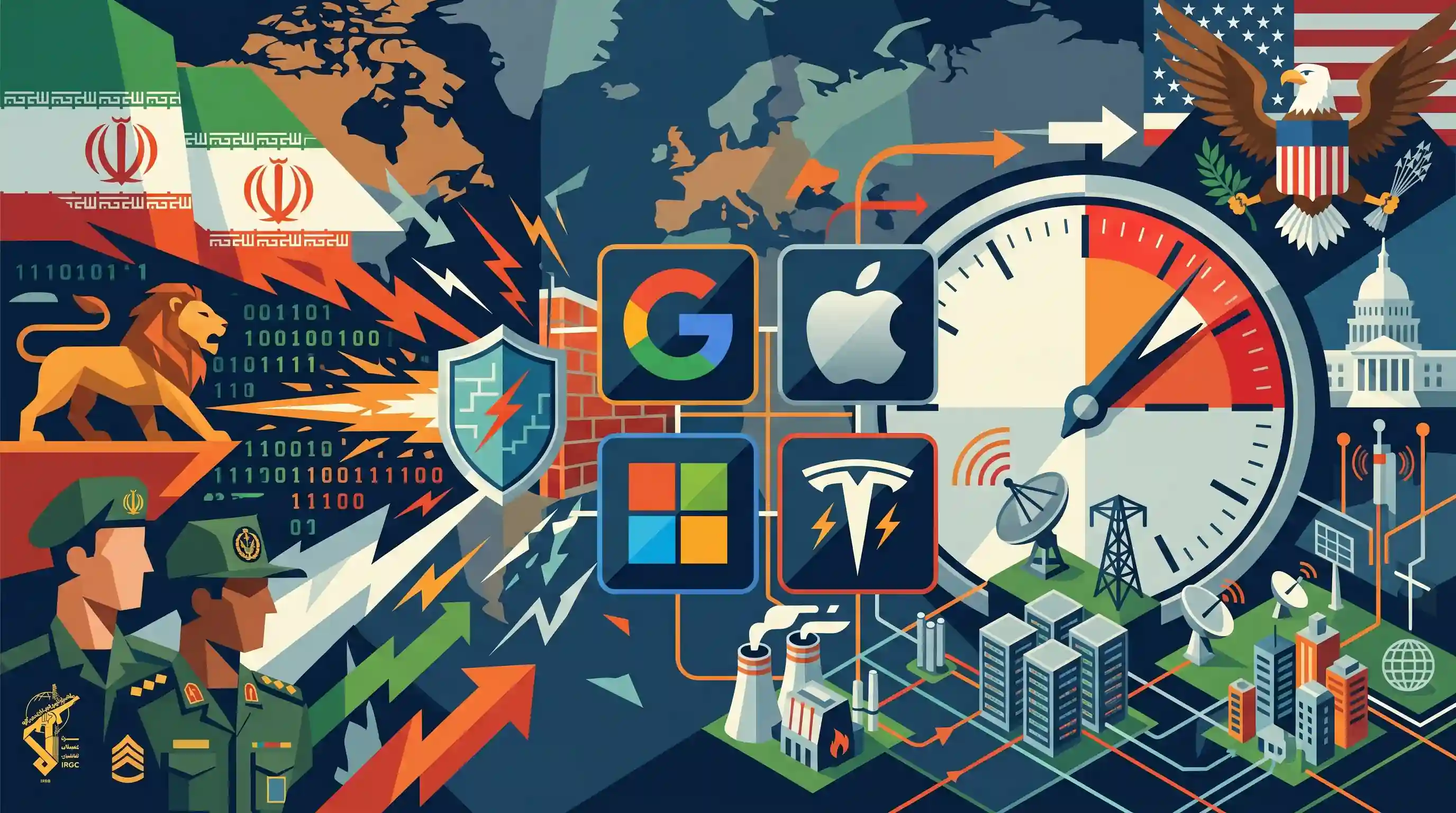
The Islamic Revolutionary Guard Corps (IRGC) of Iran has issued a retaliatory threat against major US technology companies, specifically naming Google, Apple, Microsoft, and Tesla, and imposing an April 1 deadline. This aggressive posture highlights the escalating risk of state-sponsored cyber warfare and points to the increasing vulnerability of private critical infrastructure to international geopolitical disputes. It underscores the broader geopolitical friction between the US and Iran spilling over into the corporate technology sector.
Key Points
- Iran's IRGC has publicly threatened major US tech corporations—Google, Apple, Microsoft, and Tesla—with retaliation, setting an April 1 deadline.
- The threat represents a significant escalation in state-sponsored intimidation, targeting private critical technology infrastructure over geopolitical grievances.
- This development blurs the lines between traditional state conflicts (US-Iran tensions) and corporate cybersecurity, highlighting the vulnerability of multinational tech companies to state-backed actors.
Important Terms
Islamic Revolutionary Guard Corps (IRGC)

An elite branch of Iran’s military reporting to the Supreme Leader. It handles internal security, regional proxy operations, and strategic industries, and is designated a Foreign Terrorist Organization by the US.
UPSC context
GS Paper II/III: Regional security, state-sponsored terrorism, and India-Middle East relations. Tests understanding of non-traditional security threats.
State-sponsored Cyber Warfare
Digital attacks conducted by a nation-state to disrupt or damage another country's computers, networks, or essential services for strategic, political, or military advantage.
UPSC context
GS Paper III: Internal Security and Cyber Security. Tests knowledge of asymmetric threats and national defense strategies in the digital age.
Critical Information Infrastructure (CII)
Essential digital systems (power, finance, telecom) whose destruction would debilitate national security, economy, or public health. Major tech firms like Google and Microsoft increasingly provide this underlying infrastructure.
UPSC context
GS Paper III: Infrastructure and Security. Crucial for understanding the vulnerability of private-sector technology to geopolitical conflict.
Asymmetric Warfare
A conflict where participants' military power and tactics differ significantly. It often involves a state using proxies, cyberattacks, or unconventional methods to offset a more powerful opponent’s conventional strength.
UPSC context
GS Paper III: Internal Security. Tests awareness of how nations utilize non-conventional methods to project power.
US-Iran Relations
The complex, often hostile relationship between Washington and Tehran involving nuclear disputes, regional proxy wars, and economic sanctions, significantly impacting global energy and technology security.
UPSC context
GS Paper II: International Relations. Essential for understanding West Asian geopolitics and its impact on India's energy security and diaspora.
Geopolitics
The strategic study of political and economic influence based on geography. In technology, it refers to how control over data centers and AI resources dictates global power balances.
UPSC context
GS Paper II: International Relations. Tests the ability to link corporate interests with broader global power struggles.
Prelims Trap
Critical Information Infrastructure (CII) covers only government assets and is protected solely by CERT-In.
CII under the IT Act includes both public and private assets (like banks/telecom). The nodal agency for CII is NCIIPC (under NTRO), not CERT-In.
Static Concepts Connected
What defines Critical Information Infrastructure (CII) and who protects it in India?
- Legal basis: CII is legally defined under Section 70 of the Information Technology Act, 2000.
- Nodal agency: Protected by the National Critical Information Infrastructure Protection Centre (NCIIPC), an agency operating under NTRO.
- Broad scope: Encompasses public and private assets (e.g., telecom, banking) where incapacitation threatens national security or the economy.
What characterizes Advanced Persistent Threats (APTs) in state cyber warfare?
- Stealthy presence: Attackers establish a long-term, undetected presence within a network to steal data or disrupt systems over months or years.
- State-backed actors: Typically orchestrated by nation-states (e.g., Iran's IRGC) given the exceptionally high resource and skill requirements.
- Target profile: Focuses on high-value targets like multinational tech corporations, defense contractors, and national critical infrastructure.
Cross-Topic Patterns
Weaponization of Big Tech infrastructure
Private entities like Google or Starlink are increasingly treated as geopolitical targets by rival nations because their proprietary platforms function as foundational global infrastructure.
The Stuxnet Legacy & Shadow Warfare
The 2010 US-Israeli Stuxnet attack on Iranian nuclear facilities normalized cyber-kinetic warfare. Iran’s current threats represent the evolution of this cross-border cyber-retaliation.

Expect a 2026 GS3 question testing the legal distinction between NCIIPC (critical infrastructure) and CERT-In (incident response).
Linked PYQs · 5
Linked PYQs · 5
- 2021MainsGS3
Keeping in view India's internal security, analyse the impact of cross-border cyber attacks. Also discuss defensive measures against these sophisticated attacks.
- 2017MainsGS3
Discuss the potential threats of Cyber attack and the security framework to prevent it.
- 2020MainsGS3
Discuss different types of cyber crimes and measures required to be taken to fight the menace.
- 2018PrelimsGS1
The terms 'WannaCry, Petya and EternalBlue' sometimes mentioned in the news recently are related to
- 2025MainsGS2
"Energy security constitutes the dominant kingpin of India's foreign policy, and is linked with India's overarching influence in Middle Eastern countries.” How would you integrate energy security with India's foreign policy trajectories in the coming years?
