Internet Shutdowns and Anti-Regime Unrest in Islamic Republic of Iran
Source:The Hindu ↗
Why It Matters
The ongoing unrest in Iran has significant implications for Middle Eastern stability, global energy markets, and US-Iran relations. It also raises crucial questions about digital rights, internet shutdowns as a tool for state censorship, and human rights violations, which are relevant to GS-2 (IR) and GS-3 (Security/Cyber issues).
Summary
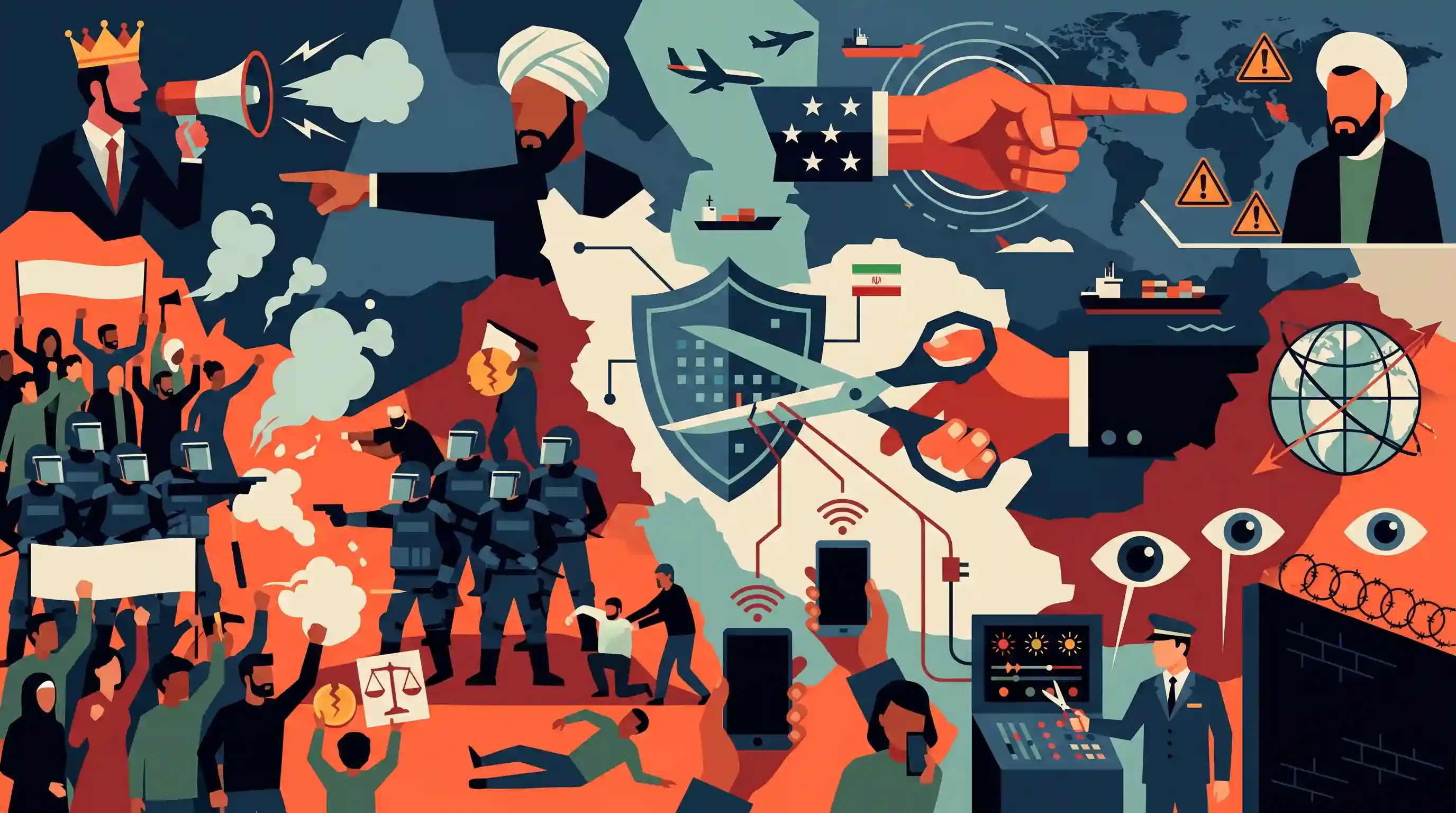
Iran faced widespread protests and a severe internet blackout after exiled Crown Prince Reza Pahlavi called for demonstrations against the Islamic Republic. Sparked by economic hardships, the protests have led to violent crackdowns by Iranian security forces, resulting in numerous casualties and arrests. The US has issued strong warnings against the Iranian government, further escalating tensions in the region. The use of internet shutdowns highlights the regime's efforts to suppress digital communication and control the narrative amidst growing domestic unrest.
Key Points
- Iran experienced a near-total internet blackout amid widespread protests coinciding with 'Iran Day', a demonstration called by exiled Crown Prince Reza Pahlavi.
- The protests are primarily driven by severe economic deterioration and widespread dissatisfaction with the Islamic Republic, leading to calls for its overthrow.
- US President Donald Trump issued a stern warning against the Iranian regime, threatening severe consequences if protesters are killed or US interests are harmed.
- The Human Rights Activists News Agency (HRANA) reports at least 39 deaths and over 2,260 arrests since the unrest began, with the Revolutionary Guard and Basij forces deployed to suppress the demonstrations.
- Internet monitoring groups like Cloudflare and NetBlocks confirmed significant national connectivity drops, a tactic frequently used by authoritarian regimes to stifle communication and organization among dissidents.
Important Terms
Islamic Revolutionary Guard Corps (IRGC)

A primary branch of Iran's Armed Forces, independent of the regular army, established to protect the Islamic Republic. It wields extensive military, political, and economic influence domestically and regionally.
UPSC context
GS Paper II: International Relations. Essential for West Asian geopolitics, India-Iran strategic ties, and maritime security in the Persian Gulf.
Basij
A paramilitary volunteer militia under the IRGC. It acts as an auxiliary force for internal security, morality policing, and the suppression of domestic dissent through a vast network of local cells.
UPSC context
GS Paper II: International Relations/Human Rights. Relevant for studying state-sponsored security apparatuses and civil liberties in the Middle East.
NetBlocks
A global watchdog and internet observatory that monitors network connectivity, internet shutdowns, and cyber-attacks in real-time to defend digital rights and promote transparency.
UPSC context
GS Paper II: Governance/Digital Rights. Vital for discussions on freedom of speech, digital authoritarianism, and the socio-economic impacts of internet blackouts.
Human Rights Activists News Agency (HRANA)
The press association of the 'Human Rights Activists in Iran' NGO. It reports on human rights violations, legal abuses, and casualties within Iran to the international community.
UPSC context
GS Paper II: Human Rights. Illustrates the role of non-state actors and independent media in monitoring international humanitarian standards.
Cloudflare
An American web-infrastructure and cybersecurity company providing DDoS protection and content delivery services. It is critical for maintaining website accessibility and security during periods of digital unrest.
UPSC context
GS Paper III: Cybersecurity. Important for understanding global digital infrastructure resilience and the technical aspects of internet censorship evasion.
Prelims Trap
"The Right to Internet access is explicitly recognized as a separate Fundamental Right under Article 21 of the Constitution."
In the Anuradha Bhasin case (2020), the SC ruled freedom of speech/trade via the internet is protected under Article 19, but did not declare internet access itself an absolute, distinct fundamental right.
Static Concepts Connected
How are internet shutdowns legally authorized in India?
- Legal Framework: Authorized under the Temporary Suspension of Telecom Services (Public Emergency or Public Safety) Rules, 2017, formulated under the Indian Telegraph Act, 1885.
- Competent Authority: Suspension orders can generally only be issued by the Secretary to the Ministry of Home Affairs (Union) or the Home Department (State).
- Review Mechanism: A statutory Review Committee must assess the order's proportionality, necessity, and legality within 5 working days of its issuance.
What are India's primary geo-strategic stakes in Iran?
- Chabahar Port: Provides India a crucial maritime-to-land transit route to access Afghanistan and resource-rich Central Asia, effectively bypassing hostile Pakistani territory.
- INSTC: Iran is a vital node in this multi-modal freight network connecting India to Russia and Europe, significantly reducing cargo transport time compared to the Suez Canal.
Cross-Topic Patterns
Digital rights vs internal security
Iran's "kill switch" mirrors global state surveillance debates. For UPSC, compare authoritarian blackout tactics with India's legal debates over proportional internet suspensions in internal conflict zones like Manipur or Kashmir.
Regime instability and geo-economics
Domestic unrest in Iran risks attracting harsher US sanctions. This directly jeopardizes India's strategic connectivity ambitions, specifically stalling operational progress on the INSTC and the Chabahar port.

Expect a multi-statement Prelims question on the 2017 Telecom Suspension Rules, or a Mains prompt linking Iranian instability to INSTC.
Linked PYQs · 3
Linked PYQs · 3
- 2018MainsGS2
In what ways would the ongoing US-Iran Nuclear Pact Controversy affect the national interest of India? How should India respond to this situation?
- 2016MainsGS3
Use of Internet and social media by non-state actors for subversive activities is a major security concern. How have these been misused in the recent past? Suggest effective guidelines to curb the above threat.
- 2024MainsGS3
Social media and encrypting messaging services pose a serious security challenge. What measures have been adopted at various levels to address the security implications of social media? Also suggest any other remedies to address the problem.
