IAEA Reports Increase in Iran Uranium Stockpile Prior to Strike
Source:The Hindu ↗
Why It Matters
Iran's continued accumulation of near-weapons-grade uranium, combined with the suspension of IAEA oversight, triggers a critical nuclear proliferation crisis. For India, instability in the Middle East directly threatens energy security, diaspora safety, and trade routes. Understanding the mandate and limitations of the IAEA is vital for topics covering international organizations and global nuclear diplomacy.
Summary
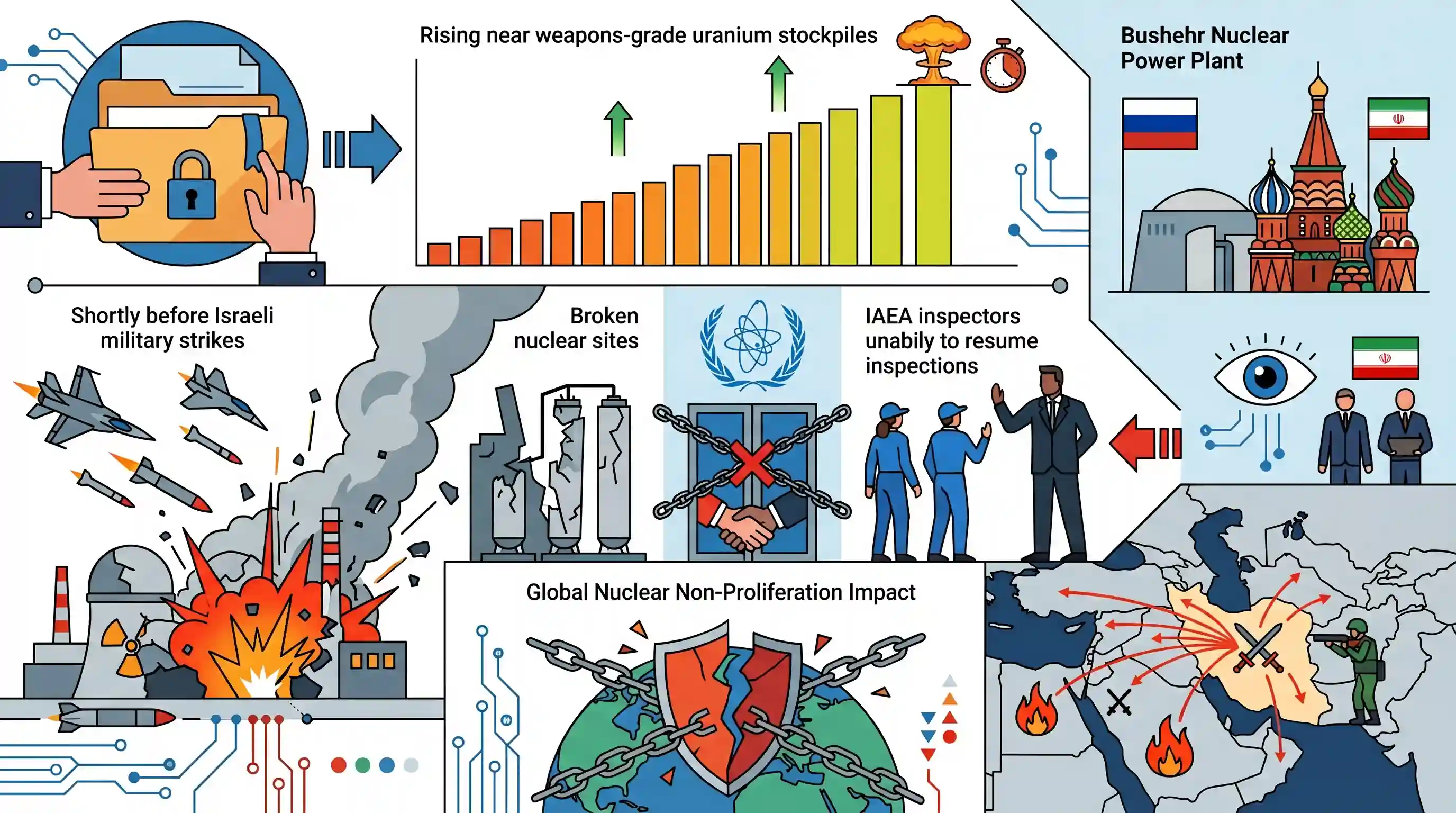
A confidential International Atomic Energy Agency (IAEA) report indicates that Iran increased its stockpile of near weapons-grade uranium (60% enriched) to 440.9 kg shortly before Israeli military strikes on June 13. This enrichment level is perilously close to the 90% threshold required to build a nuclear weapon. Additionally, the IAEA has been unable to reach an agreement with Iran to resume vital inspections at nuclear sites damaged by the conflict. Currently, international oversight is restricted to the Russian-assisted Bushehr Nuclear Power Plant, severely undermining global non-proliferation efforts and escalating Middle Eastern geopolitical tensions.
Key Points
- Prior to June 13 Israeli military strikes, Iran's stockpile of uranium enriched up to 60% reached 440.9 kilograms.
- Uranium enriched to 60% is only a short, technical step away from the 90% enrichment level required for nuclear weapons.
- The IAEA and Iran have failed to agree on a framework to resume inspections at nuclear facilities affected by the recent bombings.
- The Bushehr Nuclear Power Plant, which operates with Russian assistance, remains the only Iranian nuclear site inspected by the IAEA since the escalation.
Important Terms
International Atomic Energy Agency (IAEA)

An autonomous 1957 organization reporting to the UN, acting as the global nuclear watchdog to promote peaceful nuclear energy and verify non-proliferation compliance.
UPSC context
GS Paper 2: Important International Institutions. Tests knowledge of global safeguards and nuclear energy oversight.
Nuclear Non-Proliferation Treaty (NPT)
A landmark 1968 treaty aimed at preventing the spread of nuclear weapons, promoting peaceful nuclear use, and furthering disarmament; India is a notable non-signatory.
UPSC context
GS Paper 2: International Treaties. Essential for understanding global security frameworks and India's nuclear stance.
Weapons-Grade Uranium
Uranium enriched to approximately 90% U-235 concentration, the purity level required to sustain the rapid chain reaction necessary for a nuclear explosive device.
UPSC context
GS Paper 3: Science & Technology. Distinguishes between civilian energy needs and military weaponization thresholds.
Joint Comprehensive Plan of Action (JCPOA)
The 2015 'Iran Nuclear Deal' between Iran and world powers (P5+1) that restricted Iran’s enrichment activities in exchange for lifting international economic sanctions.
UPSC context
GS Paper 2: Bilateral/Multilateral Agreements. Key for Middle East geopolitics and India's strategic connectivity projects (e.g., Chabahar).
Bushehr Nuclear Power Plant
Iran's first and only operational civilian nuclear power plant, built with Russian assistance for electricity generation and currently under limited IAEA monitoring.
UPSC context
GS Paper 2: International Relations. Represents the intersection of civilian energy needs and regional security tensions.
Highly Enriched Uranium (HEU)
Uranium with a 20% or higher concentration of fissile U-235; enrichment to 60% (as seen in Iran) is a critical step toward weapons-grade status.
UPSC context
GS Paper 3: Security. Tests understanding of 'breakout time' and the dual-use nature of nuclear technology.
Prelims Trap
"By signing the Additional Protocol, all of India's nuclear reactors were placed under the mandatory safeguards of the IAEA."
India maintains a separation between civilian and military facilities. Only civilian reactors using imported uranium are under IAEA safeguards; strategic domestic-fueled reactors are exempt.
Static Concepts Connected
What are the different grades of uranium enrichment based on U-235 concentration?
- Natural Uranium: Mined uranium contains only about 0.7% of the fissile U-235 isotope, requiring specific heavy water reactors if used directly.
- Low-Enriched Uranium (LEU): Enriched to 3-5% U-235, this is typically required for standard commercial civilian nuclear power reactors.
- Weapons-Grade Uranium: Enriched to 90% or higher U-235. While 60% (HEU) is highly dangerous, 90%+ is the standard for constructing nuclear warheads.
How do IAEA safeguards apply to India's nuclear program?
- Separation Plan: Under the Indo-US nuclear deal, India explicitly separates its civilian nuclear facilities from its strategic/military programs.
- Imported Fuel Rule: Civilian reactors utilizing imported uranium are strictly placed under IAEA monitoring and safeguards.
- Strategic Autonomy: Reactors fueled by domestic uranium for military or strategic purposes remain entirely outside IAEA purview, preserving sovereign security.
Cross-Topic Patterns
IAEA safeguards + India's NSG bid
Iran’s compliance failures contrast with India’s strict adherence to the Additional Protocol, reinforcing India’s "responsible nuclear state" argument for Nuclear Suppliers Group (NSG) membership despite being a non-NPT signatory.
Persian Gulf geography + Energy security
Bushehr nuclear plant's location on the Persian Gulf links nuclear proliferation risks directly to the Strait of Hormuz, threatening global maritime oil transit if regional conflict expands.

Expect a multi-statement Prelims question contrasting uranium enrichment thresholds (LEU vs Weapons-grade) with India's IAEA safeguard rules.
Linked PYQs · 3
Linked PYQs · 3
- 2018PrelimsGS1
In the Indian context, what is the implication of ratifying the 'Additional Protocol' with the 'International Atomic Energy Agency (IAEA)'?
- 2020PrelimsGS1
In India, why are some nuclear reactors kept under "IAEA Safeguards" while others are not?
- 2018MainsGS2
In what ways would the ongoing US-Iran Nuclear Pact Controversy affect the national interest of India? How should India respond to this situation?
