State sponsored cyber attacks and disruption of diplomatic talks
Source:Indian Express ↗
Why It Matters
For UPSC aspirants, this illustrates the tangible impact of cyber warfare on international relations and diplomacy. The weaponization of cyberspace by state and non-state actors is a crucial component of modern internal and global security (GS-3 Cyber Security, GS-2 International Relations).
Summary
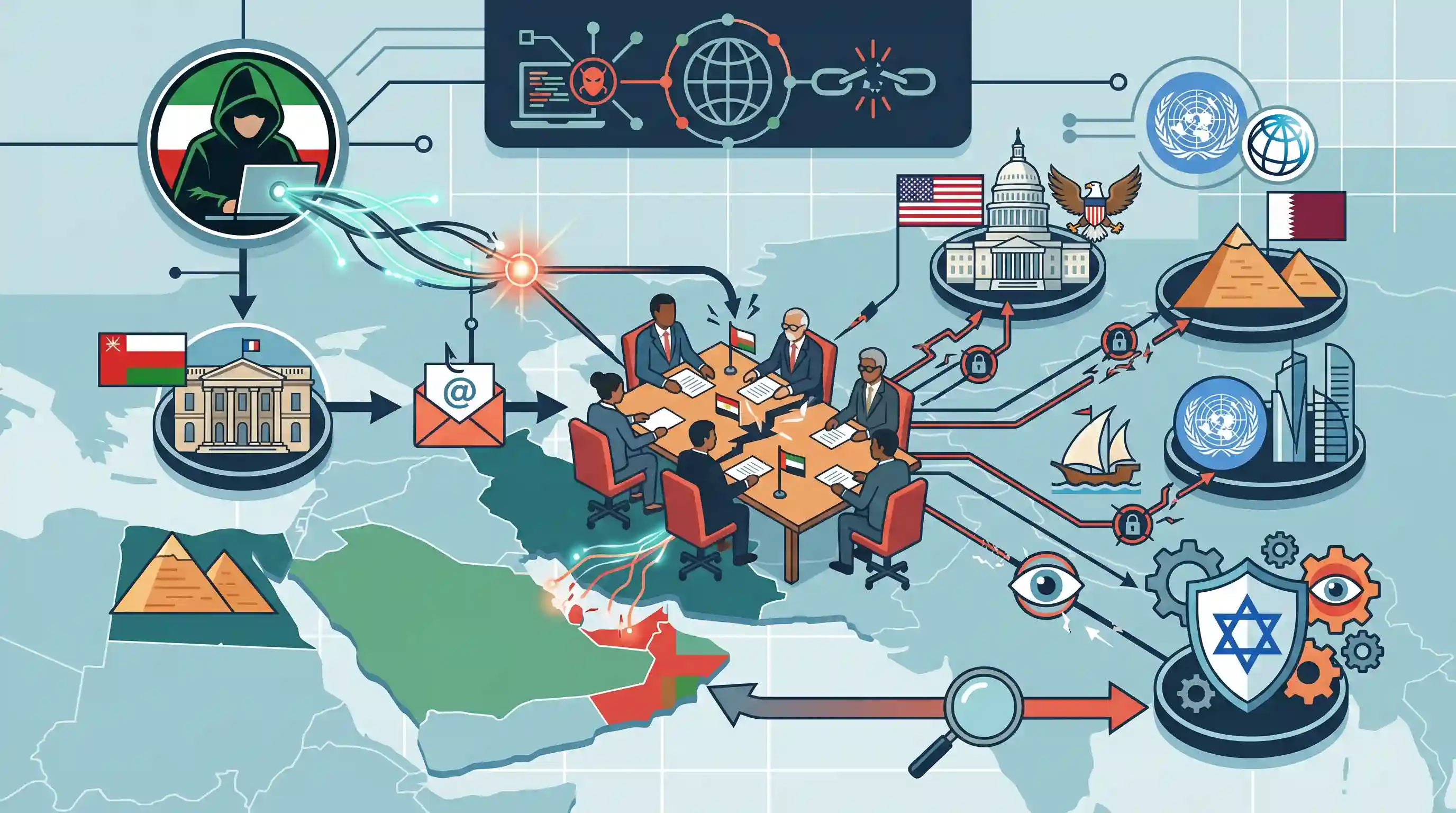
An Israeli cybersecurity firm has revealed that Iranian state-sponsored hackers orchestrated a targeted spear-phishing campaign to sabotage the Gaza ceasefire negotiations. Utilizing a compromised email address from the Omani embassy in Paris, the hacking group 'Homeland Justice' deployed malware to infiltrate the diplomatic networks of Egyptian, US, and Qatari officials, as well as multiple international organizations like the UN and the World Bank. The attack highlights a dangerous intersection of cyber espionage and geopolitics, where state-backed threat actors employ advanced cyber warfare tactics to actively disrupt sensitive international diplomatic efforts.
Key Points
- An Iranian state-backed hacking group, 'Homeland Justice', targeted diplomatic networks in the Middle East to disrupt Gaza ceasefire negotiations.
- The threat actors used spear-phishing techniques, masquerading as the Omani Ministry of Foreign Affairs via a compromised embassy email account in Paris.
- Malicious payloads embedded in Word documents targeted top officials from Egypt, the US, Qatar, and 10 major international organizations including the UN and World Bank.
- This cyberattack highlights the evolving nature of cyber warfare, where cybercriminals systematically use malware and phishing to directly interfere with high-stakes international diplomacy.
Important Terms
Gaza ceasefire deal

A proposed diplomatic agreement intended to halt hostilities between Israel and Hamas, involving hostage releases, the delivery of humanitarian aid, and a framework for regional stability.
UPSC context
GS Paper II (International Relations): Crucial for understanding West Asian geopolitics, mediation roles (US, Qatar, Egypt), and India's regional interests.
Homeland Justice
An Iranian state-sponsored hacking group (linked to the Ministry of Intelligence) known for cyber-espionage and sabotage against diplomatic, governmental, and international organizational targets.
UPSC context
GS Paper III (Cyber Security): Illustrates state-sponsored cyber warfare and its use as a tool for diplomatic sabotage.
Dream (Cybersecurity firm)
An Israeli cybersecurity firm specializing in AI-driven national defense; it identified the Iranian cyberattack targeting the Gaza ceasefire negotiations.
UPSC context
GS Paper III (Internal Security): Highlights the role of private-sector technological intelligence in identifying global security threats.
Hamas
A Palestinian Sunni-Islamic militant and political organization that governs the Gaza Strip; a primary party in the conflict and negotiations with Israel.
UPSC context
GS Paper II (International Relations): Key non-state actor in the West Asian conflict and regional security dynamics.
Spear-phishing
A highly targeted cyberattack method using personalized deceptive communications (often via hijacked official emails) to trick individuals into installing malware or revealing credentials.
UPSC context
GS Paper III (Cyber Security): A fundamental technical term for methods used in modern cyber warfare and data breaches.
United Nations (UN)
A global intergovernmental organization founded to maintain international peace and security; its diplomatic networks were specifically targeted in the reported cyber-espionage campaign.
UPSC context
GS Paper II (International Institutions): Tests knowledge of multilateral bodies and their vulnerability to digital interference.
World Bank
An international financial institution providing development loans; identified as one of the major international organizations targeted in the Iranian hacking campaign.
UPSC context
GS Paper II/III: Multilateral institutions and global financial governance.
UNICEF
A United Nations agency providing humanitarian aid to children; its diplomatic infrastructure was compromised to sabotage mediation and aid efforts in Gaza.
UPSC context
GS Paper II (International Relations): Role of international agencies in conflict management and humanitarian intervention.
Prelims Trap
"'Homeland Justice' is a Palestinian cyber-militia group targeting Israel."
Aspirants often guess origins based on geographic context. Homeland Justice is an Iranian state-sponsored APT group, not an indigenous Palestinian resistance militia.
Static Concepts Connected
What distinguishes Phishing, Spear-Phishing, and Whaling?
- Phishing (Mass): Broad, untargeted malicious emails sent to thousands of users simultaneously to blindly steal credentials.
- Spear-Phishing (Targeted): Customized, highly targeted emails aimed at a specific individual or organization, often using prior reconnaissance to build trust (e.g., spoofing an embassy).
- Whaling (High-Profile): A specialized form of spear-phishing aimed exclusively at high-profile targets like senior diplomats, CEOs, or top government officials.
Why is Oman often termed the 'Switzerland of West Asia'?
- Non-interference Policy: Oman strictly maintains neutrality and avoids taking sides in regional conflicts, such as the Saudi-Iran rivalry or the Yemen civil war.
- Backchannel Diplomacy: It regularly hosts secret negotiations and acts as a trusted backchannel, historically facilitating the preliminaries for the 2015 Iran Nuclear Deal (JCPOA).
- Strategic Geography: Sharing control of the critical Strait of Hormuz with Iran, Oman is geopolitically compelled to maintain pragmatic, balancing ties with all regional actors.
Cross-Topic Patterns
Cyber espionage as State Policy
Iran’s 'Homeland Justice', Russia’s 'Fancy Bear', and North Korea's 'Lazarus' illustrate the shift from non-state hacktivism to state-sponsored Advanced Persistent Threats (APTs) in geopolitics.
The 'Mediator State' Vulnerability
Neutral mediators like Oman and Qatar rely heavily on diplomatic trust, making their networks prime targets for spoofing by adversaries seeking to derail peace processes.

Expect a Prelims 'match the following' on state-sponsored APTs (e.g. Homeland Justice/Iran) or a Mains question on cyber-diplomacy risks.
Linked PYQs · 4
Linked PYQs · 4
- 2020MainsGS3
Discuss different types of cyber crimes and measures required to be taken to fight the menace.
- 2021MainsGS3
Keeping in view India's internal security, analyse the impact of cross-border cyber attacks. Also discuss defensive measures against these sophisticated attacks.
- 2017MainsGS3
Discuss the potential threats of Cyber attack and the security framework to prevent it.
- 2016MainsGS3
Use of Internet and social media by non-state actors for subversive activities is a major security concern. How have these been misused in the recent past? Suggest effective guidelines to curb the above threat.
