Strait of Hormuz Closure and Geopolitical Energy Security Risks
Source:The Hindu ↗
આ શા માટે મહત્વનું છે
The simultaneous threats to the Strait of Hormuz and the Red Sea pose critical risks to global energy security and supply chains, heavily impacting India's oil imports and trade. Furthermore, the new Saudi-Turkiye-Pakistan defence pact alters the balance of power in West Asia, requiring recalibration of India's strategic and diplomatic engagement in the region.
સારાંશ
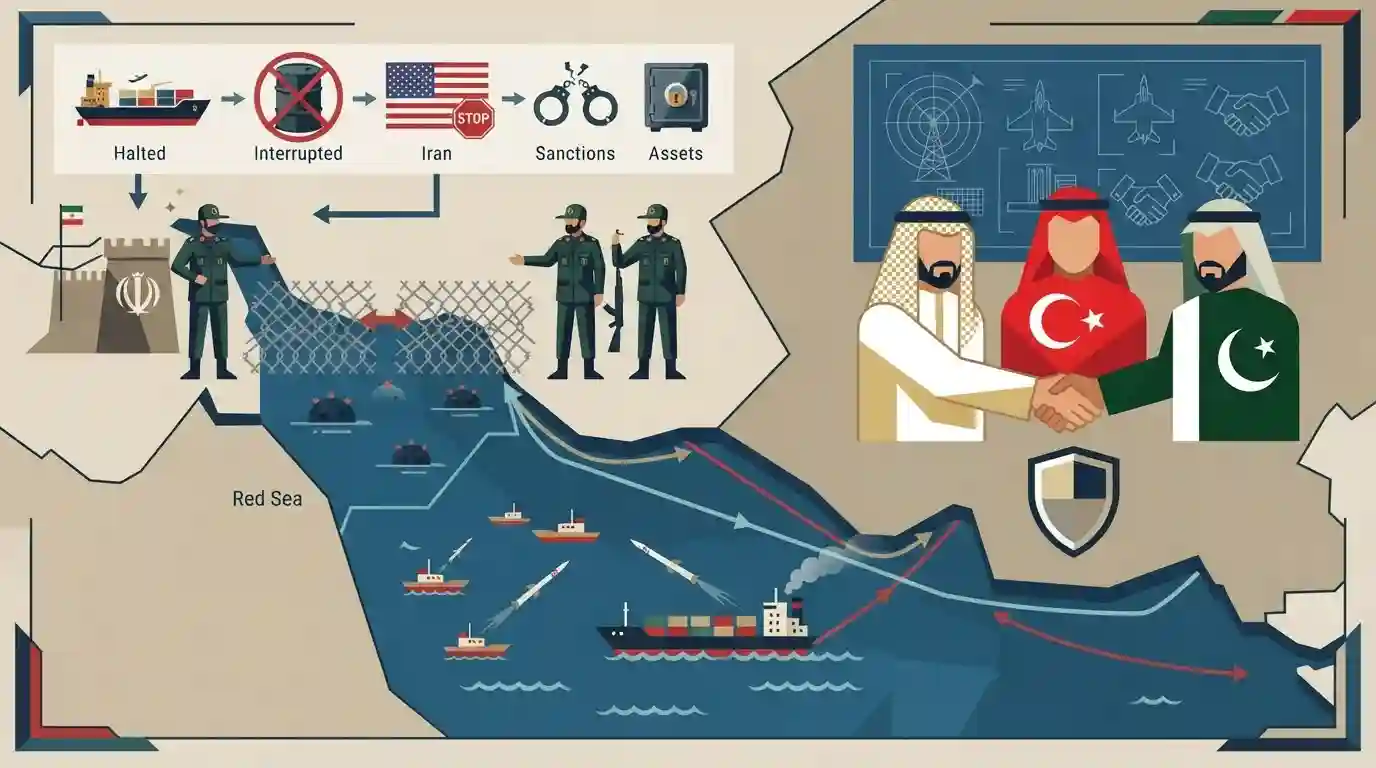
Iran's Revolutionary Guards have conditioned the reopening of the vital Strait of Hormuz on the U.S. halting hostilities in the Middle East, lifting sanctions, and releasing frozen assets. This move, coupled with ongoing Houthi attacks in the Red Sea, severely disrupts global maritime trade and energy supplies. Amidst these rising geopolitical tensions, Saudi Arabia has forged a new joint defence pact with Turkiye and Pakistan, signaling a major strategic realignment in West Asia.
મુખ્ય મુદ્દા
- Iran's Revolutionary Guards have stated they will not reopen the Strait of Hormuz until the U.S. meets demands, including ending conflicts in Lebanon, Palestine, Yemen, and Iraq, lifting sanctions, and unfreezing assets.
- Maritime traffic through the Strait of Hormuz has plummeted following attacks, with the UKMTO reporting a vessel being hit by an uncrewed system.
- The Strait of Hormuz blockade parallels the ongoing Red Sea blockade by Houthi rebels, who recently struck a Saudi oil facility.
- Amidst the escalating regional crisis, Saudi Arabia, Turkiye, and Pakistan have signed a joint defence agreement featuring a NATO-style mutual defence clause.
મહત્વપૂર્ણ શબ્દો
Mecca Joint Defence Agreement

A trilateral mutual defense pact signed in August 2026 by Saudi Arabia, Turkiye, and Pakistan, establishing a collective defense arrangement where an attack on one is considered an attack on all.
UPSC context
GS Paper II (International Relations). Tests understanding of regional security architectures, West Asian geopolitics, and emerging strategic alignments.
Islamic Revolutionary Guard Corps (IRGC)
An elite branch of the Iranian Armed Forces established in 1979, responsible for national security, asymmetric warfare, and controlling key strategic chokepoints like the Strait of Hormuz.
UPSC context
GS Paper II (Bilateral & Regional Relations). Tests knowledge of West Asian geopolitics, state-sponsored security threats, and energy security.
United Kingdom Maritime Trade Operations (UKMTO)
A Royal Navy-administered information sharing and maritime liaison cell that acts as the primary contact point for commercial shipping to report security incidents in high-risk Middle Eastern and Indian Ocean waters.
UPSC context
GS Paper III (Security & Maritime Challenges). Tests awareness of international naval cooperation, freedom of navigation, and maritime trade security.
Houthis
An Iran-backed Zaidi Shia political and military group in Yemen that controls territory and actively targets commercial and naval vessels in the Red Sea, impacting global trade chokepoints.
UPSC context
GS Paper II (Bilateral & Regional Relations). Tests knowledge of West Asian conflicts, proxy warfare, and threats to maritime security.
પ્રિલિમ્સ ટ્રેપ
The Strait of Hormuz connects the Red Sea to the Gulf of Aden, serving as a critical chokepoint.
This describes the Bab el-Mandeb Strait. The Strait of Hormuz connects the Persian Gulf to the Gulf of Oman/Arabian Sea.
સંલગ્ન સ્થિર ખ્યાલો
What are the primary maritime chokepoints in West Asia?
- Strait of Hormuz: Connects the Persian Gulf to the Gulf of Oman and the Arabian Sea.
- Bab el-Mandeb: Connects the Red Sea to the Gulf of Aden and the Indian Ocean.
- Suez Canal: Artificial sea-level waterway in Egypt connecting the Mediterranean Sea to the Red Sea.
How does India secure its energy supply against maritime disruptions?
- Naval Escorts: Operations like 'Sankalp' and 'Urja Suraksha' deploy Indian Navy warships to escort and protect Indian-flagged merchant vessels.
- Strategic Reserves (SPR): Underground rock caverns managed by ISPRL at Mangaluru, Padur, and Visakhapatnam provide emergency crude oil stockpiles.
- Import Diversification: Reducing over-dependence on the Middle East by increasing crude imports from Russia, the US, and Latin America.
આંતર-વિષય પેટર્ન
Hormuz blockade & Imported Inflation
Disruption of 20% of global daily petroleum transit directly spikes crude prices, widening India's Current Account Deficit (CAD) and fueling imported inflation.
Saudi-Turkiye-Pakistan Pact & Geopolitics
This "Mecca Pact" pools Saudi capital, Turkish drone tech, and Pakistan's nuclear capability, signaling a major non-Western security realignment in the Islamic world.

Map-based questions linking Hormuz/Bab-el-Mandeb to India's naval operations (Sankalp/Urja Suraksha) are highly probable in 2026.
સંલગ્ન PYQ · 3
સંલગ્ન PYQ · 3
- 2026PrelimsGS1
Ships from which of the following countries have to cross the Strait of Hormuz to reach out to the Indian Ocean ? 1. Bahrain 2. Syria 3. Qatar 4. Egypt Select the answer using the code given below :
- 2025MainsGS2
"Energy security constitutes the dominant kingpin of India's foreign policy, and is linked with India's overarching influence in Middle Eastern countries.” How would you integrate energy security with India's foreign policy trajectories in the coming years?
- 2024PrelimsGS1
Consider the following statements : Statement-I : Sumed pipeline is a strategic route for Persian Gulf oil and natural gas shipments to Europe. Statement-II : Sumed pipeline connects the Red Sea with the Mediterranean Sea. Which one of the following is correct in respect of the above statements?
