IRGC Strikes Aluminium Plants in Bahrain and UAE Amid Regional War
Source:The Hindu ↗
Why It Matters
The targeting of critical economic assets in Gulf nations by state actors using drones and missiles exemplifies modern asymmetric warfare. For India, escalating tensions in West Asia directly jeopardize energy security, regional trade, and the safety of millions of Indian expatriates, making it a critical geopolitical issue for UPSC aspirants.
Summary
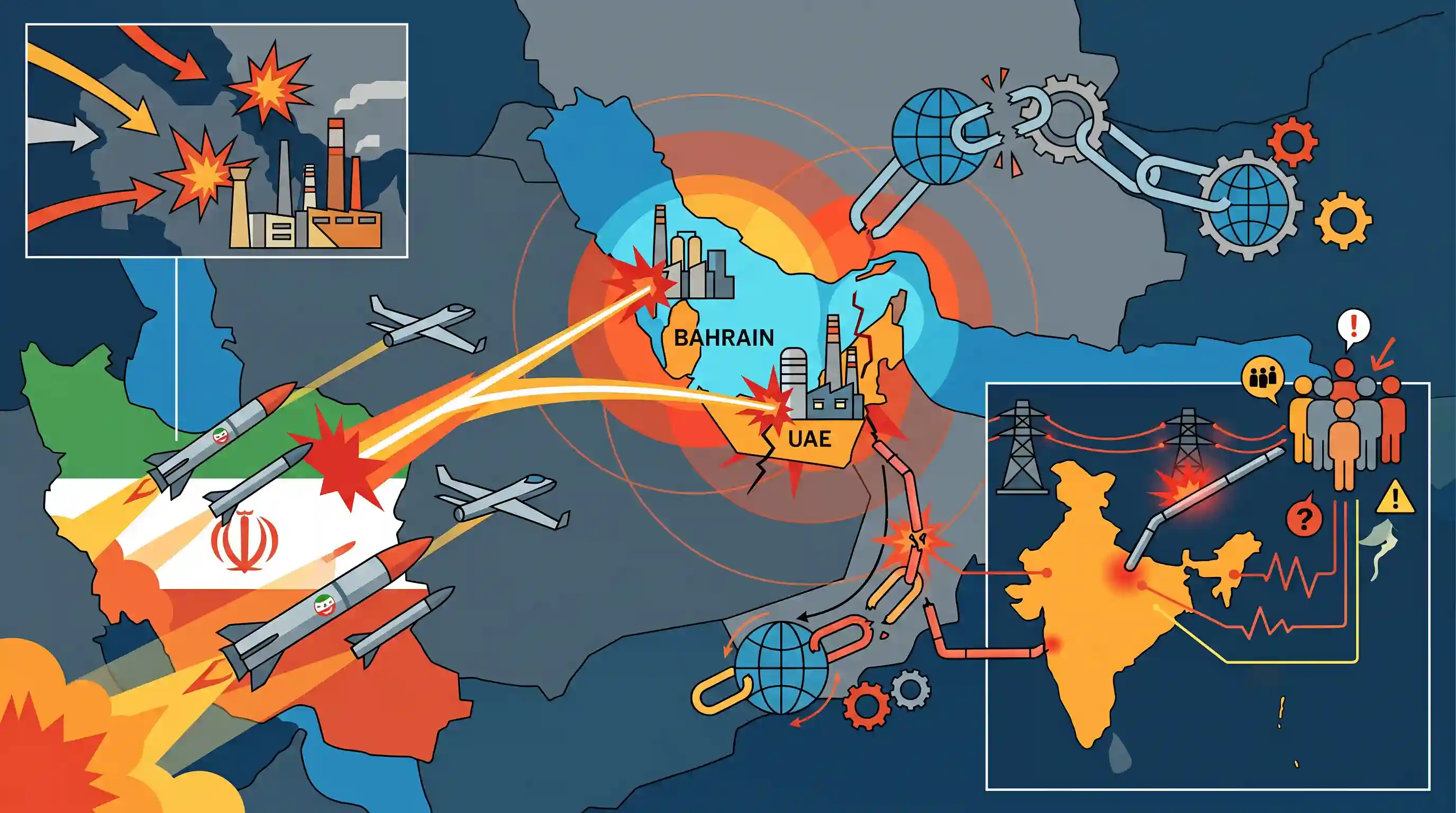
Iran's Islamic Revolutionary Guard Corps (IRGC) has claimed responsibility for missile and drone strikes targeting major aluminium plants in Bahrain and the UAE. Retaliating against recent U.S.-Israeli attacks on its own industrial and nuclear sites, Iran justified the strikes by asserting the targeted facilities are linked to the U.S. military and aerospace sectors. The deliberate targeting of critical economic infrastructure highlights a dangerous expansion of the West Asian conflict into the broader Gulf region. This escalation directly threatens regional stability, global supply chains, and has profound strategic implications for India's energy security and diaspora interests in the Middle East.
Key Points
- Iran's Revolutionary Guards (IRGC) launched missile and drone strikes on major aluminium plants in Bahrain (Alba) and the UAE (EGA), causing injuries and operational damage.
- Iran claimed the targeted aluminium facilities were connected to the U.S. military and aerospace sectors.
- The strikes were in retaliation for recent U.S.-Israeli attacks on Iranian steel and nuclear-related infrastructure, which Iran alleges were launched from bases in Gulf states.
- The attacks demonstrate a significant escalation in the ongoing West Asia conflict, with critical economic and industrial infrastructure becoming primary targets in asymmetric warfare.
- This regional instability poses severe risks to global supply chains, as well as India's energy security, trade interests, and the safety of its vast diaspora in the Gulf.
Important Terms
Islamic Revolutionary Guard Corps (IRGC)

Elite branch of Iran's armed forces reporting to the Supreme Leader, managing extraterritorial operations (Quds Force), missile programs, and significant domestic economic interests.
UPSC context
GS Paper II (International Relations) and GS Paper III (Security); tests knowledge of regional actors affecting West Asian stability.
Aluminium Bahrain (Alba)
Bahrain’s state-controlled aluminium producer, operating one of the world's largest single-site smelters; a major contributor to Bahrain’s GDP and a key trade partner for India.
UPSC context
GS Paper II (Bilateral Relations) and GS Paper III (Economy); concerns India's resource security and trade with West Asian partners.
Emirates Global Aluminium (EGA)
The UAE's largest industrial company outside oil and gas, formed by merging DUBAL and EMAL; it is a leading global producer of premium aluminium for aerospace and automotive sectors.
UPSC context
GS Paper II (International Relations) and GS Paper III (Economy); focuses on global supply chain disruptions and India-UAE strategic economic ties.
Critical Infrastructure
Physical or virtual assets (energy, transport, industry) so vital that their destruction would have a debilitating impact on a nation's security, economy, or public health.
UPSC context
GS Paper III (Security); specific syllabus topic regarding the management of challenges to vital national and regional assets.
West Asian Conflict
Geopolitical instability in the Middle East involving state and non-state actors; it significantly impacts India’s energy security, maritime trade routes, and the 9-million-strong Indian diaspora.
UPSC context
GS Paper II (International Relations); crucial for understanding "Effect of policies and politics of countries on India's interests."
Prelims Trap
The Middle East is a global aluminium hub due to its vast, naturally occurring bauxite reserves.
Middle Eastern nations import bauxite/alumina. Their competitive advantage is solely cheap natural gas (energy), as aluminium smelting is highly energy-intensive.
Static Concepts Connected
Why is the Middle East an aluminium smelting hub despite lacking bauxite?
- Energy Intensity: Aluminium smelting requires massive, continuous electricity. The Gulf's abundant and cheap natural gas provides a structural competitive edge.
- Coastal Logistics: Without domestic bauxite, Gulf nations import alumina via sea routes. Mega-smelters are strategically located on coasts to minimize logistical costs.
- Capital Availability: Sovereign wealth funds provide the massive upfront capital needed to build world-class smelter infrastructure and captive power plants.
What are the Abraham Accords and how do they impact regional security?
- Normalization Pacts: US-brokered 2020 agreements that normalized diplomatic and economic relations between Israel and select Arab nations.
- Key Signatories: The UAE and Bahrain were the original Gulf signatories (later joined by Morocco and Sudan). Saudi Arabia has not signed.
- Strategic Realignment: The pacts implicitly realigned the Gulf's security architecture against Iran, leading Tehran to view participating states as hosting hostile US/Israeli assets.
Cross-Topic Patterns
Gulf stability and Current Account Deficit
India relies on remittances from the 8M+ Gulf diaspora. Conflict-induced reverse migration and economic disruption directly threaten these inflows, pressuring India's Current Account Deficit (CAD).
Asymmetric warfare on critical infrastructure
The shift from military targets to economic chokepoints (smelters, refineries) mirrors Houthi attacks on Saudi Aramco, highlighting the growing use of cheap drones to paralyze heavy industry.

Abraham Accords signatories + Middle East aluminium location factors (energy vs ore) will likely form a geography/IR hybrid in 2026.
Linked PYQs · 3
Linked PYQs · 3
- 2025MainsGS2
"Energy security constitutes the dominant kingpin of India's foreign policy, and is linked with India's overarching influence in Middle Eastern countries.” How would you integrate energy security with India's foreign policy trajectories in the coming years?
- 2017MainsGS2
The question of India's Energy Security constitutes the most important part of India's economic progress. Analyze India's energy policy cooperation with West Asian countries.
- 2023MainsGS3
The use of unmanned aerial vehicles (UAVs) by our adversaries across the borders to ferry arms/ammunitions, drugs, etc., is a serious threat to the internal security. Comment on the measures being taken to tackle this threat.
