Iran rejects expanding upcoming US talks to cover missile program
Source:The Hindu ↗
Why It Matters
The trajectory of US-Iran relations directly impacts Middle Eastern stability, global energy security, and regional balance of power. For India, tensions in the Persian Gulf affect energy imports, diaspora safety, and strategic investments like the Chabahar port. Furthermore, Iran's ballistic missile advancements represent a critical case study in modern defence technology and proliferation challenges.
Summary
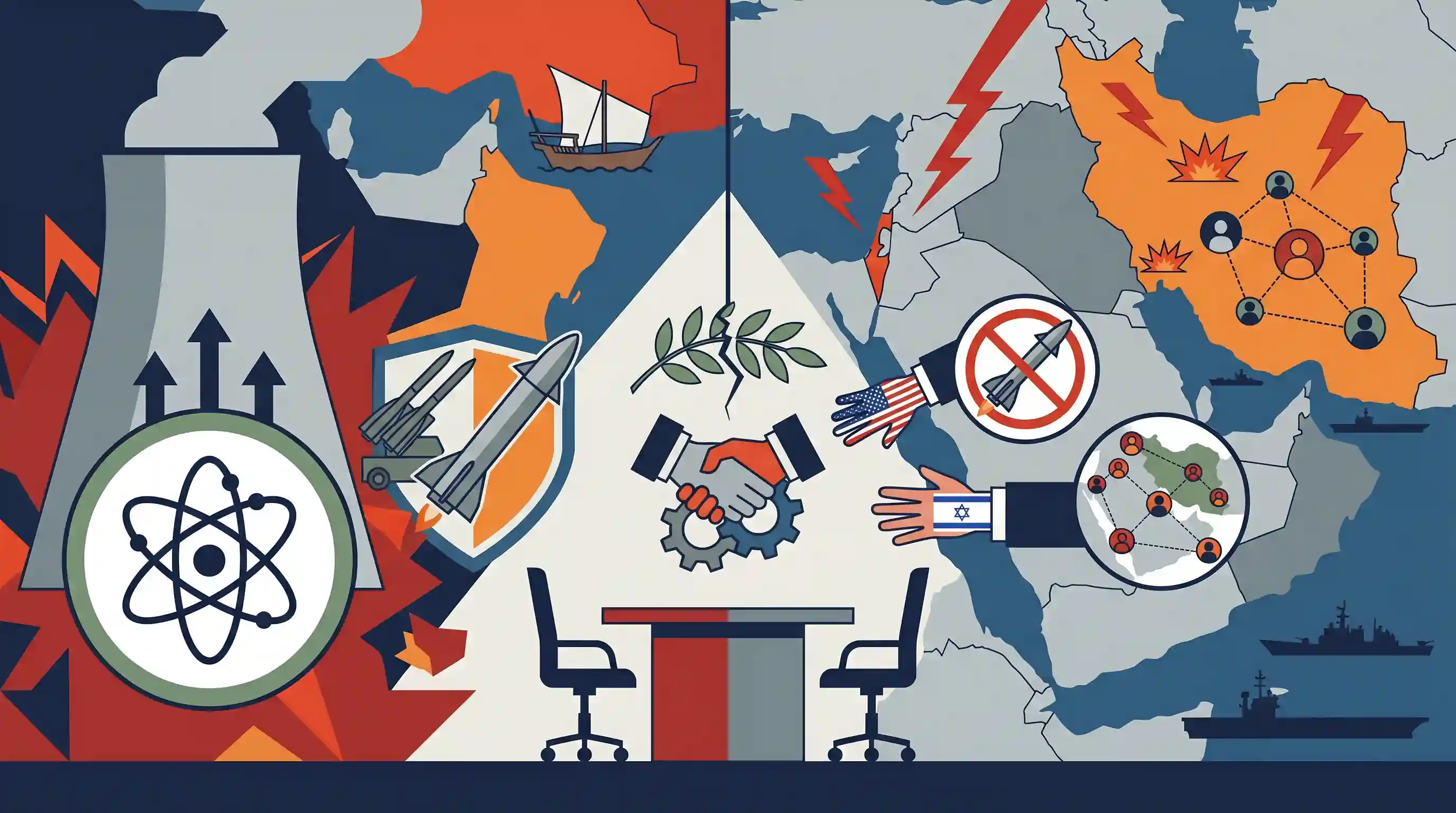
Iranian Foreign Minister Abbas Araghchi stated that a new round of talks with the United States is imminent, building on an earlier round held in Oman. While Iran aims to focus negotiations on resolving the nuclear standoff and asserting its "inalienable right" to uranium enrichment, the U.S.—backed by Israel—is pushing to expand the agenda to include Iran's ballistic missile capabilities and its backing of regional proxy groups. Araghchi firmly rejected any compromise on Iran's missile program, calling it a non-negotiable defense necessity. The diplomatic maneuvering comes amid heightened tensions in the Middle East, characterized by recent direct military exchanges between Israel and Iran and a robust U.S. military buildup in the region.
Key Points
- Iranian Foreign Minister Abbas Araghchi announced that a new round of indirect talks with the United States will take place "soon" following an initial round in Oman.
- The U.S. and Israel are pushing for negotiations to include Iran's ballistic missile program and its support for regional militant groups.
- Iran maintains that its uranium enrichment is an "inalienable right" and categorically refuses to negotiate over its ballistic missile program, classifying it as strictly defensive.
- Iran warned that any U.S. attacks on Iranian territory would result in retaliation against U.S. military bases in the region.
- The talks unfold against a backdrop of severe regional instability, including recent direct military confrontations between Israel and Iran, and the deployment of additional U.S. military assets to the Middle East.
Important Terms
Joint Comprehensive Plan of Action (JCPOA)

A 2015 landmark agreement between Iran and world powers (P5+1) to limit Iran's nuclear program in exchange for lifting economic sanctions.
UPSC context
GS II: International Relations. Tests knowledge of global agreements affecting India’s strategic interests, energy security, and regional connectivity.
Non-Proliferation Treaty (NPT)
A 1970 international treaty aiming to prevent nuclear weapon spread, promote peaceful nuclear energy, and achieve total disarmament.
UPSC context
GS II/III: International Relations & Security. Tests understanding of global disarmament regimes and India’s refusal to sign on "discriminatory" grounds.
Uranium Enrichment
The technological process of increasing the concentration of fissile Uranium-235, necessary for both civilian power (3-5%) and nuclear weapons (~90%).
UPSC context
GS III: Science & Technology. Relevant for questions on nuclear energy, dual-use technology, and the nuclear fuel cycle.
Ballistic Missiles
Rocket-propelled strategic weapons following a high-arching trajectory; Iran’s arsenal is a major sticking point in Western diplomatic negotiations.
UPSC context
GS III: Defense Technology & Security. Tests knowledge of regional military capabilities and strategic deterrence in West Asia.
Proxy Groups
Non-state armed actors (e.g., Hezbollah, Houthis) used by a nation to achieve strategic goals through asymmetric warfare rather than direct conflict.
UPSC context
GS III: Internal Security & Geopolitics. Tests understanding of regional instability and non-traditional security threats affecting global oil markets.
Breakout Time
The estimated time required for a state to produce enough weapons-grade fissile material for a single nuclear device.
UPSC context
GS II: International Relations. A technical metric central to evaluating the effectiveness of nuclear non-proliferation agreements.
Prelims Trap
"The 2015 JCPOA framework restricted both Iran's nuclear enrichment and its ballistic missile program."
The JCPOA strictly limited Iran's nuclear capabilities. It did not cover ballistic missiles or regional proxies, which is exactly why the US and Israel are demanding their inclusion in new talks.
Static Concepts Connected
How do ballistic missiles differ from cruise missiles?
- Flight trajectory: Ballistic missiles follow a parabolic, unpowered trajectory outside the atmosphere for most of their flight; cruise missiles are self-propelled and stay within the atmosphere.
- Guidance systems: Ballistic missiles are guided only during the initial boost phase; cruise missiles are guided continuously.
- Speed and interception: Ballistic missiles re-enter the atmosphere at hypersonic speeds; cruise missiles usually fly at subsonic or supersonic speeds.
What is the "inalienable right" to nuclear technology under the NPT?
- NPT Article IV: Under Article IV of the NPT, non-nuclear-weapon states have the right to develop nuclear energy for peaceful purposes.
- Enrichment thresholds: While peaceful enrichment is allowed, enriching Uranium-235 beyond low levels (typically 3-5% for power) raises severe proliferation concerns, as weapons-grade requires roughly 90%.
Cross-Topic Patterns
Oman's neutrality + India's maritime security
Oman’s strict non-alignment allows it to mediate US-Iran talks. For India, Oman is a crucial strategic partner providing access to the Duqm port, essential for Western Indian Ocean security.
Proxy warfare + Maritime chokepoints
Iran’s strategic use of proxies like the Houthis links its regional deterrence directly to the Bab-el-Mandeb strait and Red Sea, severely affecting India's vital trade and energy routes to Europe.

Expect a multi-statement Prelims question merging the NPT’s 'peaceful use' clauses with the geography of West Asian chokepoints (Hormuz).
Linked PYQs · 2
Linked PYQs · 2
- 2023PrelimsGS1
Consider the following statements: 1. Ballistic missiles are jet-propelled at subsonic speeds throughout their flights, while cruise missiles are rocket-powered only in the initial phase of flight. 2. Agni-V is a medium-range supersonic cruise missile, while BrahMos is a solid-fuelled intercontinental ballistic missile. Which of the statements given above is/are correct?
- 2025MainsGS2
"Energy security constitutes the dominant kingpin of India's foreign policy, and is linked with India's overarching influence in Middle Eastern countries.” How would you integrate energy security with India's foreign policy trajectories in the coming years?
