Geopolitical Tensions in Strait of Hormuz and Seafarer Safety
Source:Indian Express ↗
Why It Matters
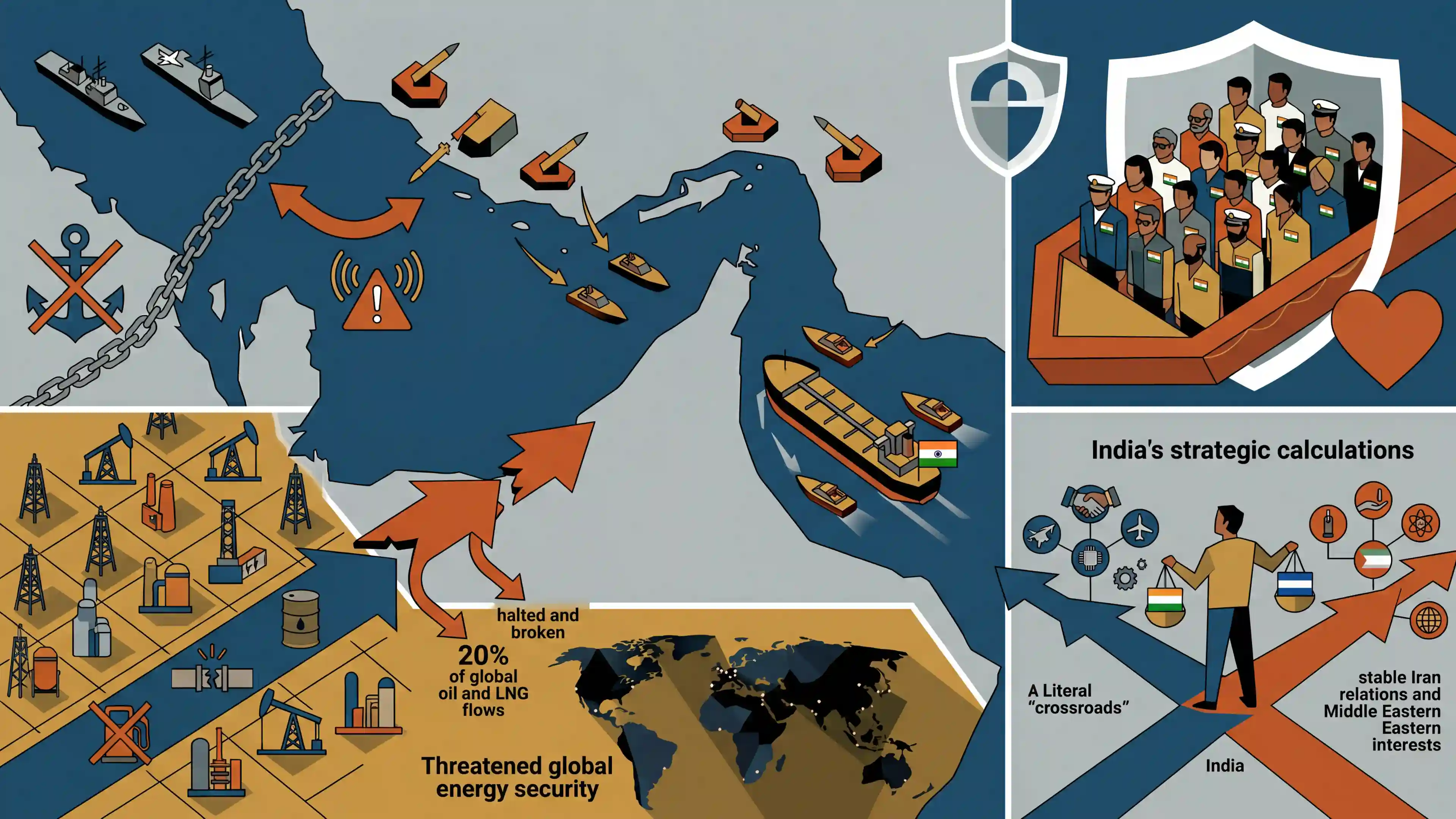
The Strait of Hormuz is a vital maritime chokepoint. Disruptions here directly threaten India's energy security and economic stability. Furthermore, the safety of Indian seafarers highlights the vulnerability of the Indian diaspora in conflict zones, requiring deft diplomatic maneuvering amid the broader US-Iran geopolitical rivalry.
Summary
Twenty-two Indian seafarers are safe after being caught in the crossfire of escalating US-Iran tensions in the Strait of Hormuz. Iranian forces, retaliating against a US maritime blockade, fired upon and seized commercial vessels, including those carrying Indian crew members. The disruption has halted shipping through the Strait, a critical maritime chokepoint responsible for 20% of global oil and LNG flows, threatening global energy security and complicating India's diplomatic and strategic calculations in the Middle East.
Key Points
- 22 Indian seafarers are reported safe after their vessels (Euphoria and Epaminondas) came under fire from Iranian forces in the Strait of Hormuz.
- The attack by the Islamic Revolutionary Guard Corps (IRGC) was a retaliation against the US blockade of Iranian ports and the US seizure of Iran-linked tankers in the Indian Ocean.
- Two India-flagged vessels, the oil tanker Sanmar Herald and bulk carrier Jag Arnav, also had to retreat into the Persian Gulf after being fired upon.
- The Strait of Hormuz, which accounts for one-fifth of global oil and LNG flows, has seen vessel movements halt, deeply impacting global energy security.
Important Terms
Strait of Hormuz

A strategically vital waterway between Oman and Iran, connecting the Persian Gulf to the Gulf of Oman. It handles approximately 20% of global oil and LNG shipments.
UPSC context
GS Paper I (Geography) & II (International Relations). Tested via map-based Prelims questions and Mains analysis of West Asian geopolitics.
Maritime Chokepoints
Narrow, natural or man-made passages along major sea routes (e.g., straits or canals) where high traffic concentration makes global trade vulnerable to blockades or disruptions.
UPSC context
GS Paper I & III. Essential for understanding global trade vulnerabilities, freight costs, and supply chain resilience in Mains answers.
Islamic Revolutionary Guard Corps (IRGC)
An elite branch of the Iranian Armed Forces established after the 1979 Revolution. It answers directly to the Supreme Leader and oversees Iran's internal security and regional proxy networks.
UPSC context
GS Paper II (International Relations). Relevant for discussing West Asian instability, terrorism designations, and India-Iran-US diplomatic balancing.
Energy Security
The uninterrupted availability of energy sources at an affordable price. For India, it involves diversifying suppliers and routes to mitigate dependence on volatile regions like the Middle East.
UPSC context
GS Paper III (Economy/Infrastructure). A core theme for questions on India's strategic autonomy, CAD, and energy transition.
Ministry of Ports, Shipping and Waterways
The nodal Indian ministry for formulating laws and regulations related to ports, shipping, and inland waterways. It manages the Sagarmala Project and maritime infrastructure development.
UPSC context
GS Paper III (Infrastructure). Important for governance-related questions on India's blue economy and logistics cost reduction strategies.
Bharat Maritime Insurance Pool (BMI Pool)
A domestic, state-backed sovereign insurance mechanism established to provide affordable coverage for Indian vessels transiting high-risk maritime corridors, bypassing reliance on international insurance clubs.
UPSC context
GS Paper III (Economy). A niche 2026 current affairs term relevant for India's economic response to maritime war risks.
Prelims Trap
The Strait of Hormuz connects the Persian Gulf directly to the Red Sea.
Aspirants often confuse Middle Eastern maritime chokepoints. Hormuz connects the Persian Gulf to the Gulf of Oman, whereas Bab el-Mandeb connects the Red Sea to the Gulf of Aden.
Static Concepts Connected
What are the primary maritime chokepoints for Middle Eastern energy flows?
- Strait of Hormuz: Connects the Persian Gulf to the Gulf of Oman and Arabian Sea. Critical for 20% of global oil and LNG flows.
- Bab el-Mandeb: Connects the Red Sea to the Gulf of Aden. It is the southern gate to the Suez Canal trade route.
- Suez Canal: An artificial waterway in Egypt connecting the Red Sea to the Mediterranean Sea, bypassing the longer Cape of Good Hope route.
How does UNCLOS govern straits used for international navigation?
- Transit Passage Right: All ships and aircraft enjoy the right of continuous and expeditious transit through straits used for international navigation.
- No Suspension: Unlike innocent passage in territorial seas, the right of transit passage through international straits cannot be suspended by bordering nations in peacetime.
- Coastal State Duties: Bordering states may regulate navigational safety and marine pollution but cannot hamper or block transit passage.
Cross-Topic Patterns
Energy chokepoints & Strategic Petroleum Reserves
Hormuz disruptions underscore the urgent need for expanding India's Strategic Petroleum Reserves (ISPRL) to insulate the domestic economy from severe global crude oil and LNG supply shocks.
Indian Navy as Net Security Provider
Attacks on India-flagged ships amplify the importance of operations like Operation Sankalp, where the Indian Navy escorts merchant vessels to secure vital trade routes in the volatile Persian Gulf.

Expect a 2026 map question pairing Middle East straits (Hormuz, Bab-el-Mandeb) with their bordering nations and global trade dependencies.
Linked PYQs · 5
Linked PYQs · 5
- 2024PrelimsGS1
Consider the following statements : Statement-I : Sumed pipeline is a strategic route for Persian Gulf oil and natural gas shipments to Europe. Statement-II : Sumed pipeline connects the Red Sea with the Mediterranean Sea. Which one of the following is correct in respect of the above statements?
- 2025MainsGS3
Why is maritime security vital to protect India's sea trade? Discuss maritime and coastal security challenges and the way forward.
- 2022MainsGS3
What are the maritime security challenges in India ? Discuss the organisational, technical and procedural initiatives taken to improve the maritime security.
- 2018MainsGS2
In what ways would the ongoing US-Iran Nuclear Pact Controversy affect the national interest of India? How should India respond to this situation?
- 2012MainsGS2
How have the US sanctions against Iran affected India's bilateral relations with Iran?
