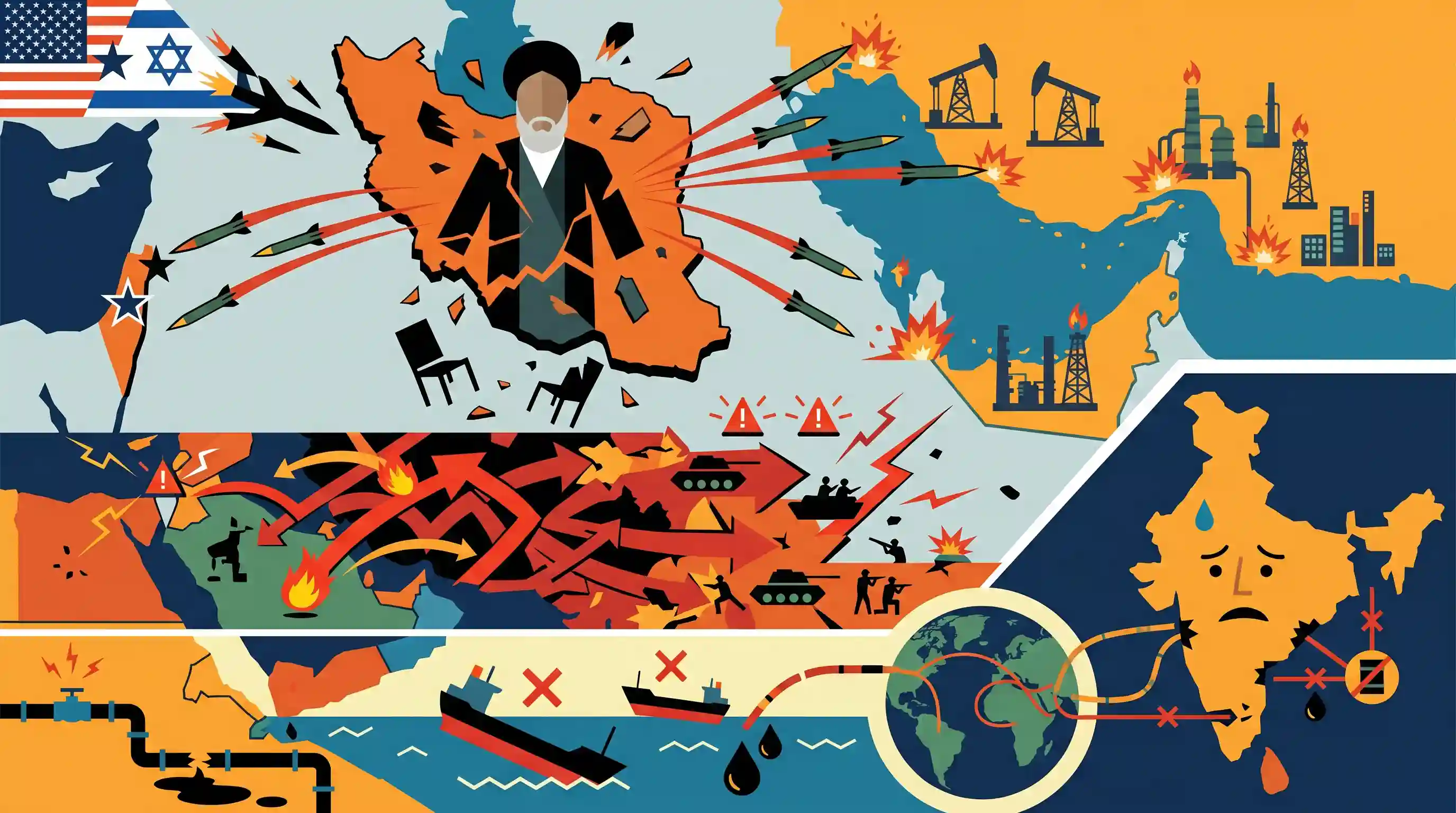
Iran retaliates with Missiles following Leadership Assassination
Source:The Hindu ↗
Why It Matters
The killing of Iran's Supreme Leader and the resulting multi-front escalation drastically destabilize the Middle East. For India, this crisis has profound implications for energy security, maritime trade through the Strait of Hormuz, and the safety of the massive Indian diaspora in the Gulf.
Summary
Iran launched missile strikes against Israel and several Gulf states in retaliation for a joint US-Israeli airstrike that killed Supreme Leader Ayatollah Ali Khamenei. The unprecedented attacks and resulting leadership vacuum in Iran risk triggering a wider regional war, with severe implications for global energy security and Middle Eastern geopolitical stability.
Key Points
- Iran launched a massive missile barrage against Israel and Gulf Arab states (UAE, Bahrain, Kuwait, Qatar) in an unprecedented regional escalation.
- The attacks were in retaliation for a joint US-Israeli airstrike that killed Iran's Supreme Leader Ayatollah Ali Khamenei.
- The assassination creates a severe leadership vacuum in Iran and puts the survival of the Islamic Republic's current structure into question.
- Major General Mohammad Pakpour was named the new top commander of the Revolutionary Guard following the airstrikes.
- The crisis threatens to spiral into a wider Middle Eastern war, posing severe risks to global energy markets and maritime chokepoints like the Strait of Hormuz.
Important Terms
Islamic Revolutionary Guard Corps (IRGC)

An elite branch of the Iranian Armed Forces established in 1979 to protect the Islamic system. It operates independently of the regular military, managing Iran's ballistic missile arsenal and regional proxy networks.
UPSC context
GS Paper II (International Relations) and GS Paper III (Security). Tests understanding of non-state actors and regional security architectures.
Supreme Leader
The highest political and religious authority in Iran (known as Rahbar). The position holds ultimate power over the judiciary, military, and foreign policy, serving as the Commander-in-Chief.
UPSC context
GS Paper II (Constitutional & Political Systems). Tests knowledge of theocratic governance structures and their impact on global diplomacy.
West Asia
A geographically neutral term for the Middle East, referring to the westernmost part of Asia. It is a strategic bridge between Asia, Africa, and Europe, and a core focus of India's foreign policy.
UPSC context
GS Paper II (International Relations). Central to questions on India's 'Look West' policy and diaspora interests.
Strait of Hormuz
A narrow maritime chokepoint between Iran and Oman connecting the Persian Gulf to the open ocean. It handles roughly 20-25% of the world's total seaborne oil and LNG consumption.
UPSC context
GS Paper I (Geography) and GS Paper III (Economy). Tests knowledge of maritime trade routes and global supply chain vulnerabilities.
Energy Security
The uninterrupted availability of energy sources at an affordable price. It includes availability (supply), accessibility (infrastructure), and affordability (stable pricing), particularly vital for import-dependent nations like India.
UPSC context
GS Paper III (Infrastructure and Economy). Focuses on India's strategic petroleum reserves and dependency on volatile regions.
Velayat-e-faqih
The constitutional doctrine of 'Guardianship of the Islamic Jurist,' which forms the ideological basis of Iran’s theocratic government, granting ultimate authority to a learned religious scholar.
UPSC context
GS Paper II. Relevant for understanding the political ideology driving Iran’s internal stability and foreign interactions.
Prelims Trap
The Strait of Hormuz connects the Persian Gulf directly to the Red Sea.
Aspirants often confuse Middle Eastern straits. Hormuz connects the Persian Gulf to the Gulf of Oman/Arabian Sea. Bab el-Mandeb connects the Red Sea to the Gulf of Aden.
Static Concepts Connected
What are the key maritime chokepoints critical to West Asian geopolitics?
- Strait of Hormuz: Connects the Persian Gulf to the Gulf of Oman. Bordered by Iran and Oman (Musandam Peninsula), it is a vital transit route for ~20% of global oil consumption.
- Bab el-Mandeb: Connects the Red Sea to the Gulf of Aden and the Arabian Sea. It is a critical gateway for maritime trade heading to the Suez Canal and Europe.
What are the strategic pillars of India's Look West (Think West) policy?
- Energy Security: Ensuring unhindered supply of crude oil and LNG, as the Gulf region accounts for roughly 65% of India's external energy requirements.
- Diaspora Protection: Safeguarding the lives, rights, and financial remittances of over 8 million Indians living and working across Gulf Cooperation Council (GCC) countries.
- De-hyphenation Strategy: Maintaining independent, mutually beneficial relationships with rival power centers—namely Israel, Arab Gulf states, and Iran—without taking sides in regional disputes.
Cross-Topic Patterns
Energy chokepoints & imported inflation
Disruptions in the Strait of Hormuz directly spike crude prices, widening India's Current Account Deficit (CAD) and fueling imported inflation, which complicates the RBI's monetary policy targeting.
Abraham Accords under severe stress
Iranian missile strikes on the UAE and Bahrain severely test the 2020 Abraham Accords, forcing Gulf nations to balance their diplomatic normalization with Israel against direct regional security threats.

Expect a 2026 Prelims multi-statement question mapping Middle East chokepoints (Hormuz/Bab-el-Mandeb) to global oil supply chain risks.
Linked PYQs · 2
Linked PYQs · 2
- 2025MainsGS2
"Energy security constitutes the dominant kingpin of India's foreign policy, and is linked with India's overarching influence in Middle Eastern countries.” How would you integrate energy security with India's foreign policy trajectories in the coming years?
- 2017MainsGS2
The question of India's Energy Security constitutes the most important part of India's economic progress. Analyze India's energy policy cooperation with West Asian countries.
