Strait of Hormuz Blockade Triggers Global Energy Security Crisis
Source:The Hindu ↗
Why It Matters
The conflict exposes the fragility of global energy supply chains dependent on the Strait of Hormuz. For India, this crisis is critical as it directly impacts energy security (crude oil imports), inflation, and the safety of the large Indian diaspora in the Gulf region.
Summary
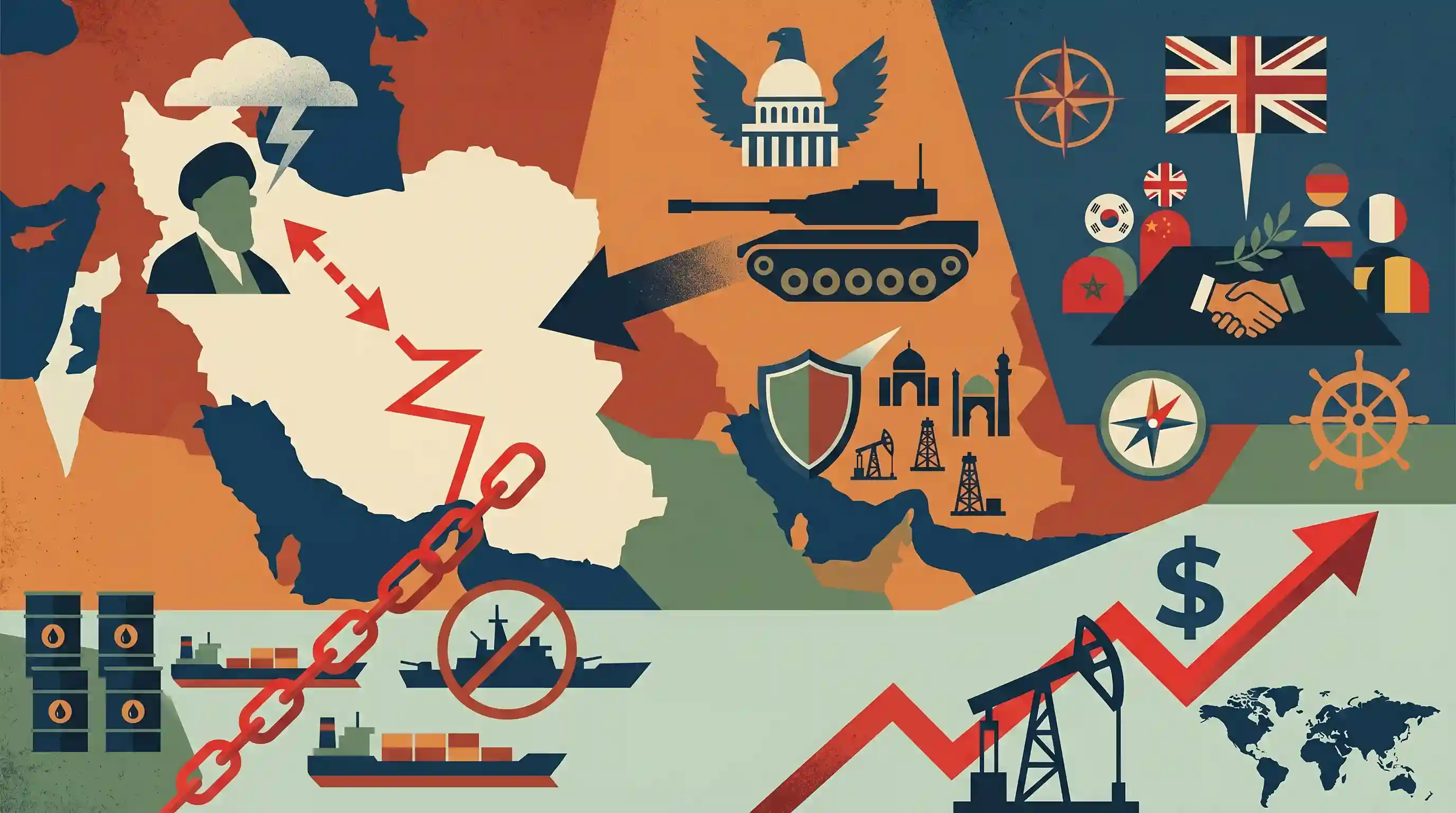
The escalating conflict between the U.S., Israel, and Iran has profoundly disrupted West Asian geopolitics and global energy security. Following allied strikes that killed Iran's Supreme Leader Ayatollah Ali Khamenei, Iran retaliated with missile attacks on Israel and blockaded the Strait of Hormuz—a crucial maritime chokepoint. This blockade has severely impacted global supply chains, driving crude oil prices to surge. U.S. President Donald Trump has issued stark military threats against Iran while assuring a defense umbrella for Gulf allies. Meanwhile, an international coalition led by Britain is seeking diplomatic and political measures to restore freedom of navigation in the strait. The crisis highlights severe vulnerabilities in regional stability and global energy markets.
Key Points
- U.S. President Donald Trump threatened intense military strikes to bomb Iran into the "Stone Ages" unless a deal is reached, following strikes that killed Supreme Leader Ayatollah Ali Khamenei.
- Iran has effectively blockaded the strategic Strait of Hormuz, through which one-fifth of global oil passes, causing Brent crude prices to surge past $105 a barrel.
- In retaliation to U.S. and Israeli actions, Iran and its proxy Hezbollah fired missiles and drones at Israel, while the UAE activated its air defenses.
- The U.S. has pledged a defense umbrella over regional allies, including Saudi Arabia, Qatar, the UAE, Kuwait, and Bahrain, shielding them from Iranian strikes.
- Britain is convening a 35-nation diplomatic meeting to restore freedom of navigation in the Strait of Hormuz and address the escalating energy and maritime security crisis.
Important Terms
Maritime Chokepoint

A narrow, strategically significant maritime passage connecting larger water bodies, vital for global trade but highly vulnerable to blockades or disruptions.
UPSC context
GS Paper I (Geography) and III (Security); tests knowledge of trade vulnerabilities and global supply chain stability.
Strait of Hormuz
A strategic waterway between the Persian Gulf and Gulf of Oman; it is the world’s most critical oil transit point, handling ~20% of global consumption.
UPSC context
GS Paper II (International Relations); critical for India’s energy security and regional mapping questions.
Islamic Revolutionary Guard Corps (IRGC)
An elite branch of the Iranian Armed Forces established to protect the Islamic system; it operates independently of the regular army and manages regional proxies.
UPSC context
GS Paper II (IR) and III (Internal Security); relevant to West Asian security and non-state actors.
Hezbollah
A Lebanon-based Shia militant group and political party; it acts as a primary Iranian proxy in the "Axis of Resistance" against Israel.
UPSC context
GS Paper II (International Relations); essential for understanding proxy warfare and Middle East conflict dynamics.
Freedom of Navigation (FON)
A principle of international law ensuring ships of any sovereign state can traverse international waters without interference, primarily codified under UNCLOS.
UPSC context
GS Paper II (IR); critical for international maritime law and global trade route disputes.
UNCLOS
The 1982 international treaty defining the legal framework for all ocean activities, including maritime zones, navigation rights, and resource management.
UPSC context
GS Paper II (International Relations); a core topic for maritime security and international legal regimes.
Ayatollah / Supreme Leader
A high-ranking Shia clerical title; in Iran, the Supreme Leader holds ultimate religious and political authority over state policy and military.
UPSC context
GS Paper II (IR); relates to the political structure and foreign policy of the Iranian theocracy.
Prelims Trap
"The Strait of Hormuz is a strategic chokepoint bordered by Iran and the United Arab Emirates."
Aspirants often confuse the UAE as a bordering nation due to its regional prominence, but the Strait of Hormuz is strictly bordered by Iran and Oman (specifically, Oman's Musandam Peninsula exclave).
Static Concepts Connected
What are the key maritime chokepoints in West Asia relevant to global trade?
- Strait of Hormuz: Connects the Persian Gulf to the Gulf of Oman and Arabian Sea. Bordered by Iran and Oman.
- Bab el-Mandeb: Connects the Red Sea to the Gulf of Aden and Arabian Sea. Bordered by Yemen, Djibouti, and Eritrea.
- Suez Canal: An artificial waterway in Egypt connecting the Mediterranean Sea to the Red Sea, bypassing the African continent.
How do crude oil price spikes impact India's macroeconomic indicators?
- Wider CAD: As India imports over 80% of its crude oil, sudden price spikes directly inflate the import bill, severely widening the Current Account Deficit (CAD).
- Imported Inflation: Elevated fuel costs trigger cost-push inflation across the domestic economy due to more expensive freight, transportation, and manufacturing processes.
- Rupee Depreciation: Surging oil import bills require greater foreign exchange outflows, increasing dollar demand and exerting downward depreciation pressure on the Indian Rupee.
Cross-Topic Patterns
UNCLOS and Transit Passage
The Hormuz blockade tests the UNCLOS framework, specifically the non-suspendable right of 'transit passage' through international straits, drawing direct parallels to freedom of navigation disputes in the South China Sea.
Strategic Petroleum Reserves (SPR)
Geopolitical vulnerabilities in West Asian chokepoints frequently prompt UPSC questions on India's energy security framework and the strategic necessity of its petroleum reserves (SPRs) in Mangaluru, Padur, and Visakhapatnam.

Expect a 2026 multi-statement question combining West Asian maritime chokepoint geography (Hormuz, Oman) with UNCLOS transit passage rules.
Linked PYQs · 3
Linked PYQs · 3
- 2024PrelimsGS1
Consider the following statements : Statement-I : Sumed pipeline is a strategic route for Persian Gulf oil and natural gas shipments to Europe. Statement-II : Sumed pipeline connects the Red Sea with the Mediterranean Sea. Which one of the following is correct in respect of the above statements?
- 2018MainsGS2
“India’s relations with Israel have, of late, acquired a depth and diversity, which cannot be rolled back.” Discuss.
- 2025MainsGS3
Why is maritime security vital to protect India's sea trade? Discuss maritime and coastal security challenges and the way forward.
