Leadership Transition and State Funeral in Iran Amid Regional Conflict
Source:Indian Express ↗
Why It Matters
The death of Iran's long-serving Supreme Leader and the resulting transition of power occur at a highly volatile juncture in West Asian geopolitics. For India, maintaining strategic relations with a stable Iran is essential for safeguarding long-term energy security, protecting maritime trade routes, and ensuring the viability of critical connectivity projects such as the Chabahar Port and the International North-South Transport Corridor (INSTC).
Summary
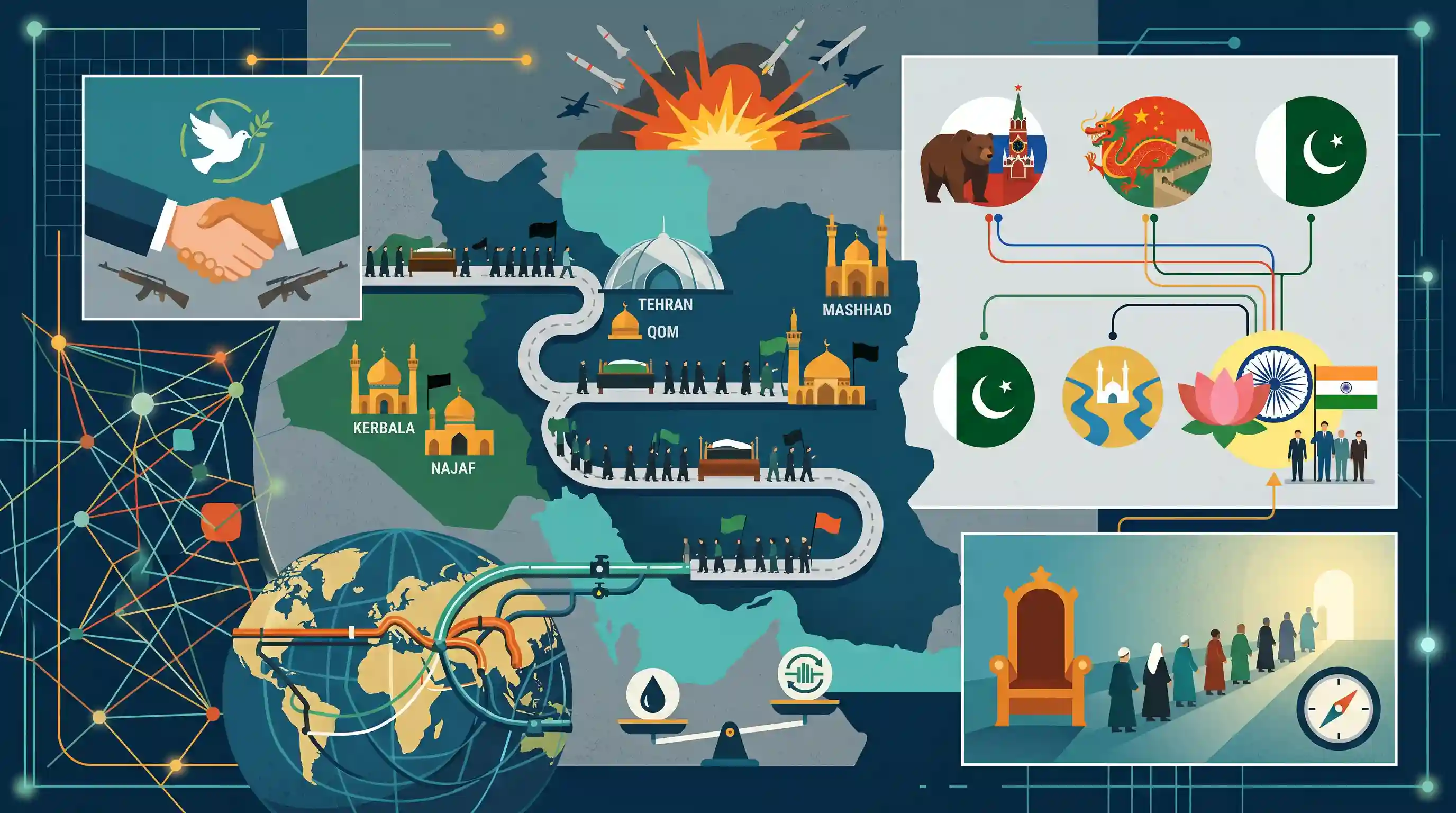
The article details the commencement of a week-long state funeral in Tehran for Iran’s longtime Supreme Leader, Ayatollah Ali Khamenei, who was killed in US-Israeli airstrikes. Scheduled only after an interim US-Iran truce was agreed upon, the elaborate funeral itinerary spans prominent theological and political centers across both Iran and Iraq, including Tehran, Qom, Najaf, Kerbala, and Mashhad. High-ranking dignitaries from several nations—including Russia, China, Pakistan, Iraq, and an official delegation from India—are attending, highlighting the complex geopolitical web of West Asia during a critical leadership transition.
Key Points
- Iran has commenced a week-long state funeral for Ayatollah Ali Khamenei, who ruled as the Supreme Leader of the Islamic Republic for 37 years and was killed in US-Israeli airstrikes.
- The funeral was delayed due to wartime security concerns and only proceeded after an interim truce agreement was brokered between the United States and Iran.
- The extensive funeral route traces highly symbolic religious and political nodes across the region: starting in Tehran, moving to Qom (Iran), crossing into Iraq to the holy Shia cities of Najaf and Kerbala, and concluding with burial at the shrine of Imam Reza in Mashhad (Iran).
- High-profile international delegates are in attendance, including representatives from Russia, China, Pakistan, Iraq, and an official delegation sent by India, signifying the diplomatic complexity and strategic alignments of West Asia.
- The leadership transition occurs amidst extreme regional volatility, with security forces on high alert and the newly appointed Revolutionary Guards chief Ahmad Vahidi paying tribute alongside interim political leaders.
Important Terms
Islamic Revolutionary Guard Corps (IRGC)

An elite branch of the Iranian Armed Forces established in 1979 to protect the country's Islamic system, maintain internal security, and project regional influence through its asymmetric and expeditionary units.
UPSC context
GS Paper II (International Relations); tests understanding of West Asian security architecture, regional militaries, and geopolitical conflicts.
Basij volunteer force
A paramilitary volunteer militia in Iran under the command of the IRGC, serving as an auxiliary force for internal security, domestic law enforcement, and ideological mobilization.
UPSC context
GS Paper II (International Relations); tests knowledge of state-backed paramilitary forces and domestic security apparatuses in West Asia.
Hezbollah
A Shia Islamist militant group and political party based in Lebanon, founded with Iranian assistance in the 1982 Lebanon War to resist Israeli occupation and project regional influence.
UPSC context
GS Paper II (International Relations); tests understanding of non-state actors, proxy warfare, and regional instability in West Asia.
US-Iran interim truce agreement
A temporary bilateral framework signed in June 2026 to halt hostilities, reopen the strategic Strait of Hormuz to maritime shipping, and initiate broader negotiations on nuclear and sanction disputes.
UPSC context
GS Paper II (Bilateral Relations/International Relations); tests awareness of West Asian geopolitics, energy security, and conflict mediation.
National People's Congress (NPC)
The unicameral legislature of the People's Republic of China, constitutionally designated as the highest organ of state power, operating under the political leadership of the Chinese Communist Party.
UPSC context
GS Paper II (Comparative Constitutions/Polity); tests understanding of non-democratic legislative systems and comparative governance models.
Prelims Trap
The Guardian Council of Iran is the constitutional body responsible for electing and dismissing the Supreme Leader.
Aspirants confuse the Guardian Council (which vets laws and election candidates) with the Assembly of Experts, the clerical body that elects the Supreme Leader.
Static Concepts Connected
How is the Supreme Leader of Iran selected, and what is the role of the Assembly of Experts?
- Ultimate Authority: The Supreme Leader (Rahbar) is the head of state, commander-in-chief, and holds ultimate veto power over all state affairs.
- Assembly of Experts: An 88-member clerical body directly elected by citizens every eight years, constitutionally empowered to appoint or dismiss the Supreme Leader.
- Guardian Council Vet: While the Assembly is elected, the Guardian Council (half appointed by the Supreme Leader) vets all candidates, controlling the pool.
What is the strategic significance of the Shahid Beheshti Terminal at Chabahar Port for India?
- Bypassing Pakistan: Enables a direct transit route to landlocked Afghanistan and Central Asia, neutralizing Pakistan's denial of overland access.
- INSTC Linkage: Functions as the crucial sea-land node connecting India to the 7,200 km International North-South Transport Corridor.
- Geopolitical Balance: Counters the Chinese-operated Gwadar Port in Pakistan, securing India's strategic maritime footprint in the Gulf of Oman.
Cross-Topic Patterns
Chabahar & strategic autonomy under Western sanctions
India’s proactive execution of Chabahar commitments despite unilateral US sanctions illustrates the resilience and independent decision-making of its multi-aligned foreign policy.
Shia religious corridors & regional diplomacy
The transnational funeral route through Iraq and Iran highlights how shared sacred geography (Najaf, Kerbala, Mashhad) is mobilized to project post-Khamenei Shia geopolitical solidarity.

Chabahar's operational control, INSTC routes, and Iran's unique constitutional bodies will likely be combined in a 2026 Prelims question.
Linked PYQs · 3
Linked PYQs · 3
- 2025MainsGS2
"Energy security constitutes the dominant kingpin of India's foreign policy, and is linked with India's overarching influence in Middle Eastern countries.” How would you integrate energy security with India's foreign policy trajectories in the coming years?
- 2022PrelimsGS1
The term "Levant" often heard in the news roughly corresponds to which of the following regions?
- 2015PrelimsGS1
The area known as 'Golan Heights' sometimes appears in the news in the context of the events related to
