Baghdad Security Alert Warns of Imminent Militia Attacks
Source:Indian Express ↗
Why It Matters
The ongoing proxy conflicts in West Asia, particularly involving Iran-backed militias in Iraq, are critical for understanding modern geopolitical instability. For UPSC aspirants, this illustrates the dynamics of state-sponsored non-state actors, the challenges of global terrorism (GS3), and the strategic implications of Middle Eastern volatility on international relations (GS2). It also serves as important context for map-based Prelims questions concerning the geography of the Persian Gulf and surrounding nations.
Summary
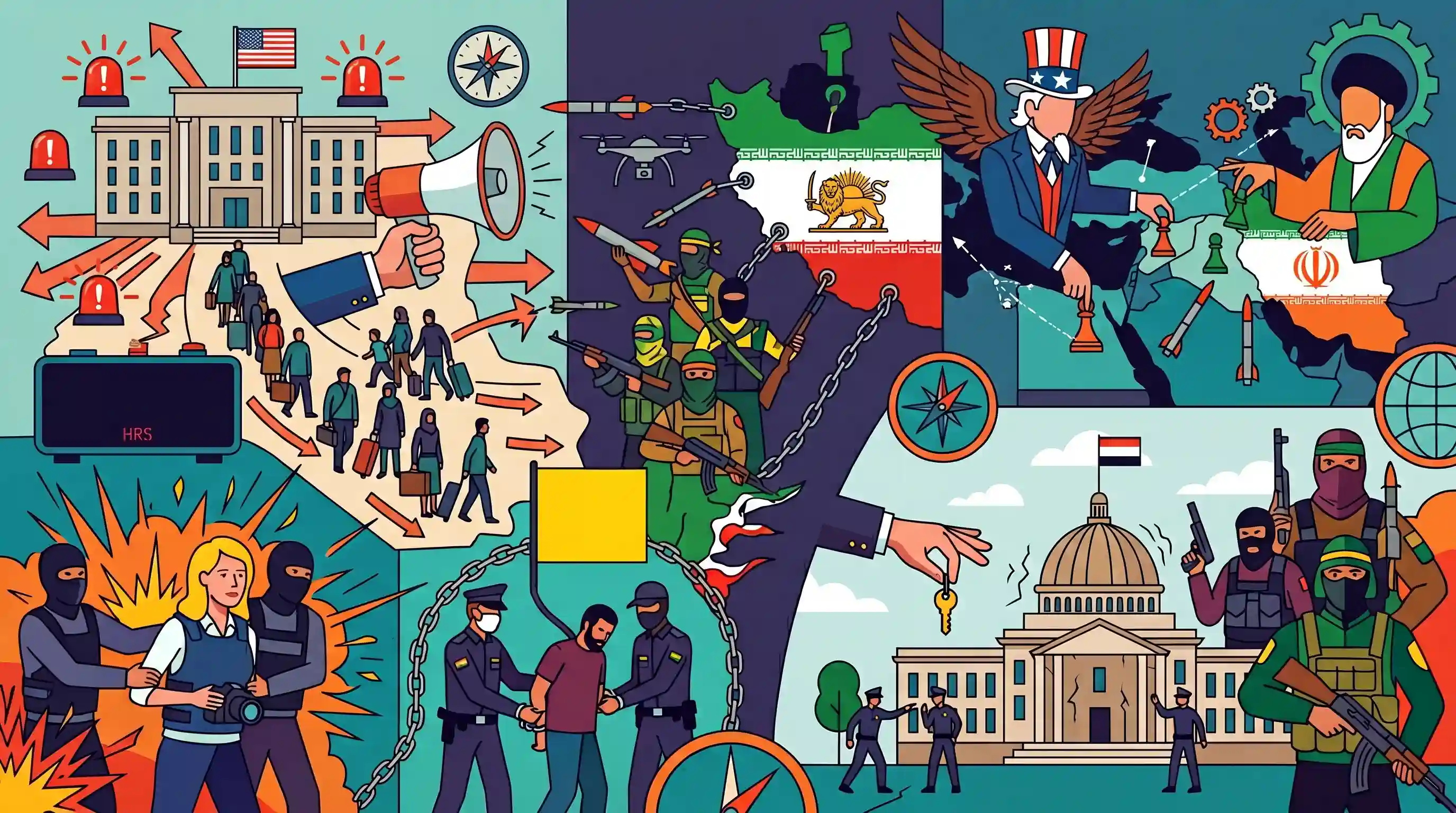
The US Embassy in Baghdad has issued a high-level security alert advising American citizens to leave Iraq immediately due to anticipated attacks by Iran-backed Iraqi militia groups within 24 to 48 hours. The warning comes amid heightened tensions following the kidnapping of an American journalist, Shelly Kittleson, and the detention of a suspect linked to Kata'ib Hezbollah. This localized escalation is symptomatic of the broader US-Iran proxy conflict in West Asia. The Embassy also expressed doubts regarding the Iraqi government's capacity to secure diplomatic and foreign assets, highlighting the pervasive influence of armed non-state actors operating with impunity in the region.
Key Points
- The US Embassy in Baghdad issued an urgent security alert, warning of imminent attacks by Iran-backed Iraqi militias and urging US citizens to depart immediately.
- The heightened threat level follows the abduction of American journalist Shelly Kittleson and the subsequent detention of a suspect affiliated with the Kata'ib Hezbollah militia.
- The advisory reflects escalating regional hostilities between the US and Iran, including recent rhetoric about potential US strikes on Iranian infrastructure.
- US officials raised concerns over the Iraqi government's ability to thwart such attacks, noting that militia members might impersonate state security personnel.
- The situation underscores the outsized role of non-state proxy actors in exacerbating geopolitical volatility and terrorism in the Middle East.
Important Terms
Kata'ib Hezbollah

An elite, Iran-backed Shia militia in Iraq and a primary component of the Popular Mobilization Forces (PMF), often operating as part of Iran's regional "Axis of Resistance."
UPSC context
GS Paper 2 (International Relations) and Paper 3 (Security); tests knowledge of specific regional actors affecting West Asian stability and security.
Non-state Actors
Entities independent of sovereign government control—such as militias, terrorist groups, or NGOs—that significantly influence national security, international relations, and regional stability.
UPSC context
GS Paper 3 (Internal Security); tests understanding of threats originating from entities outside formal state structures.
West Asia
A geopolitically sensitive region comprising the Middle East; it is central to India's "extended neighborhood" policy, energy security, and the welfare of a massive Indian diaspora.
UPSC context
GS Paper 2 (International Relations); critical for India’s "Link West" policy, energy security, and maritime trade routes.
Proxy War
A conflict where major powers use third parties—typically non-state actors or smaller states—to fight indirectly, allowing the powers to pursue strategic interests while avoiding direct conventional war.
UPSC context
GS Paper 2 (International Relations); tests analysis of indirect geopolitical competition and its impact on regional peace and Indian interests.
Popular Mobilization Forces (PMF)
An Iraqi state-sponsored umbrella organization of dozens of militias; it represents a "hybrid" security model where paramilitary groups are formally recognized but often maintain independent command structures.
UPSC context
GS Paper 2 (International Relations); tests understanding of complex security architectures and state fragility in conflict-prone regions.
State Capacity
The ability of a government to effectively administer territory, enforce law, and protect assets; in fragile states, this capacity is often challenged by influential armed militias.
UPSC context
GS Paper 2 (Governance/IR); tests analysis of government effectiveness and its impact on foreign diplomatic security.
Prelims Trap
Kata'ib Hezbollah is a prominent armed non-state group operating primarily out of Lebanon.
Aspirants often confuse Kata'ib Hezbollah (Iraq) with Hezbollah (Lebanon). UPSC frequently tests regional militia-to-country pairings in match-the-following formats.
Static Concepts Connected
Which countries border Iraq, and does it have maritime access?
- Land Borders: Bounded by six nations: Turkey (North), Iran (East), Kuwait and Saudi Arabia (South), and Jordan and Syria (West).
- Maritime Coastline: Iraq is not completely landlocked; it has a narrow coastline along the northern Persian Gulf.
- Major Rivers: The Tigris and Euphrates flow through Iraq, combining into the Shatt al-Arab waterway before entering the Gulf.
What is the 'Axis of Resistance' in West Asian geopolitics?
- Core Meaning: An informal, Iran-led political and military coalition of non-state armed groups aimed at countering US and Israeli regional influence.
- Key Members: Includes Hezbollah (Lebanon), Hamas (Gaza), Houthis (Yemen), and various Shia militias in Iraq like Kata'ib Hezbollah.
- Strategic Purpose: Allows Iran to engage in asymmetric proxy warfare, providing plausible deniability while projecting power across the Middle East.
Cross-Topic Patterns
Proxy militias + Energy Security
Volatility involving Iraqi militias and Iran threatens maritime shipping in the nearby Persian Gulf, directly impacting India's oil imports and macroeconomic stability.
Proxy warfare + State-sponsored terrorism
The West Asian tactic of utilizing non-state actors for plausible deniability conceptually mirrors the cross-border terrorism apparatus India faces from its neighbors.

Match-the-following Prelims questions pairing regional non-state actors (Houthis/Kata'ib Hezbollah/Hamas) with their base countries are highly likely in 2026.
Linked PYQs · 4
Linked PYQs · 4
- 2017PrelimsGS1
Mediterranean Sea is a border of which of the following countries? 1. Jordan 2. Iraq 3. Lebanon 4. Syria Select the correct answer using the code given below:
- 2016PrelimsGS1
Which of the following is not a member of 'Gulf Cooperation Council'?
- 2025MainsGS3
Terrorism is a global scourge. How has it manifested in India? Elaborate with contemporary examples. What are the counter measures adopted by the State? Explain.
- 2017MainsGS3
The scourge of terrorism is a grave challenge to national security. What solutions do you suggest to curb this growing menace? What are the major sources of terrorist funding?
