US and Israel launch Joint Missile Strikes on Tehran in Escalation
Source:Indian Express ↗
Why It Matters
The direct military confrontation involving Iran, Israel, and the US marks a significant escalation in West Asian geopolitics. For UPSC aspirants, understanding this conflict is critical due to its direct impact on India's strategic interests, including energy security, the safety of the Indian diaspora in the Middle East, and India's delicate diplomatic balancing act between Israel, Iran, and the US.
Summary
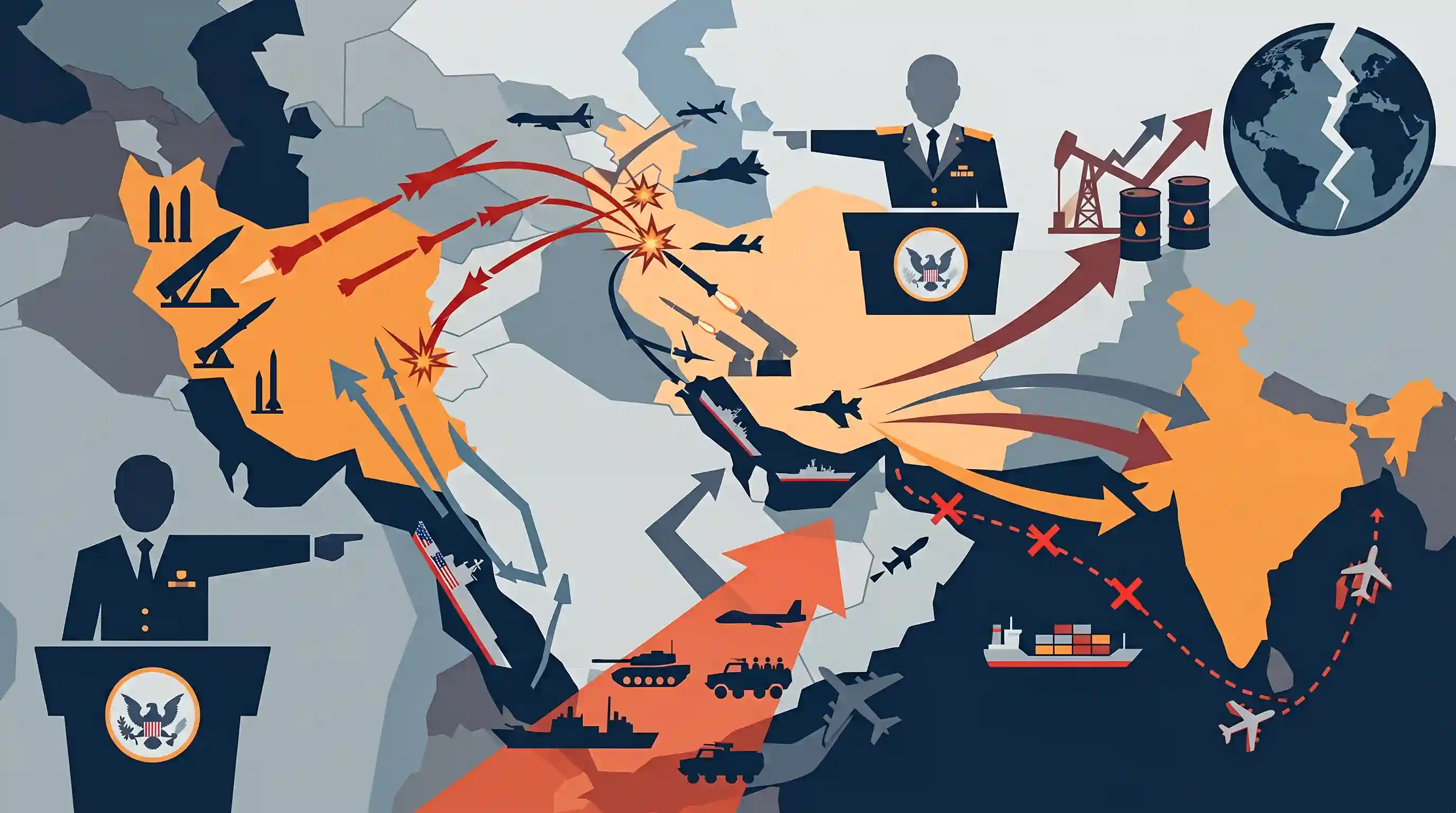
Iran's attack on Israel has triggered a massive joint missile strike on Tehran by Israeli and US forces. The crisis escalated dramatically as US President Donald Trump declared "Major Combat Operations," signaling direct and sustained American military engagement in the Middle East. This unprecedented direct confrontation between the US/Israel alliance and Iran threatens to plunge the region into a broader war, bearing severe implications for global energy security, international trade, and geopolitical stability.
Key Points
- Iran launched direct attacks on Israel, sparking a massive military response.
- Israel and the United States conducted a joint, daylight missile strike targeting Tehran in retaliation.
- US President Donald Trump escalated the geopolitical situation by declaring 'Major Combat Operations', signaling direct, sustained American military involvement against Iran.
- The escalation significantly deepens the Middle East crisis, bringing the region to the brink of outright war and threatening global energy security and trade routes.
Important Terms
Strait of Hormuz

The world's most critical maritime chokepoint between the Persian Gulf and Gulf of Oman, carrying approximately 20% of global oil consumption.
UPSC context
GS Paper II & III: Crucial for India's energy security and West Asian maritime geography.
Axis of Resistance
An informal Iran-led coalition including Hezbollah, the Houthis, and various militias aimed at countering Western and Israeli influence in the Middle East.
UPSC context
GS Paper II: Tests understanding of regional proxy dynamics and West Asian stability.
Strategic Autonomy
India's foreign policy doctrine emphasizing independent decision-making and national interest without aligning with specific global military blocs.
UPSC context
GS Paper II: Central to India's balancing act between the US, Israel, and Iran.
Operation Epic Fury
The codename for the 2026 United States military operation involving joint strikes with Israel against Iranian leadership and nuclear infrastructure.
UPSC context
GS Paper II: Current affairs topic involving direct US intervention in West Asian conflicts.
Energy Security
The uninterrupted availability of energy sources at an affordable price, vital for sustaining India's economic growth and industrial activity.
UPSC context
GS Paper III: Impact of West Asian conflicts on India's oil/gas import dependency.
Nuclear Non-Proliferation Treaty (NPT)
A landmark international treaty established to prevent the spread of nuclear weapons and promote cooperation in peaceful nuclear energy use.
UPSC context
GS Paper II & III: Geopolitical implications of Iranian withdrawal from global nuclear frameworks.
Israel Defense Forces (IDF)
The unified military forces of Israel, responsible for its defense across ground, air, and maritime domains.
UPSC context
GS Paper II: Role in regional security and direct kinetic engagement in Tehran.
Prelims Trap
The Strait of Hormuz is a critical chokepoint connecting the Red Sea to the Gulf of Aden.
UPSC frequently swaps Middle Eastern chokepoints. Hormuz connects the Persian Gulf to the Gulf of Oman, whereas Bab-el-Mandeb connects the Red Sea to the Gulf of Aden.
Static Concepts Connected
What are the geographical features surrounding the Strait of Hormuz?
- Location: It is a narrow maritime chokepoint connecting the Persian Gulf in the west to the Gulf of Oman and the Arabian Sea in the east.
- Bordering Nations: It is bounded by Iran to the north and the UAE and Oman (Musandam Peninsula) to the south.
- Strategic Value: It handles roughly 20% of global oil trade, making it the world's most critical energy transit chokepoint.
How does the Chabahar Port function within India's strategic framework?
- Geographic Location: Located in the Sistan-Balochistan province on Iran's south-western coast, situated directly on the Gulf of Oman.
- Strategic Access: It is crucial for India to bypass Pakistan, providing a direct transit route to Afghanistan, Central Asia, and Russia.
- INSTC Link: It serves as a critical node for the International North-South Transport Corridor (INSTC), a multi-mode route connecting Mumbai to St. Petersburg.
Cross-Topic Patterns
I2U2 vs. Chabahar Balancing Act
India's participation in the US-led I2U2 faces extreme diplomatic pressure when Washington attacks Iran, simultaneously jeopardizing New Delhi's strategic transit investments in Iran's Chabahar port.
Abraham Accords under extreme strain
Direct US-Israel strikes on Iran polarize the Arab world, forcing Abraham Accord signatories to navigate intense domestic pressure, threatening the broader Arab-Israeli normalization process.
Hormuz disruption and Rupee depreciation
Spikes in crude oil prices due to Gulf conflicts inflate India's import bill, directly widening the Current Account Deficit and exerting downward pressure on the Rupee.

West Asian chokepoints (Hormuz, Bab-el-Mandeb) mixed with minilaterals (I2U2, INSTC) and trade disruptions is highly likely for 2026 Prelims.
Linked PYQs · 3
Linked PYQs · 3
- 2025MainsGS2
"Energy security constitutes the dominant kingpin of India's foreign policy, and is linked with India's overarching influence in Middle Eastern countries.” How would you integrate energy security with India's foreign policy trajectories in the coming years?
- 2022MainsGS2
How will I2U2 (India, Israel, UAE and USA) grouping transform India's position in global politics?
- 2023PrelimsGS1
Consider the following statements: Statement-I: Israel has established diplomatic relations with some Arab States. Statement-II: The 'Arab Peace Initiative' mediated by Saudi Arabia was signed by Israel and Arab League. Which one of the following is correct in respect of the above statements?
