West Asian Rivalries Surface in Multilateral BRICS Ministerial Forum
Source:The Hindu ↗
Why It Matters
For UPSC aspirants, this event serves as a prime example of the challenges inherent in multilateral groupings like BRICS when they expand to include members with deep-rooted regional conflicts (Iran and the UAE). It highlights shifting West Asian geopolitics, the impact of US and Israeli regional presence, and how such rivalries test the consensus-based functioning of global institutions where India plays a crucial balancing role.
Summary
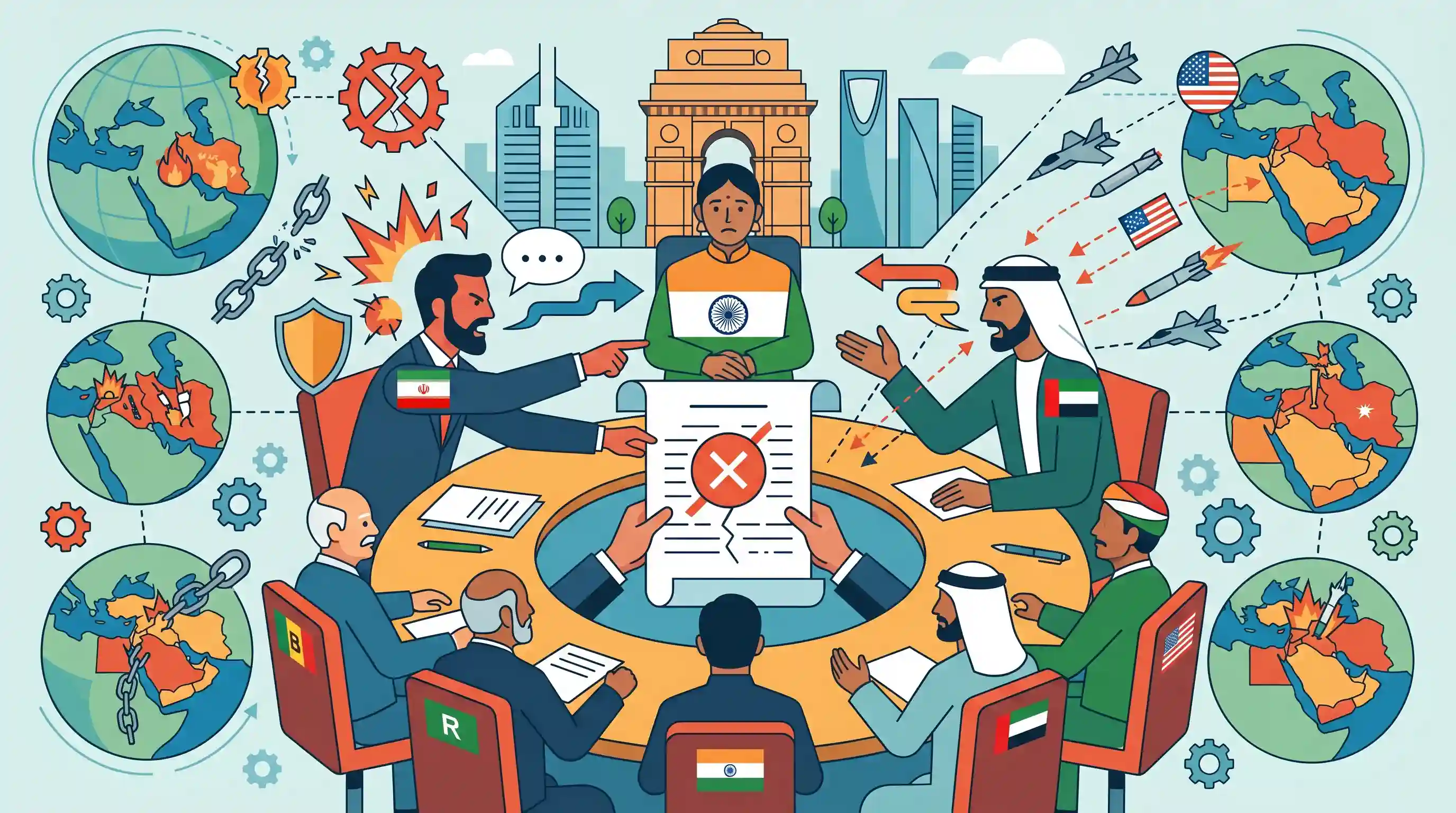
The article highlights an unprecedented diplomatic clash between Iran and the United Arab Emirates (UAE) during the BRICS foreign ministers' meeting in New Delhi. Iranian Foreign Minister Abbas Araghchi accused the UAE of facilitating and participating in US and Israeli military strikes against Iran during the recent "Iran war". This bilateral dispute between two newly inducted BRICS members delayed the drafting of the group's joint communique, exposing how the bloc's recent expansion has imported volatile West Asian geopolitical rivalries into its forums. The development underscores the broader regional instability in the Middle East and its impact on multilateral consensus.
Key Points
- An open diplomatic clash occurred between new BRICS members Iran and the UAE during the foreign ministers' meeting in New Delhi.
- Iranian Foreign Minister Abbas Araghchi publicly accused the UAE of direct involvement in US and Israeli military operations against Iran in February and April 2026.
- The confrontation underscores the vulnerability of Gulf countries hosting US military bases amidst escalating Iran-Israel-US regional conflict.
- The inability to easily reach a final joint communique highlighted how bringing deep-seated regional rivalries into BRICS challenges the grouping's unity and consensus-building processes.
Important Terms
BRICS

An intergovernmental organization comprising major emerging economies (Brazil, Russia, India, China, South Africa) and newly admitted members, focused on enhancing economic cooperation and challenging Western-dominated global governance.
UPSC context
GS Paper 2: Important International institutions, agencies and fora - their structure, mandate. Relevant for multipolarity and Global South leadership.
Joint Communiqué
A formal official statement issued by the participants at the end of a diplomatic meeting, outlining agreed positions, shared goals, and common commitments on regional or global issues.
UPSC context
GS Paper 2: International Relations. Tests understanding of diplomatic consensus-building and challenges in reaching collective agreements within diverse groupings.
BRICS Expansion (BRICS+)
The 2024 process of admitting new members (Iran, UAE, Egypt, Ethiopia, Saudi Arabia) to the BRICS bloc, aimed at increasing its global demographic and economic weight.
UPSC context
GS Paper 2: Regional and global groupings involving India. Highlights the shift from an economic club to a broader geopolitical forum.
West Asia
The geopolitical subregion of Asia comprising the Middle East, critical to global energy security and a primary theatre for regional rivalries and major power competition.
UPSC context
GS Paper 2: Effect of policies and politics of developed and developing countries on India’s interests; Indian diaspora and energy security.
Multilateralism
An approach to international relations where multiple countries work together on a particular issue, typically through international organizations, to find collective solutions.
UPSC context
GS Paper 2: Global groupings and agreements. Tests the ability of non-Western platforms to maintain cooperation despite internal bilateral conflicts.
Strategic Autonomy
India's foreign policy principle of making independent decisions based on national interest without being constrained by alliances or the dictates of other major powers.
UPSC context
GS Paper 2: India's Foreign Policy. Relevant for India's role as BRICS Chair balancing ties between rival members like Iran and the UAE.
Prelims Trap
"BRICS possesses a formal internal dispute resolution mechanism to mediate conflicts between member states."
BRICS operates strictly on consensus without any formal institutional charter or binding dispute resolution mechanism. Bilateral tensions can thus easily paralyze its communiques.
Static Concepts Connected
What is the decision-making structure of the BRICS grouping?
- Consensus-driven: All decisions, including communiques and new member inductions, require unanimous agreement, leaving the bloc vulnerable to internal bilateral vetoes.
- No formal charter: Unlike the UN or EU, BRICS operates as an informal platform without a foundational treaty or formal dispute resolution mechanism.
- Institutional extensions: While lacking a permanent secretariat, it has created concrete financial institutions like the New Development Bank (NDB) and Contingent Reserve Arrangement.
What are India's diverging strategic interests in Iran and the UAE?
- Iran connectivity: Iran provides India with crucial access to Central Asia via the Chabahar Port and the International North-South Transport Corridor (INSTC), bypassing Pakistan.
- UAE economic integration: The UAE is a top trading partner (via CEPA), a critical source of FDI, and hosts a massive Indian diaspora sending vital remittances.
- De-hyphenation policy: India successfully navigates these rivalries through its "Think West" multi-alignment strategy, maintaining independent, parallel bilateral ties without picking sides.
Cross-Topic Patterns
BRICS+ mirrors SCO's bilateral paralysis
Similar to how India-Pakistan tensions stall the SCO, admitting Middle Eastern rivals into BRICS imports bilateral disputes that paralyze multilateral consensus and joint declarations.
Maritime chokepoints and energy security
Iran-UAE clashes near the Persian Gulf threaten the Strait of Hormuz, directly linking West Asian geopolitical instability to India's energy inflation and strategic petroleum reserve planning.

2026 prelims will likely test the structural vulnerabilities of BRICS+ (consensus mechanism vs expanded membership) in a multi-statement Q.
Linked PYQs · 3
Linked PYQs · 3
- 2012MainsGS2
Compare the significance of IBSA and BRICS in the context of India's multilateral diplomacy.
- 2025MainsGS2
"Energy security constitutes the dominant kingpin of India's foreign policy, and is linked with India's overarching influence in Middle Eastern countries.” How would you integrate energy security with India's foreign policy trajectories in the coming years?
- 2017MainsGS2
The question of India's Energy Security constitutes the most important part of India's economic progress. Analyze India's energy policy cooperation with West Asian countries.
