BRICS Foreign Ministers Meet in New Delhi
Source:Indian Express ↗
Why It Matters
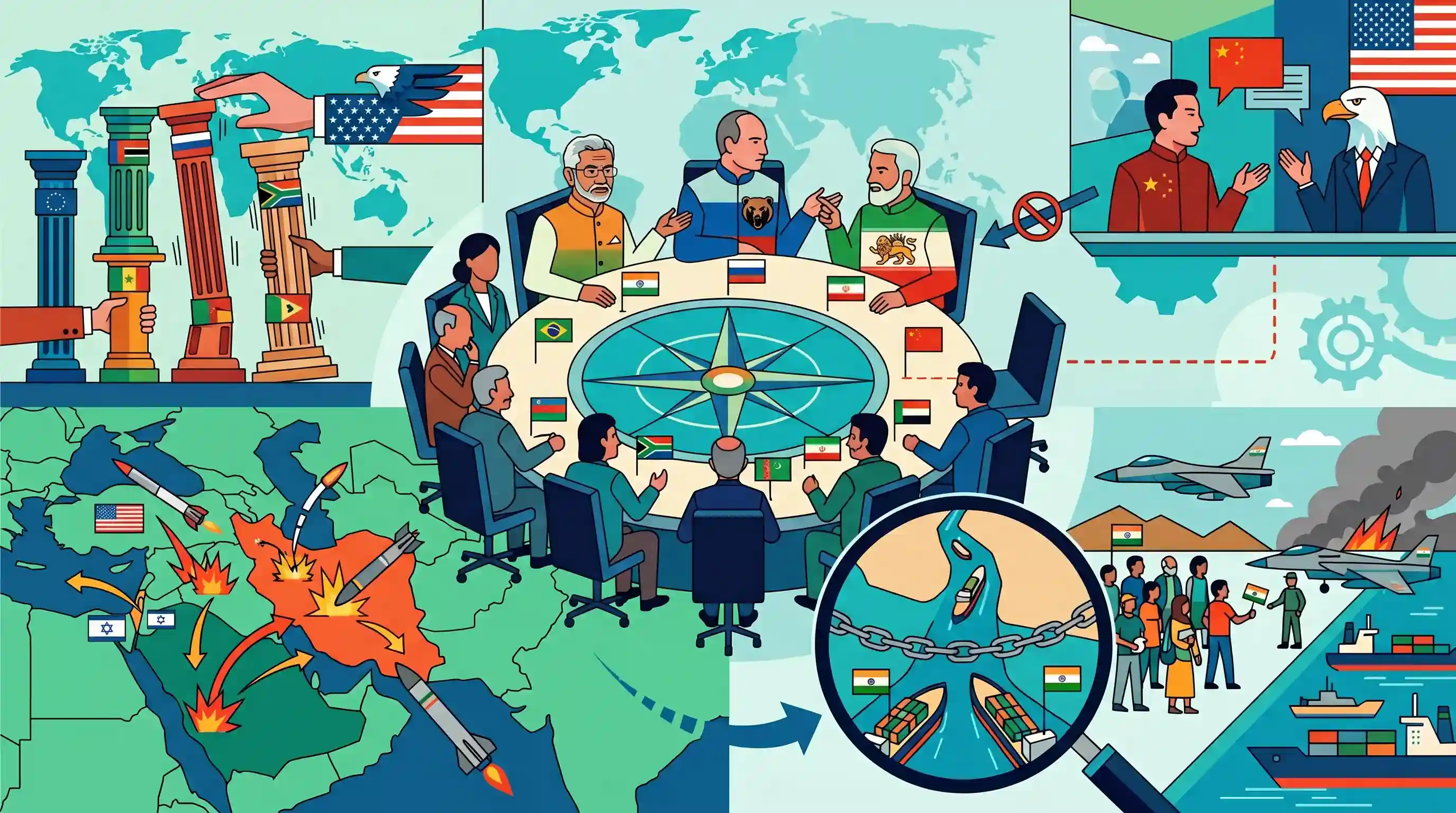
The diplomatic summit highlights the evolving dynamics and inherent challenges of the expanded BRICS grouping in building consensus on global crises. For India, it underscores the intricate balance required to safeguard its strategic and economic interests in West Asia—particularly maritime security in the Strait of Hormuz and diaspora protection—while navigating the broader push for a multipolar world order.
Summary
Russian Foreign Minister Sergey Lavrov and Iranian Foreign Minister Abbas Araghchi are in New Delhi for a BRICS Foreign Ministers' meeting, though Chinese Foreign Minister Wang Yi is absent due to parallel bilateral discussions with the US. A primary challenge for the newly expanded 11-member BRICS grouping is forming a unified consensus on the volatile conflict in West Asia, particularly the ongoing strikes involving the US, Israel, and Iran. For India, the meeting serves as an opportunity to address critical bilateral concerns with Iran, such as the closure of the Strait of Hormuz—which has stranded Indian ships—and strategies for evacuating Indian nationals from the region. Additionally, the multilateral talks will focus on reinforcing a multipolar international order amidst shifting geopolitical dynamics driven by recent US policies.
Key Points
- New Delhi is hosting a BRICS Foreign Ministers' meeting, attended by top diplomats like Russia's Sergey Lavrov and Iran's Abbas Araghchi, while China's Wang Yi skips due to US-China talks.
- The recently expanded 11-member BRICS grouping is struggling to achieve a consensus regarding the escalating conflict in West Asia, specifically concerning strikes involving the US, Israel, and Iran.
- Bilateral discussions between India and Iran are expected to prioritize the strategic situation in the Strait of Hormuz, where Indian commercial ships are currently stuck.
- Contingency planning for the safe evacuation of the Indian diaspora from the conflict-ridden Middle East remains a critical priority for New Delhi.
- The broader BRICS agenda will focus on preserving and shaping a multipolar international order, particularly in response to geopolitical disruptions caused by US policy under Donald Trump.
Important Terms
BRICS

An informal grouping of major emerging economies, expanded in 2024-2025 to 11 members including India, China, Russia, Iran, and the UAE, representing over 40% of global GDP (PPP).
UPSC context
GS Paper II: Bilateral/Global Groupings. Tests India's balancing act between the Global South and Western-led institutions like the G7.
Strait of Hormuz
A strategic maritime chokepoint between the Persian Gulf and Gulf of Oman, through which approximately 20% of the world’s oil and LNG shipments transit.
UPSC context
GS Paper II & III: International Relations/Energy Security. Crucial for India’s oil imports and the safety of its maritime trade routes.
Multipolar International Order
An international system where power is distributed among several significant actors (e.g., US, China, Russia, India) rather than dominated by a single superpower (unipolarity).
UPSC context
GS Paper II: International Relations Theory. Tests understanding of shifting global power dynamics and India's pursuit of a 'Multipolar Asia'.
Strategic Autonomy
A policy framework allowing a nation to make independent decisions in its foreign policy without being coerced by other states or joining rigid military alliances.
UPSC context
GS Paper II: Indian Foreign Policy. A core tenet tested in the context of India's relations with competing powers like the US and Russia.
Global South
A term used to describe developing, less developed, or emerging economies, primarily located in Africa, Asia, and Latin America, seeking reform in global governance.
UPSC context
GS Paper II: International Relations. Relevant for India’s leadership role and its advocacy for inclusive global financial and political systems.
Indian Diaspora
The community of Indian citizens living abroad (NRIs) and Persons of Indian Origin (PIOs), whose safety and interests are key drivers of Indian foreign policy.
UPSC context
GS Paper II: Effect of Politics of Developed/Developing Countries on India’s interests. Important for questions on repatriation and soft power.
Prelims Trap
The Strait of Hormuz connects the Red Sea to the Gulf of Aden.
Aspirants frequently confuse West Asian maritime chokepoints. Hormuz connects the Persian Gulf to the Gulf of Oman, while Bab-el-Mandeb connects the Red Sea to the Gulf of Aden.
Static Concepts Connected
What is the strategic geography of the Strait of Hormuz?
- Location: It is a narrow maritime chokepoint situated between Iran to the north and Oman/UAE to the south.
- Connectivity: It connects the Persian Gulf to the Gulf of Oman and the Arabian Sea.
- Strategic Value: It is the world's most critical oil transit chokepoint, facilitating the passage of approximately 20% of global daily petroleum consumption.
What are the core financial mechanisms established by BRICS?
- New Development Bank: Headquartered in Shanghai, the NDB mobilizes resources for infrastructure and sustainable development projects in BRICS and other emerging economies.
- Contingent Reserve Arrangement: The CRA provides a framework for providing liquidity through currency swaps in response to actual or potential short-term balance of payments pressures.
- De-dollarization push: BRICS has been actively exploring mechanisms to trade in local currencies to reduce dependence on the US Dollar and mitigate unilateral sanctions.
Cross-Topic Patterns
Maritime chokepoints & Energy Security
India's heavy reliance on Hormuz for crude imports directly links to its investments in alternative routes like Chabahar Port and the INSTC to ensure supply chain resilience.
Diaspora Evacuations & Soft Power
West Asian instability forces India to balance strategic partnerships with the logistical reality of evacuating millions of expats, echoing past mandates like Operation Raahat and Operation Ajay.

A 2026 multi-statement question will likely test expanded BRICS membership mapped against West Asian maritime chokepoints like Hormuz.
Linked PYQs · 4
Linked PYQs · 4
- 2012MainsGS2
Compare the significance of IBSA and BRICS in the context of India's multilateral diplomacy.
- 2017MainsGS2
The question of India's Energy Security constitutes the most important part of India's economic progress. Analyze India's energy policy cooperation with West Asian countries.
- 2025MainsGS2
"Energy security constitutes the dominant kingpin of India's foreign policy, and is linked with India's overarching influence in Middle Eastern countries.” How would you integrate energy security with India's foreign policy trajectories in the coming years?
- 2025MainsGS2
"With the waning of globalization, post-Cold War world is becoming a site of sovereign nationalism.” Elucidate.
