Iran submits fourteen point peace proposal to US via Omani mediation
Source:Indian Express ↗
Why It Matters
The US-Iran geopolitical rivalry, the security of the Strait of Hormuz, and broader Middle Eastern conflicts directly impact global energy markets, trade routes, and India's strategic interests (diaspora safety, energy security, and bilateral ties with both the US and Iran). Understanding these diplomatic maneuvers is essential for analyzing West Asia's evolving security architecture.
Summary
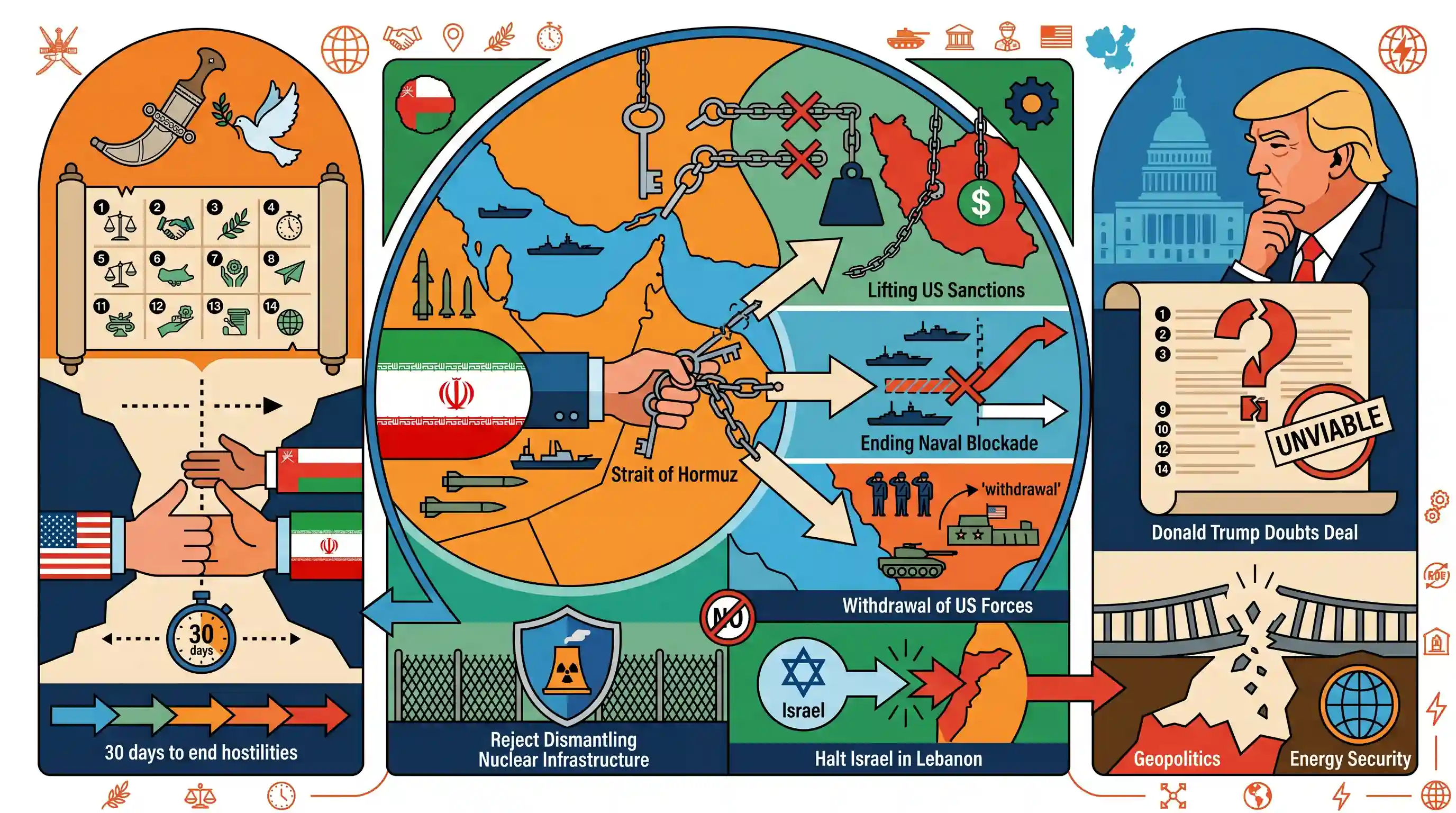
Iran has submitted a 14-point peace proposal to the United States, facilitated by Omani mediation, aiming to end ongoing regional hostilities within 30 days. The plan conditions a gradual reopening of the Strait of Hormuz on major US concessions, including lifting sanctions, ending its naval blockade, and withdrawing forces from the region. It also demands a halt to Israel's military actions in Lebanon and rejects the dismantling of Iran's nuclear infrastructure. US President-elect Donald Trump has expressed doubt that the sweeping demands will lead to a viable deal.
Key Points
- Iran presented a 14-point proposal to the United States to secure a definitive 30-day peace plan rather than merely extending an expiring ceasefire in the ongoing regional conflict.
- Key Iranian demands include the lifting of US sanctions, release of frozen funds, ending the US naval blockade, and a broader withdrawal of US forces from the region.
- The proposal calls for a cessation of all hostilities, notably including an end to Israel's military actions in Lebanon, and a mutual non-aggression pledge.
- Iran envisions a gradual reopening of the strategically vital Strait of Hormuz but firmly rejects any demands to dismantle its nuclear infrastructure.
- Donald Trump expressed skepticism regarding the proposal, casting doubt on whether it would lead to a viable agreement.
- Oman's Foreign Minister Badr al-Busaidi played a central role in mediating the proposal between Tehran and Washington.
Important Terms
14-point proposal

A 2026 Iranian diplomatic framework demanding the lifting of sanctions, U.S. military withdrawal, and cessation of Israeli actions in Lebanon in exchange for a phased reopening of the Strait of Hormuz.
UPSC context
GS-II: International Relations. Tests understanding of West Asian geopolitics, bilateral diplomacy, and conflict resolution mechanisms in a multipolar world.
30-day peace plan
A proposed timeline by Tehran to transition from a temporary ceasefire to a permanent end of hostilities with the U.S. and Israel within one month.
UPSC context
GS-II: International Relations. Relevant for studying crisis management timelines and the efficacy of fast-track diplomacy in prolonged regional conflicts.
Strait of Hormuz
A strategic maritime chokepoint between the Persian Gulf and Gulf of Oman; it is the world's most critical artery for global oil and LNG trade.
UPSC context
GS-I: World Geography / GS-III: Energy Security. Tests knowledge of maritime trade routes and their impact on India’s energy security.
Naval Blockade
A military operation to restrict shipping to and from a country's ports; used by the U.S. in 2026 to pressure the Iranian economy during negotiations.
UPSC context
GS-II: International Relations. Relevant to maritime security and the effect of policies of developed countries on India's energy interests.
Omani Mediation
The diplomatic role of the Sultanate of Oman as a neutral facilitator between the U.S. and Iran, leveraging its balanced foreign policy to bridge communication gaps.
UPSC context
GS-II: International Relations. Tests knowledge of regional actors' roles in stability and India's "Extended Neighborhood" policy.
Prelims Trap
"The Strait of Hormuz connects the Persian Gulf directly to the Red Sea."
UPSC frequently swaps water bodies for West Asian straits. Hormuz links the Persian Gulf to the Gulf of Oman; the Red Sea is accessed via Bab-el-Mandeb.
Static Concepts Connected
What is the geographical and economic significance of the Strait of Hormuz?
- Strategic Location: It is a narrow maritime chokepoint situated between Iran to the north and Oman/UAE to the south.
- Connectivity: It serves as the sole sea passage linking the oil-rich Persian Gulf to the Gulf of Oman and the wider Arabian Sea.
- Energy Security: It facilitates roughly 20% of the world's global petroleum liquids consumption, making it the world's most critical energy chokepoint.
What was the core framework of the Joint Comprehensive Plan of Action (JCPOA)?
- Parties Involved: An agreement between Iran and the P5+1 nations (US, UK, France, Russia, China, plus Germany) signed in 2015.
- Core Trade-off: Iran agreed to strictly limit and monitor its nuclear enrichment activities in exchange for comprehensive relief from UN, US, and EU economic sanctions.
- Collapse: The US unilaterally withdrew in 2018 under the Trump administration, reimposing harsh sanctions and triggering Iran's gradual departure from the nuclear constraints.
Cross-Topic Patterns
Chabahar Port and US Secondary Sanctions
Iran's diplomatic isolation and US secondary sanctions directly threaten India's investments in the Chabahar Port and the International North-South Transport Corridor (INSTC), complicating access to Central Asia.
Oman as the Middle East's diplomatic bridge
Unlike other GCC nations, Oman leverages its unique Ibadi demographic and strict non-interventionist foreign policy to act as the primary, trusted back-channel mediator between Tehran and Washington.

Map-based matching of West Asian straits (Hormuz, Bab-el-Mandeb) with bordering nations is highly probable in 2026 Prelims.
Linked PYQs · 2
Linked PYQs · 2
- 2012MainsGS2
How have the US sanctions against Iran affected India's bilateral relations with Iran?
- 2022MainsGS2
How will I2U2 (India, Israel, UAE and USA) grouping transform India's position in global politics?
