Iran Peace Proposal and West Asia Conflict De-escalation Plan
Source:Indian Express ↗
Why It Matters
The Strait of Hormuz is one of the world's most critical chokepoints for oil shipments. An agreement to reopen it and de-escalate the broader US-Iran and Israel-Lebanon conflicts is vital for global energy security and macroeconomic stability. For India, which relies heavily on Middle Eastern energy imports and has a large diaspora in the region, the outcome of these peace negotiations directly impacts its economic interests and strategic foreign policy maneuvers.
Summary
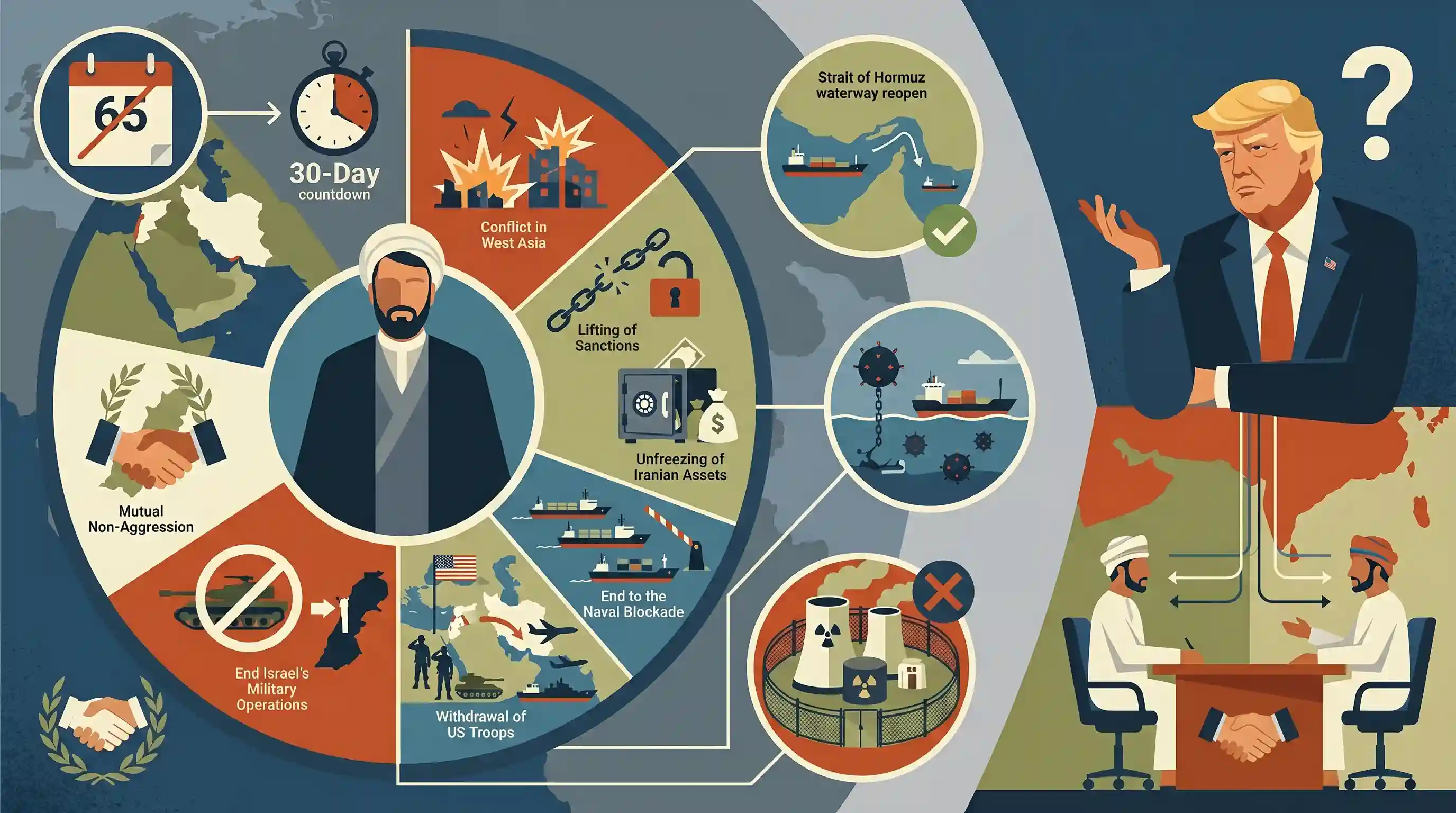
Iran has presented a 14-point peace proposal to the United States aimed at ending the ongoing 65-day conflict in West Asia within a 30-day timeframe. The comprehensive plan demands significant concessions from Washington, including the lifting of sanctions, the unfreezing of Iranian assets, an end to the naval blockade, and a complete withdrawal of US troops from the region. Furthermore, Iran insists on an end to Israel's military operations in Lebanon and mutual nonaggression pledges. In exchange, Iran offers a phased reopening of the vital Strait of Hormuz and commits to clearing sea mines, though it staunchly refuses to dismantle its nuclear infrastructure. US President Donald Trump has voiced strong doubts about the viability of the proposal, while Omani diplomats continue their historical role as regional mediators.
Key Points
- Iran has submitted a 14-point proposal to the US to end the ongoing 65-day conflict in West Asia within 30 days, rather than extending the current fragile ceasefire.
- Key demands include the lifting of US sanctions, the release of frozen funds, ending the US naval blockade, and the withdrawal of US forces from the region.
- The plan calls for an immediate end to all hostilities, specifically including Israel's war in Lebanon, along with mutual pledges of nonaggression.
- Under the proposal, the strategic Strait of Hormuz would be gradually reopened in the first phase, with Iran taking responsibility for clearing sea mines.
- Iran explicitly rejects any demands to dismantle its nuclear infrastructure as part of the deal.
- US President Donald Trump has expressed skepticism regarding the proposal, citing Iran's historical actions over the past 47 years.
Important Terms
14-point proposal

A May 2026 Iranian diplomatic framework demanding sanctions removal, asset unfreezing, and US regional withdrawal within 30 days to end the West Asia conflict.
UPSC context
GS Paper II (International Relations); tests knowledge of regional security architectures and Iranian diplomatic strategy.
Nine-point plan
A preceding US diplomatic offer (Trump administration) suggesting a two-month ceasefire extension and stricter nuclear/missile limits, to which the 14-point plan was a rebuttal.
UPSC context
GS Paper II (IR); concerns US foreign policy tools and negotiation tactics in the Middle East.
Strait of Hormuz
The world's most critical maritime oil chokepoint between the Persian Gulf and Gulf of Oman, central to global energy security and recent US-Iran military standoffs.
UPSC context
GS Paper I (Geography) and Paper II (IR); focuses on global trade routes and India's energy security interests.
Naval Blockade
A military operation preventing vessels from entering or leaving a country; the US current blockade of Iranian ports is a primary target for lifting in peace talks.
UPSC context
GS Paper III (Internal Security/Maritime Security); tests understanding of UNCLOS and coercive economic diplomacy.
Mutual Nonaggression Pledge
A proposed diplomatic commitment within the 14-point plan where the US, Israel, and Iran agree to refrain from military strikes against each other.
UPSC context
GS Paper II (IR); important for analyzing regional de-escalation and long-term conflict resolution frameworks.
Prelims Trap
"The Strait of Hormuz serves as the critical maritime chokepoint connecting the Red Sea to the Arabian Sea."
This geographically confuses it with the Bab-el-Mandeb strait. The Strait of Hormuz connects the Persian Gulf to the Gulf of Oman.
Static Concepts Connected
What are the primary maritime chokepoints in the West Asian region?
- Strait of Hormuz: Connects the Persian Gulf to the Gulf of Oman and Arabian Sea. Bordered by Iran, Oman, and the UAE. Crucial for global oil transit.
- Bab-el-Mandeb: Connects the Red Sea to the Gulf of Aden and Arabian Sea. Bordered by Yemen, Djibouti, and Eritrea.
- Suez Canal: Artificial sea-level waterway in Egypt connecting the Mediterranean Sea to the Red Sea, separating the African continent from Asia.
How do unilateral US sanctions on Iran affect India's strategic interests?
- Energy Security: Sanctions previously forced India to halt cheap crude oil imports from Iran to avoid secondary sanctions under mechanisms like CAATSA.
- Regional Connectivity: Limits foreign investment and complicates banking channels for India's strategic Chabahar Port and the International North-South Transport Corridor (INSTC).
- Payment Mechanisms: The exclusion of Iran from the SWIFT system necessitates complex, alternative bilateral arrangements like the Rupee-Rial payment mechanism.
Cross-Topic Patterns
Maritime Chokepoints + Macroeconomic Inflation
Disruptions in the Strait of Hormuz immediately spike global crude prices, directly expanding India's Current Account Deficit (CAD) and driving imported inflation in the domestic economy.
Geopolitics + Eurasian Connectivity (INSTC)
Peace or escalation between the US and Iran dictates the operational viability and financing of India's Eurasian connectivity gateways, specifically the Chabahar Port and the INSTC.

Expect a 2026 map-based question pairing West Asian straits (Hormuz, Bab-el-Mandeb) with bordering countries and conflict zones.
Linked PYQs · 5
Linked PYQs · 5
- 2012MainsGS2
How have the US sanctions against Iran affected India's bilateral relations with Iran?
- 2025MainsGS2
"Energy security constitutes the dominant kingpin of India's foreign policy, and is linked with India's overarching influence in Middle Eastern countries.” How would you integrate energy security with India's foreign policy trajectories in the coming years?
- 2024PrelimsGS1
Consider the following statements : Statement-I : Sumed pipeline is a strategic route for Persian Gulf oil and natural gas shipments to Europe. Statement-II : Sumed pipeline connects the Red Sea with the Mediterranean Sea. Which one of the following is correct in respect of the above statements?
- 2017PrelimsGS1
Mediterranean Sea is a border of which of the following countries? 1. Jordan 2. Iraq 3. Lebanon 4. Syria Select the correct answer using the code given below:
- 2022PrelimsGS1
The term "Levant" often heard in the news roughly corresponds to which of the following regions?
