Iran submits fourteen point peace proposal to United States
Source:Indian Express ↗
Why It Matters
The US-Iran conflict directly impacts global energy markets and maritime trade routes, particularly through the Strait of Hormuz. For India, maintaining balanced relations with both nations while securing energy supplies and protecting diasporic interests in West Asia remains a critical strategic priority.
Summary
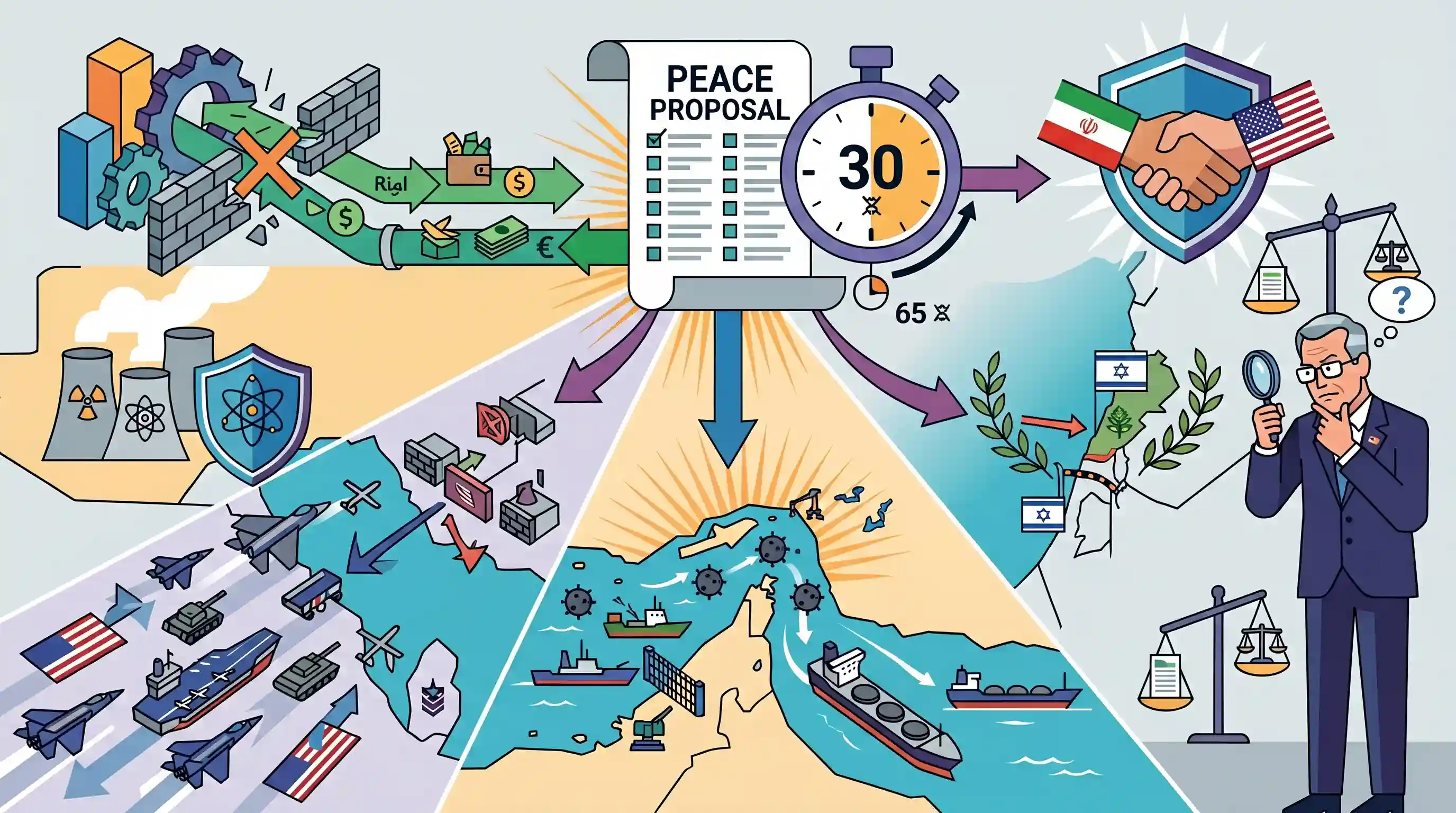
Iran has submitted a comprehensive 14-point peace proposal to the United States designed to formally end their ongoing 65-day conflict within 30 days. The ambitious plan outlines several major concessions demanded by Tehran, including the immediate lifting of economic sanctions, the release of frozen financial assets, and the withdrawal of US military forces from the region. Crucially, the proposal addresses maritime security by advocating for the gradual reopening of the vital Strait of Hormuz and the cessation of the US naval blockade, with Iran offering to take charge of clearing sea mines. It also links regional stability to the broader geopolitical landscape by demanding a halt to Israel's military actions in Lebanon and mutual non-aggression pledges. However, the proposal faces significant hurdles, notably Iran's outright refusal to dismantle its nuclear infrastructure and skepticism from the US administration.
Key Points
- Iran has presented a 14-point proposal to the US aiming to end the 65-day war within 30 days instead of extending the existing fragile ceasefire.
- Key demands include the lifting of US sanctions, release of frozen funds, withdrawal of US forces, and the end of the US naval blockade.
- The proposal calls for an end to hostilities across the region, including Israel's war in Lebanon, and mutual pledges of non-aggression.
- Maritime aspects of the plan include the gradual reopening of the Strait of Hormuz and Iran taking responsibility for clearing sea mines.
- Iran firmly rejects the dismantling of its nuclear infrastructure, a major sticking point for future negotiations.
Important Terms
Iran's 14-point Proposal

A 14-point peace framework submitted by Tehran in May 2026 to end the 65-day conflict with the US within 30 days.
UPSC context
GS Paper 2: International Relations; tests conflict resolution mechanisms and diplomatic negotiation strategies in West Asia.
Strait of Hormuz
A vital maritime chokepoint between the Persian Gulf and Gulf of Oman through which 20% of global oil passes.
UPSC context
GS Paper 1 & 3: Geography and Energy Security; critical for understanding global trade disruptions and India's energy interests.
Project Freedom
A US military operation launched in May 2026 to escort commercial vessels through the Strait of Hormuz during the Iran-US war.
UPSC context
GS Paper 2: Global Groupings; illustrates US strategic maneuvers to secure maritime trade and protect international shipping lanes.
Naval Blockade
A military strategy used to prevent access to an enemy's ports; the US applied this to Iran's coast in April 2026.
UPSC context
GS Paper 2: International Law; deals with sovereign rights and the legal ramifications of maritime warfare.
West Asia Geopolitics
The study of power dynamics and security relationships between Middle Eastern nations and global powers like the US and China.
UPSC context
GS Paper 2: International Relations; essential for analyzing India's "Look West" policy and regional stability.
Nuclear Infrastructure
Physical facilities for uranium enrichment; Iran's refusal to dismantle them remains a major hurdle in reaching a permanent peace deal.
UPSC context
GS Paper 3: Internal Security and Science; relates to nuclear non-proliferation and regional arms control.
Prelims Trap
The Strait of Hormuz is a maritime chokepoint connecting the Persian Gulf to the Red Sea.
Aspirants often confuse West Asian straits. Hormuz connects the Persian Gulf to the Gulf of Oman, while Bab el-Mandeb connects the Red Sea to the Gulf of Aden.
Static Concepts Connected
What are the key strategic maritime chokepoints in West Asia?
- Strait of Hormuz: Connects the Persian Gulf to the Gulf of Oman and Arabian Sea. It handles approximately 20-25% of global seaborne oil trade.
- Bab el-Mandeb: Connects the Red Sea to the Gulf of Aden. It is critical for maritime traffic heading toward the Suez Canal.
- Suez Canal: Artificial waterway connecting the Mediterranean Sea to the Red Sea, serving as the shortest maritime route between Europe and Asia.
How do US sanctions on Iran affect India's strategic interests?
- Energy Security: US secondary sanctions forced India to halt Iranian crude imports, disrupting the historically favorable Rupee-Rial bilateral payment mechanism.
- Chabahar Port: While Chabahar is officially exempted, over-compliance by foreign private firms delays equipment procurement, hindering India's gateway to Central Asia.
- Connectivity (INSTC): Geopolitical volatility and sanctions on Iran severely complicate the operationalization and funding of the International North-South Transport Corridor (INSTC).
Cross-Topic Patterns
INSTC & IMEC Corridors
Prolonged US-Iran friction delays India's INSTC ambitions through Chabahar, increasing the strategic necessity of the alternative India-Middle East-Europe Economic Corridor (IMEC).
Nuclear latency and JCPOA
Iran's refusal to dismantle its nuclear infrastructure revives the static UPSC theme of nuclear latency vs. weaponization in the post-JCPOA geopolitical landscape.
Sanctions & De-dollarization
The weaponization of US sanctions and freezing of Iranian/Russian assets accelerates BRICS-led initiatives to build alternative, non-dollar payment systems.

Expect a 2026 prelims pairing of West Asian straits (Hormuz/Bab el-Mandeb) with their bordering nations and connected water bodies.
Linked PYQs · 2
Linked PYQs · 2
- 2012MainsGS2
How have the US sanctions against Iran affected India's bilateral relations with Iran?
- 2017MainsGS2
The question of India's Energy Security constitutes the most important part of India's economic progress. Analyze India's energy policy cooperation with West Asian countries.
