Iran Proposes Fourteen Point Peace Plan to End West Asia Conflict
Source:Indian Express ↗
Why It Matters
The Strait of Hormuz is a crucial chokepoint for global energy supplies. Tensions between the US, Israel, and Iran directly affect global oil prices, India's energy security, and the safety of the Indian diaspora in West Asia, making it a critical topic for International Relations.
Summary
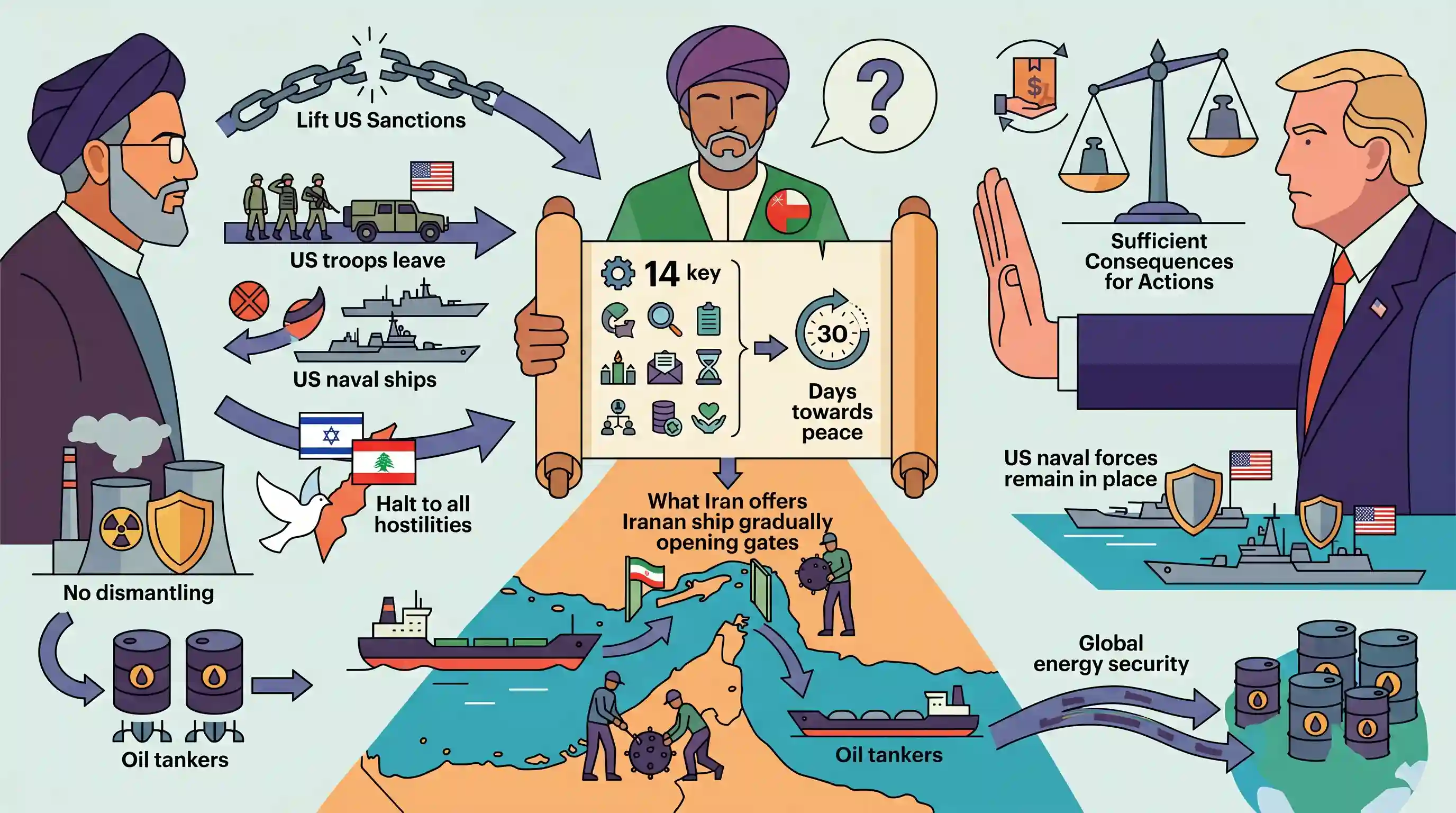
Iran has proposed a 14-point peace plan to the US aimed at concluding the 65-day conflict in West Asia within 30 days. Mediated through Oman, the proposal seeks the lifting of US sanctions, withdrawal of American forces from the region, and the lifting of the naval blockade by the US Navy. Iran also offered to oversee the gradual reopening of the critical Strait of Hormuz and manage sea mines, provided it does not have to dismantle its nuclear infrastructure. However, the plan demands a halt to all regional hostilities, including Israel's actions in Lebanon. US President Donald Trump has cast doubt on the viability of the proposal, raising concerns over whether Iran is facing sufficient consequences for its actions.
Key Points
- Iran submitted a 14-point peace proposal to the US, aiming to end the ongoing 65-day war in West Asia within 30 days rather than extending the existing ceasefire.
- Key demands from Iran include the lifting of US sanctions, release of frozen funds, US military withdrawal from the region, and ending the US Navy's blockade of Iran.
- The plan proposes a phased reopening of the Strait of Hormuz and Iran taking responsibility for clearing sea mines, while explicitly rejecting any dismantling of its nuclear infrastructure.
- The proposal demands a cessation of all regional hostilities, including Israel's operations in Lebanon, alongside a mutual non-aggression pledge.
- US President Donald Trump has expressed skepticism about reaching a deal, emphasizing that Iran has not yet faced sufficient consequences for its past actions.
Important Terms
Iran's 14-point Peace Proposal

A 2026 diplomatic counter-proposal by Tehran to end Middle East hostilities within 30 days, demanding U.S. military withdrawal and sanctions relief while postponing nuclear-specific negotiations.
UPSC context
GS Paper II: International Relations; crucial for understanding conflict resolution frameworks and diplomatic posturing in West Asia.
America's Nine-point Plan
A Washington-led framework proposing a two-month ceasefire, requiring Iran to immediately reopen the Strait of Hormuz and commit to nuclear constraints in exchange for conditional sanctions relief.
UPSC context
GS Paper II: Bilateral relations involving major powers and regional stability in India’s extended neighborhood.
Strait of Hormuz
The world's most critical oil transit chokepoint between the Persian Gulf and Gulf of Oman, through which approximately 20% of global petroleum liquids pass.
UPSC context
GS Paper I & III: World Geography and Energy Security; vital for India’s energy import dependency.
Economic Fury
A 2026 U.S. Treasury-led "economic blockade" designed to collapse Iran’s financial system by banning all payment forms, including digital assets and informal swaps.
UPSC context
GS Paper III: Security and Economic Statecraft; tests knowledge of unconventional warfare and financial sanctions.
Back-channel Diplomacy
Unconventional diplomatic channels (often via third parties like Oman or Pakistan) used by hostile nations to negotiate without formal recognition or public oversight.
UPSC context
GS Paper II: International Relations; relevant for studying the role of middle powers in mediating global conflicts.
Naval Blockade
The use of naval forces to prevent ships from entering or leaving a nation's ports, utilized here by the U.S. to force Iranian concessions.
UPSC context
GS Paper III: Maritime Security and International Law; concerns freedom of navigation and global trade laws.
Prelims Trap
"The Strait of Hormuz is a strategic maritime chokepoint connecting the Persian Gulf directly to the Red Sea."
UPSC often swaps the connecting water bodies of key chokepoints. Hormuz connects the Persian Gulf to the Gulf of Oman, not the Red Sea.
Static Concepts Connected
What are the critical maritime chokepoints in West Asia?
- Strait of Hormuz: Connects the Persian Gulf to the Gulf of Oman and the Arabian Sea. Crucial for global oil transit.
- Bab el-Mandeb: Connects the Red Sea to the Gulf of Aden. A key transit route for Suez Canal traffic.
- Suez Canal: Artificial waterway in Egypt connecting the Mediterranean Sea to the Red Sea, separating Africa from Asia.
What was the Joint Comprehensive Plan of Action (JCPOA)?
- P5+1 Framework: A 2015 agreement between Iran and the P5+1 (US, UK, France, China, Russia + Germany).
- Core Objective: Designed to restrict Iran's nuclear program and enrichment capabilities in exchange for lifting international economic sanctions.
- US Withdrawal: The US unilaterally withdrew from the pact in 2018 under the Trump administration, reinstating heavy sanctions on Iran.
Cross-Topic Patterns
Iran sanctions + India's Chabahar access
US sanctions on Iran directly complicate India's strategic investments in Chabahar port and the INSTC, requiring delicate diplomatic balancing by New Delhi to secure waiver exemptions for regional connectivity.
Strait of Hormuz blockade + Imported inflation
Disruptions or mining in the Strait of Hormuz threaten 20% of global oil trade, instantly spiking crude prices, widening India's current account deficit (CAD), and driving imported inflation.
Oman's "Positive Neutrality" diplomacy
Oman consistently acts as the key Arab mediator for Western-Iranian conflicts, serving as the trusted diplomatic bridge for historical treaties like the JCPOA and current ceasefire negotiations.

Map questions on West Asian chokepoints (Hormuz, Bab el-Mandeb) linked to US sanctions and India's INSTC are highly probable for 2026.
Linked PYQs · 3
Linked PYQs · 3
- 2025MainsGS2
"Energy security constitutes the dominant kingpin of India's foreign policy, and is linked with India's overarching influence in Middle Eastern countries.” How would you integrate energy security with India's foreign policy trajectories in the coming years?
- 2017MainsGS2
The question of India's Energy Security constitutes the most important part of India's economic progress. Analyze India's energy policy cooperation with West Asian countries.
- 2025PrelimsGS1
India is one of the founding members of the International North-South Transport Corridor (INSTC), a multimodal transportation corridor, which will connect
