IPCC Synthesis Report Climate Action Findings
Source:Indian Express ↗
Why It Matters
The IPCC synthesis report serves as the foundational scientific baseline for global climate negotiations, UNFCCC COPs, and national policy formulations like India's net-zero and NDC targets.
Summary
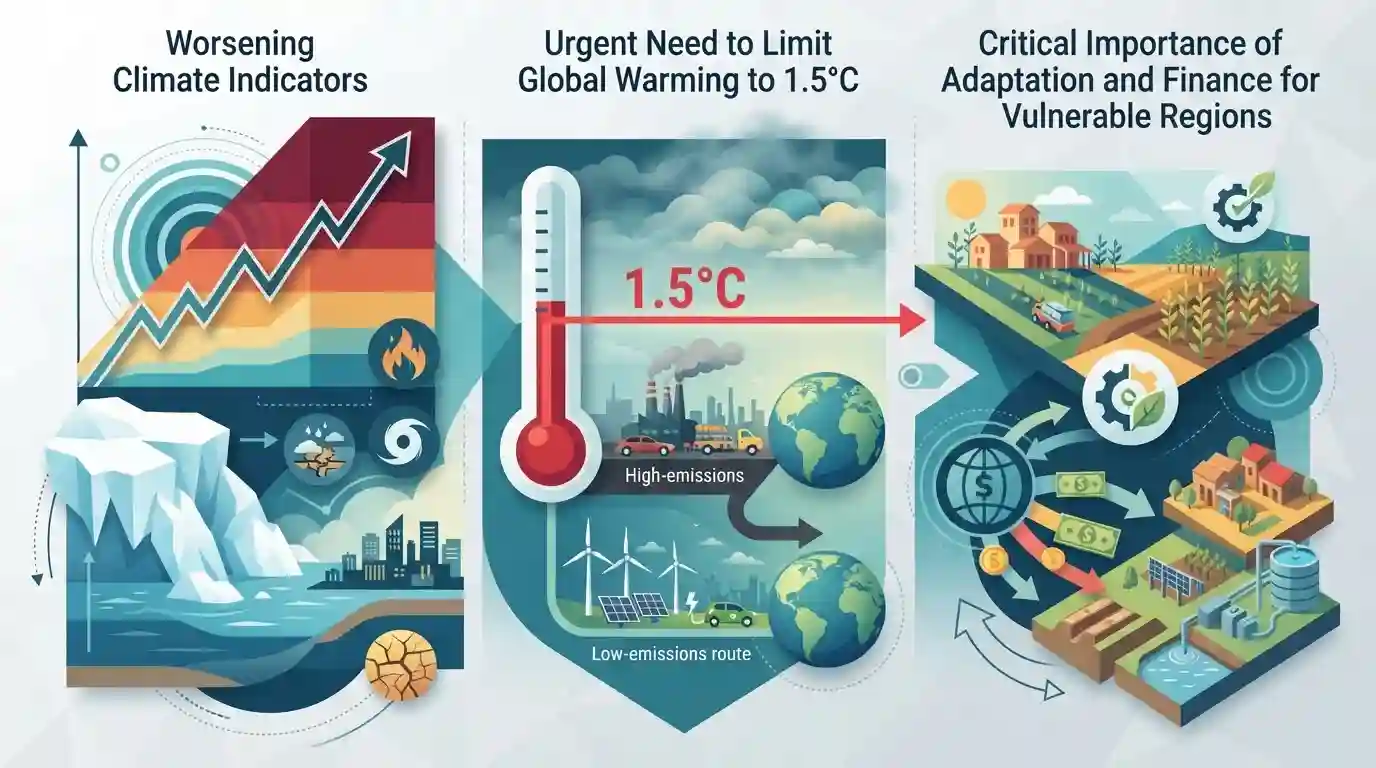
The article details the key takeaways from the Intergovernmental Panel on Climate Change (IPCC) Synthesis Report under its Sixth Assessment Report (AR6) cycle, highlighting worsening climate indicators, the urgent need to limit global warming to 1.5°C, and the critical importance of adaptation and finance for vulnerable regions.
Key Points
- The IPCC Synthesis Report integrates findings from its Sixth Assessment Cycle, summarizing the state of scientific knowledge on climate change.
- Global surface temperatures have already risen by about 1.1 degrees Celsius above pre-industrial levels due to historic and ongoing greenhouse gas emissions.
- The report emphasizes that limiting global warming to 1.5°C requires deep, rapid, and sustained reductions in global greenhouse gas emissions across all sectors.
- Climate impacts are hitting vulnerable communities hardest, and gaps in adaptation and finance remain major hurdles for developing nations.
Important Terms
Intergovernmental Panel on Climate Change (IPCC)

An intergovernmental body established by the WMO and UNEP to provide objective, scientific information on anthropogenic climate change, its risks, and adaptation options.
UPSC context
GS Paper III (Environment and Ecology); vital for studying global climate assessments, scientific reports like AR6, and international climate negotiations.
Paris Agreement
A legally binding international treaty adopted under the UNFCCC in 2015 aiming to hold global temperature rise to well below 2°C while pursuing efforts to limit it to 1.5°C.
UPSC context
GS Paper III (International Environmental Conventions); frequently tested on NDCs, global stocktakes, and emission reduction commitments.
Kyoto Protocol
An international treaty linked to the UNFCCC that committed industrialized nations to binding greenhouse gas emission reduction targets, operationalizing the principle of common but differentiated responsibilities.
UPSC context
GS Paper III (Environment and Ecology); important for understanding historical climate treaties, carbon trading, and differentiation between developed and developing countries.
Sendai Framework
A global, voluntary UN framework adopted in 2015 to prevent new and reduce existing disaster risks by focusing on disaster risk reduction across multiple sectors.
UPSC context
GS Paper III (Disaster Management); tests disaster risk reduction strategies, resilience-building, and multi-hazard approaches.
Prelims Trap
The IPCC Synthesis Report mandates legally binding emission reduction targets for member states.
Aspirants often confuse IPCC reports as policy prescriptions rather than scientific assessments; IPCC provides policy-relevant, not policy-prescriptive guidance.
Static Concepts Connected
What are the foundational bodies and reporting mechanisms of the IPCC?
- Creation & Mandate: Established in 1988 by WMO and UNEP to provide policymakers with regular scientific assessments on climate change.
- Working Groups: Comprises three working groups: WGI (Physical Science Basis), WGII (Impacts, Adaptation, Vulnerability), and WGIII (Mitigation of Climate Change).
- Assessment Role: Does not conduct original research; instead, it assesses published scientific, technical, and socio-economic literature worldwide.
Cross-Topic Patterns
Climate Science + UNFCCC Global Stocktake
IPCC assessment cycles directly inform Paris Agreement Nationally Determined Contributions (NDCs) and global stocktake negotiations under the UNFCCC.
Climate Finance + Principle of CBDR-RC
Loss and damage finance debates highlight the tension between historic emitters and developing economies in multilateral climate forums.

IPCC AR6 synthesis report findings + CBDR-RC principles will likely feature in a multi-statement environment & IR question.
Linked PYQs · 3
Linked PYQs · 3
- 2022MainsGS3
Discuss global warming and mention its effects on the global climate. Explain the control measures to bring down the level of greenhouse gases which cause global warming, in the light of the Kyoto Protocol, 1997.
- 2023MainsGS3
The Intergovernmental Panel on Climate Change (IPCC) has predicted a global sea level rise of about one metre by AD 2100. What would be its impact in India and the other countries in the Indian Ocean region?
- 2025MainsGS3
Write a review on India's climate commitments under the Paris Agreement (2015) and mention how these have been further strengthened in COP26 (2021). In this direction, how has the first Nationally Determined Contribution intended by India been updated in 2022?
