US Withdrawal from Multilateral Bodies Alters Global Governance
Source:The Hindu ↗
Why It Matters
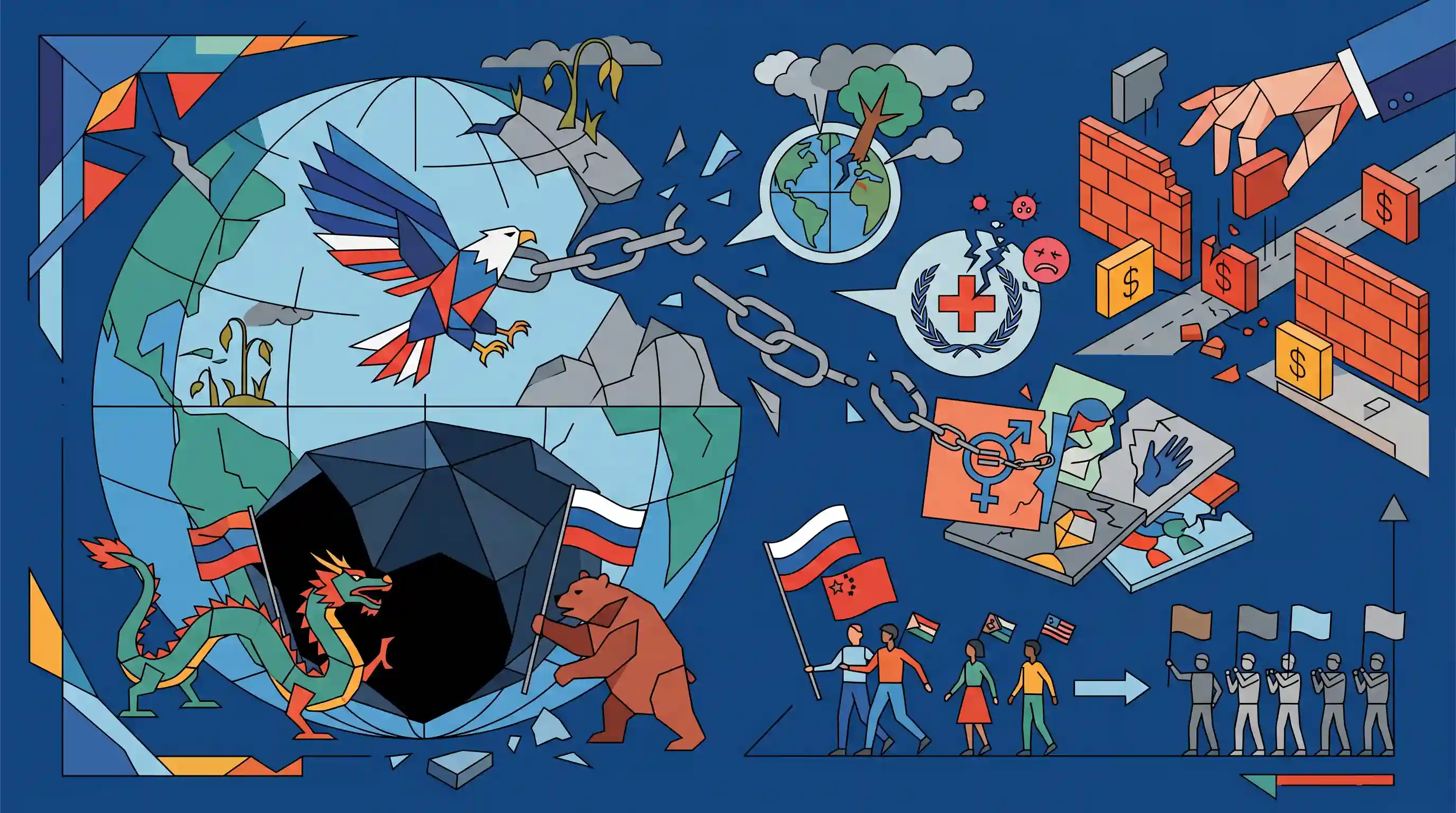
The U.S. withdrawal from multilateral institutions drastically alters the global governance landscape, directly impacting international climate finance, global health architectures, and trade. For India, this necessitates a strategic recalibration to handle the resulting power vacuum, navigate a disrupted trade order, and build new coalitions for addressing global challenges.
Summary
The editorial analyzes the second Trump administration's aggressive shift toward isolationism, marked by its withdrawal from the UNFCCC, the Paris Agreement, the WHO, and over 65 other global platforms. This retreat from international commitments severely undermines global efforts in climate action, public health, gender equality, and human rights. Furthermore, the weaponization of trade tariffs disrupts the international economic order. By abdicating its leadership role in global governance, the U.S. creates a massive geopolitical vacuum that powers like China and Russia are poised to fill, while potentially fueling ethno-nationalism globally.
Key Points
- The U.S. administration has issued executive orders to withdraw from the UNFCCC, the Paris Agreement, and over 65 other international organizations.
- Withdrawal from the WHO will drastically impact global health funding and disease surveillance, notably affecting TB, malaria, and HIV/AIDS programs in developing nations.
- The U.S. exit creates a global leadership vacuum in multilateral institutions, which is likely to be filled by strategic competitors like China and Russia.
- Alongside retreating from climate and human rights commitments, the U.S. is weaponizing trade tariffs, threatening the global economic order.
- This pure isolationism signifies an inward turn that could fuel ethno-nationalism and undermine global cooperation on gender equality, minority rights, and the rule of law.
Important Terms
Paris Agreement

A 2015 legally binding international treaty aiming to limit global temperature rise to well below 2°C (preferably 1.5°C) above pre-industrial levels through voluntary national climate commitments (NDCs).
UPSC context
GS-III Environment. Tests knowledge of global climate accords, India’s NDC commitments, and the impact of major powers’ withdrawal on climate finance.
UN Framework Convention on Climate Change (UNFCCC)
A 1992 environmental treaty providing a framework for intergovernmental efforts to stabilize greenhouse gas concentrations and combat 'dangerous human interference' with the global climate system.
UPSC context
GS-III Conservation and Climate Change. Foundational for understanding the evolution of global climate policy and annual Conference of the Parties (COP) negotiations.
World Health Organization (WHO)
A specialized UN agency established in 1948 responsible for coordinating international public health, setting global health norms, and managing health emergencies and pandemic preparedness.
UPSC context
GS-II Social Sector/Health. Significant for global health governance, institutional reforms, and the impact of funding shifts on international health security.
Isolationism
A foreign policy approach advocating for non-involvement in the political affairs, alliances, and conflicts of other nations to prioritize domestic sovereignty, self-reliance, and protectionism.
UPSC context
GS-II Effect of policies of developed countries. Relevant for analyzing shifts in major powers' foreign policy and the resulting geopolitical vacuums.
Global Governance
The collaborative management of global affairs through international institutions, treaties, and norms designed to facilitate cooperation and address transnational challenges like climate change and economic stability.
UPSC context
GS-II Important International institutions. Tests knowledge of the challenges to multilateralism and the need for reforms in a multipolar world order.
United Nations (UN)
An intergovernmental organization founded in 1945 to maintain international peace and security, protect human rights, deliver humanitarian aid, and promote global sustainable development.
UPSC context
GS-II International institutions. Essential for understanding the structure and efficacy of the world's primary multilateral body in conflict resolution and governance.
Prelims Trap
A country withdrawing from the Paris Agreement automatically ceases to be a party to the parent UNFCCC.
Withdrawing from the Paris Agreement (Article 28) does not end UNFCCC membership. However, withdrawing from the UNFCCC automatically terminates Paris Agreement membership.
Static Concepts Connected
What are the primary funding mechanisms of the World Health Organization (WHO)?
- Assessed Contributions: Calculated based on a country's wealth and population; covers core administrative and regular budget expenses.
- Voluntary Contributions: Donated by member states and private entities (e.g., Gates Foundation); often earmarked for specific health programs like polio or HIV/AIDS.
- US Dominance: The US has historically been the largest single contributor, making its withdrawal catastrophic for voluntary program funding.
How does the withdrawal mechanism work for the UNFCCC and the Paris Agreement?
- Paris Agreement Rules: Under Article 28, a party can give notice of withdrawal three years after entry into force, taking effect one year later.
- UNFCCC Umbrella: Under Article 25, any party withdrawing from the Convention is automatically considered to have withdrawn from any protocol (like Paris).
Cross-Topic Patterns
Climate finance deficit & Global South
US withdrawal shrinks the Green Climate Fund, forcing developing nations to rely on debt-creating bilateral loans rather than multilateral grants for climate adaptation.
Tariff barriers bypassing the WTO
Unilateral US tariffs without WTO authorization accelerate the shift from rules-based multilateral trade to transactional bilateral FTAs and minilateral economic blocs.

Expect a 2026 multi-statement question linking WHO funding mechanisms (assessed vs voluntary) with the impact of US withdrawal on TB/HIV.
Linked PYQs · 5
Linked PYQs · 5
- 2025MainsGS2
"The reform process in the United Nations remains unresolved, because of the delicate imbalance of East and West and entanglement of the USA vs. Russo-Chinese alliance.” Examine and critically evaluate the East-West policy confrontations in this regard.
- 2025MainsGS2
"With the waning of globalization, post-Cold War world is becoming a site of sovereign nationalism.” Elucidate.
- 2021MainsGS2
“The USA is facing an existential threat in the form of a China, that is much more challenging than the erstwhile Soviet Union.” Explain.
- 2025MainsGS3
Write a review on India's climate commitments under the Paris Agreement (2015) and mention how these have been further strengthened in COP26 (2021). In this direction, how has the first Nationally Determined Contribution intended by India been updated in 2022?
- 2022MainsGS3
Discuss global warming and mention its effects on the global climate. Explain the control measures to bring down the level of greenhouse gases which cause global warming, in the light of the Kyoto Protocol, 1997.
