Foreign Outflows and Macroeconomic Pressures on Indian Economy
Source:The Hindu ↗
Why It Matters
The article highlights the vulnerability of the Indian economy to external shocks, particularly geopolitical conflicts and global energy price fluctuations. For UPSC aspirants, this serves as a live case study on the interconnectedness of foreign portfolio investments, currency exchange rates (Rupee depreciation), import dependence (crude oil and gold), and balance of payments. It also illustrates demand-side management as a policy response to preserve forex reserves during macroeconomic stress.
Summary
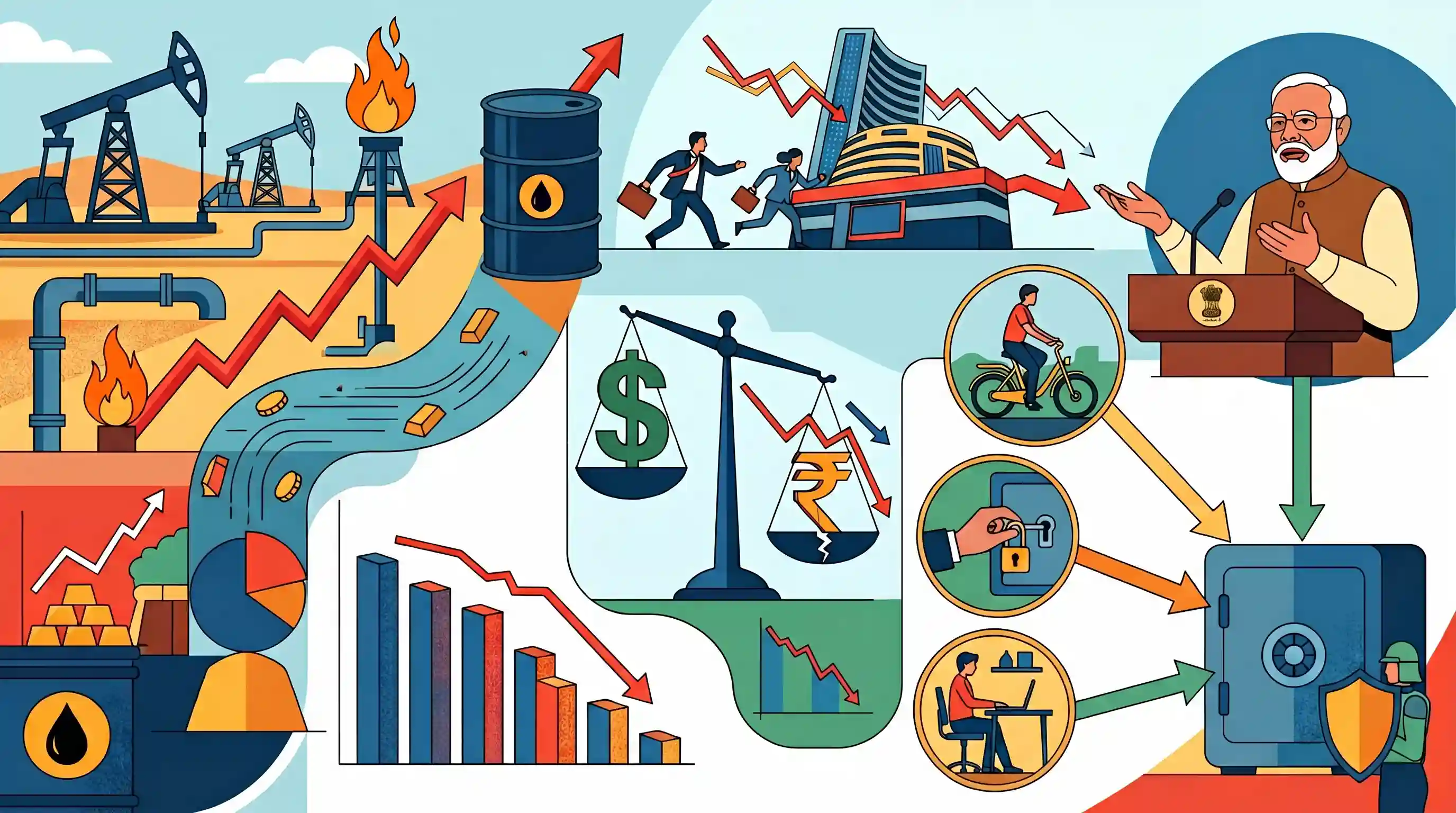
Indian equity markets extended their losses for a fourth consecutive session, driven by massive Foreign Institutional Investor (FII) outflows exceeding ₹2 lakh crore. The continuous sell-off has triggered severe currency depreciation, with the rupee hitting a record low of ₹95.6 against the US dollar. The economic pressure is largely attributed to escalating geopolitical tensions in West Asia and soaring Brent crude prices, which surged to $107.4 per barrel. In response to the growing macroeconomic strain, Prime Minister Narendra Modi has appealed to citizens to adopt austerity measures—such as reducing fuel consumption, cutting gold imports, and working from home—to help preserve the nation's foreign exchange reserves and mitigate the crisis.
Key Points
- Indian equity markets (Nifty 50 and Sensex) witnessed their fourth consecutive trading day of decline, losing over 1.8% as investors continued heavy selling.
- The Indian Rupee hit a new record low of ₹95.6 to a US dollar, driven by capital flight and rising import costs.
- Foreign Institutional Investors (FII) have pulled out over ₹2 lakh crore in net outflows, contributing heavily to the market plunge.
- Brent Crude futures rose by 3.7% to $107.4 per barrel, exacerbating concerns about India's energy import bill and Current Account Deficit.
- PM Modi urged citizens to curtail foreign exchange-draining consumption by saving fuel, reducing gold purchases, and adopting work-from-home measures to preserve macroeconomic stability amidst the lack of de-escalation in West Asia.
Important Terms
Foreign Institutional Investors (FIIs)

Foreign entities, such as hedge funds and pension funds, that invest in Indian financial markets. Often termed "hot money," their rapid entry or exit significantly impacts market volatility and currency value.
UPSC context
GS Paper III: Economy/Capital Markets; crucial for understanding capital flows, market stability, and Balance of Payments.
Currency Depreciation
A fall in the value of the Rupee against foreign currencies (like the US Dollar) determined by market forces of demand and supply in a floating exchange rate system.
UPSC context
GS Paper III: External Sector; tests impacts on trade competitiveness, imported inflation, and external debt obligations.
Foreign Exchange (Forex) Reserves
Assets held by the central bank (RBI) in foreign currencies, gold, Special Drawing Rights (SDRs), and the IMF Reserve Tranche. They act as a buffer against external economic shocks.
UPSC context
GS Paper III: Economy; vital for managing currency volatility and maintaining national creditworthiness during crises.
Brent Crude
A major global price benchmark for sweet light crude oil extracted from the North Sea. It serves as the primary reference for India's oil import pricing.
UPSC context
GS Paper III: Energy/Infrastructure; critical for analyzing trade deficits, energy security, and inflationary pressures.
Current Account Deficit (CAD)
A situation where the total value of a country's imports of goods, services, and transfers exceeds the total value of its exports. It indicates a net outflow of foreign exchange.
UPSC context
GS Paper III: External Sector/BOP; essential for assessing macroeconomic health and reliance on foreign capital inflows.
Austerity Measures
Strict economic policies involving public spending cuts and tax increases implemented by a government to reduce budget deficits and demonstrate fiscal discipline during a financial crisis.
UPSC context
GS Paper III: Fiscal Policy; relates to government budgeting, deficit management, and its socio-economic impacts.
Reserve Bank of India (RBI)
India's central bank and regulatory body responsible for monetary policy, managing foreign exchange reserves, and ensuring the stability of the financial system.
UPSC context
GS Paper III: Indian Economy; foundational institution for banking regulation, inflation control, and external sector management.
Prelims Trap
"Massive FII outflows directly widen India's Current Account Deficit (CAD)."
FII flows are part of the Capital Account. While FII flight depreciates the rupee (indirectly affecting CAD via costlier imports), the outflow itself is purely a Capital Account transaction.
Static Concepts Connected
How do crude prices and FII flight impact India's Balance of Payments?
- Current Account: High crude prices increase the import bill, directly widening the Trade Deficit and Current Account Deficit (CAD).
- Capital Account: FII portfolio flight creates a deficit in the capital account, leading to a depletion of overall foreign exchange reserves.
- Rupee Value: This twin pressure of CAD widening and severe capital outflow fundamentally crashes the domestic currency's exchange rate.
What is imported inflation and how does a depreciating rupee trigger it?
- Mechanism: When the rupee depreciates, the domestic rupee cost of globally priced, inelastic imported goods like crude oil and electronics rises sharply.
- Cost-Push Effect: Expensive energy imports increase logistics, transportation, and production costs across all economic sectors, driving generalized cost-push inflation.
- Policy Dilemma: The RBI faces a tough tradeoff: hike interest rates to defend the rupee and curb inflation, at the risk of stifling domestic growth.
Cross-Topic Patterns
Energy Security + Strategic Petroleum Reserves
Geopolitical crude shocks directly link to India's energy security strategy, emphasizing the expansion of Indian Strategic Petroleum Reserves (ISPRL) to buffer against global supply chain disruptions.
Behavioral Economics + Macroeconomic Policy
The PM's appeal to voluntarily cut gold and fuel consumption reflects 'Nudge' theory (highlighted in previous Economic Surveys), utilizing behavioral economics to manage forex reserves instead of imposing hard import quotas.

Twin deficit risks + imported inflation + RBI forex sterilization will likely form a core multi-statement conceptual question in 2026.
Linked PYQs · 3
Linked PYQs · 3
- 2022PrelimsGS1
With reference to the Indian economy, consider the following statements: 1. If the inflation is too high, Reserve Bank of India (RBI) is likely to buy government securities. 2. If the rupee is rapidly depreciating, RBI is likely to sell dollars in the market. 3. If interest rates in the USA or European Union were to fall, that is likely to induce RBI to buy dollars. Which of the statements given above are correct?
- 2019PrelimsGS1
Which one of the following is not the most likely measure the Government/RBI takes to stop the slide of Indian rupee?
- 2018MainsGS3
How would the recent phenomena of protectionism and currency manipulations in world trade affect macroeconomic stability of India?
