Congress blames government policies for sluggish private investment
Source:The Hindu ↗
Why It Matters
This article highlights core debates around India's macroeconomic health, questioning the efficacy of supply-side interventions (like the PLI scheme and corporate tax cuts) when demand-side constraints (low wages, dwindling household savings, inequality) persist. It provides crucial arguments for GS3 questions analyzing structural bottlenecks in the Indian economy and investment climate.
Summary
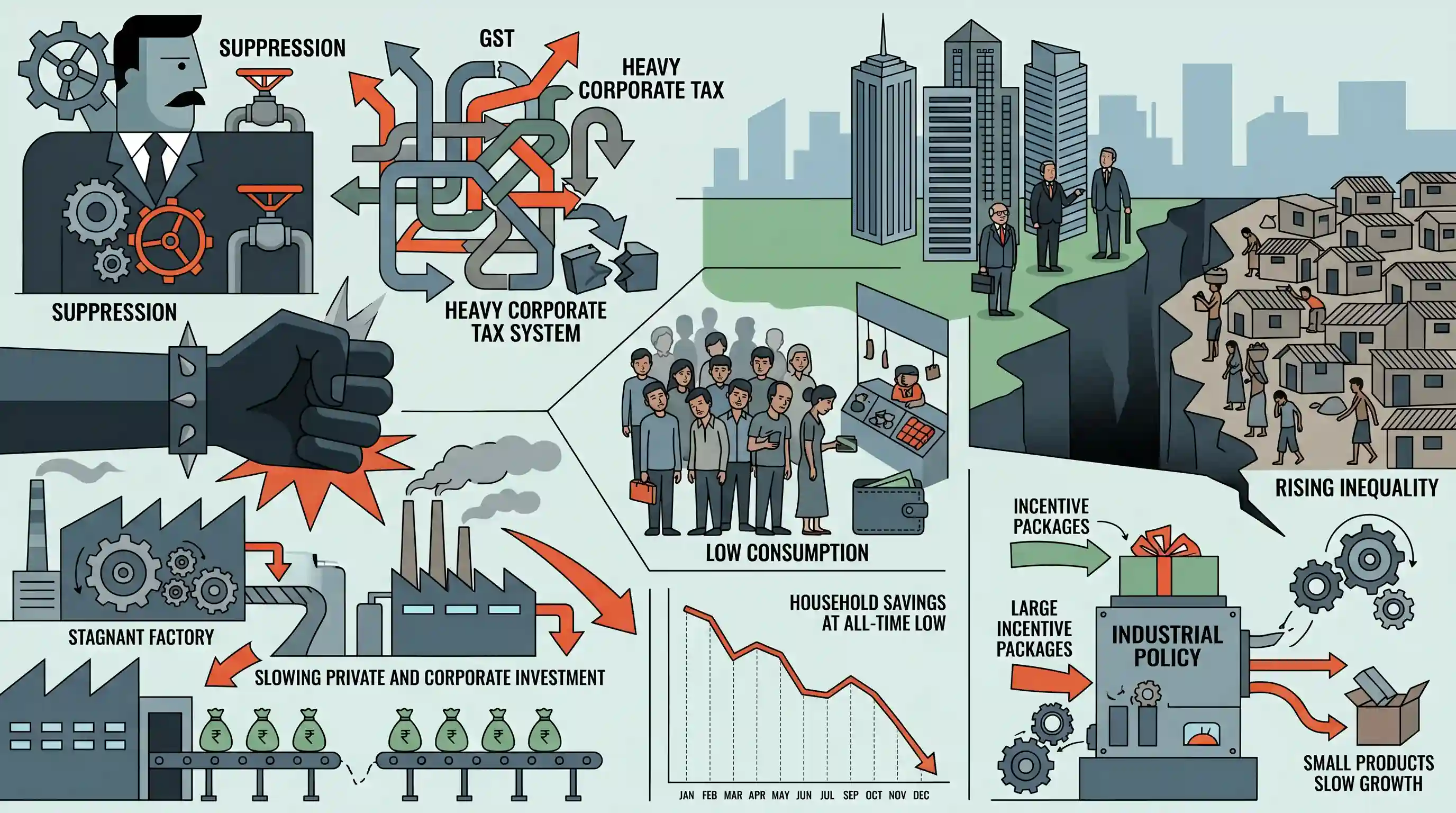
The Congress party has strongly criticized the Modi government's economic policies, attributing India's sluggish private investment and consumption slowdown to 'policies of suppression' and 'tax terrorism.' Party leaders highlighted that household savings have hit a 50-year low, and corporate investment remains stagnant despite the 2019 corporate tax cuts and the Production Linked Incentive (PLI) scheme. They cited stagnant wages, a distorted GST structure, and rising inequalities as structural barriers curbing domestic demand and corporate expansion.
Key Points
- Congress claims household savings have fallen to a 50-year low, alongside historically low interest rates on savings accounts.
- Private corporate investment remains sluggish despite supply-side incentives like the 2019 corporate tax cuts and the PLI scheme.
- A government survey indicates private sector capital expenditure may be 25% lower in 2025-26 compared to the previous year.
- Stagnant wages, a distorted GST structure, and widening inequalities are identified as structural factors constraining domestic consumption and demand.
- The opposition blames the investment depression on psychological and political factors, citing 'tax terrorism' and a general climate of fear in the corporate sector.
Important Terms
Production Linked Incentive (PLI) Scheme

A performance-linked incentive rewarding companies with 4-6% cash payouts on incremental sales from products manufactured in domestic units across 14 strategic sectors.
UPSC context
GS-III: Industrial Policy. Tests knowledge of 'Atmanirbhar Bharat' and strategies to boost domestic manufacturing and exports.
Goods and Services Tax (GST)
A destination-based, comprehensive indirect tax on the supply of goods and services, introduced via the 101st Constitutional Amendment to replace multiple cascading taxes.
UPSC context
GS-III: Fiscal Policy. Essential for understanding federal fiscal relations, indirect tax reforms, and the GST Council.
Tax Terrorism
A term describing the perceived use of aggressive, arbitrary, or retrospective tax enforcement practices by authorities that create uncertainty and harass businesses.
UPSC context
GS-III: Indian Economy. Relevant for discussions on Ease of Doing Business, administrative reforms, and investment climate.
Household Savings
The portion of disposable income not spent on consumption; net financial savings serve as the primary domestic source for funding capital investments.
UPSC context
GS-III: Mobilization of Resources. Key for analyzing domestic capital formation and long-term economic sustainability.
Private Investment
Capital expenditure by non-government entities on physical assets like machinery and factories (Gross Fixed Capital Formation) to expand production capacity.
UPSC context
GS-III: Investment Models. Central to debates on 'crowding-in' effects, economic growth engines, and corporate deleveraging.
Prelims Trap
India's overall gross household savings have plummeted to a 50-year low.
The 50-year low applies strictly to 'Net Financial' Household Savings (due to rising household debt), not gross total savings which include physical assets.
Static Concepts Connected
What comprises Net Financial Household Savings in the Indian economy?
- Gross Financial Assets: Includes currency, bank deposits, insurance funds, provident funds, and mutual fund investments.
- Financial Liabilities: Includes borrowings from commercial banks, NBFCs, and housing finance companies.
- Net Calculation: Calculated as Gross Financial Assets minus Financial Liabilities. A drop often indicates rising household borrowing.
What does Gross Fixed Capital Formation (GFCF) represent?
- Capital Additions: Measures the net additions to capital assets (machinery, buildings, infrastructure) by the public and private sectors.
- Investment Proxy: Serves as a primary proxy for investment activity and future productive capacity in the economy.
- Exclusions: Excludes land purchases, depreciation, and financial assets (like stocks or bonds) as they do not create new capacity.
Cross-Topic Patterns
Supply-side tweaks vs. Demand-side drag
Corporate tax cuts and PLI failing to crowd-in private investment illustrates a classic macro problem: supply-side incentives struggle to trigger capital expenditure when structural demand deficits and stagnant wages persist.
Retail credit boom and saving shifts
The steep drop in net financial savings directly correlates with the RBI's recent regulatory clampdowns on unsecured retail credit growth and rising household financial liabilities.

Expect a tricky 2026 Prelims statement differentiating 'Net Financial Household Savings' trends from total gross savings or GFCF.
Linked PYQs · 4
Linked PYQs · 4
- 2020MainsGS3
Explain the meaning of investment in an economy in terms of capital formation. Discuss the factors to be considered while designing a concession agreement between a public entity and a private entity.
- 2025MainsGS3
Discuss the rationale of the Production Linked Incentive (PLI) scheme. What are its achievements? In what way can the functioning and outcomes of the scheme be improved?
- 2019MainsGS3
Enumerate the indirect taxes which have been subsumed in the Goods and Services Tax (GST) in India. Also, comment on the revenue implications of the GST introduced in India since July 2017.
- 2023MainsGS3
Faster economic growth requires increased share of the manufacturing sector in GDP, particularly of MSMEs. Comment on the present policies of the Government in this regard.
