Himachal ranks high in NITI Aayog investment index for hill states
Source:face2news ↗
Why It Matters
UPSC and state civil service exams frequently ask about NITI Aayog indices, ease of doing business rankings, and state-level economic reforms. Himachal Pradesh's performance in specific pillars (like infrastructure and women workforce participation) is directly relevant to HPAS Prelims and GS3 economy questions.
Summary
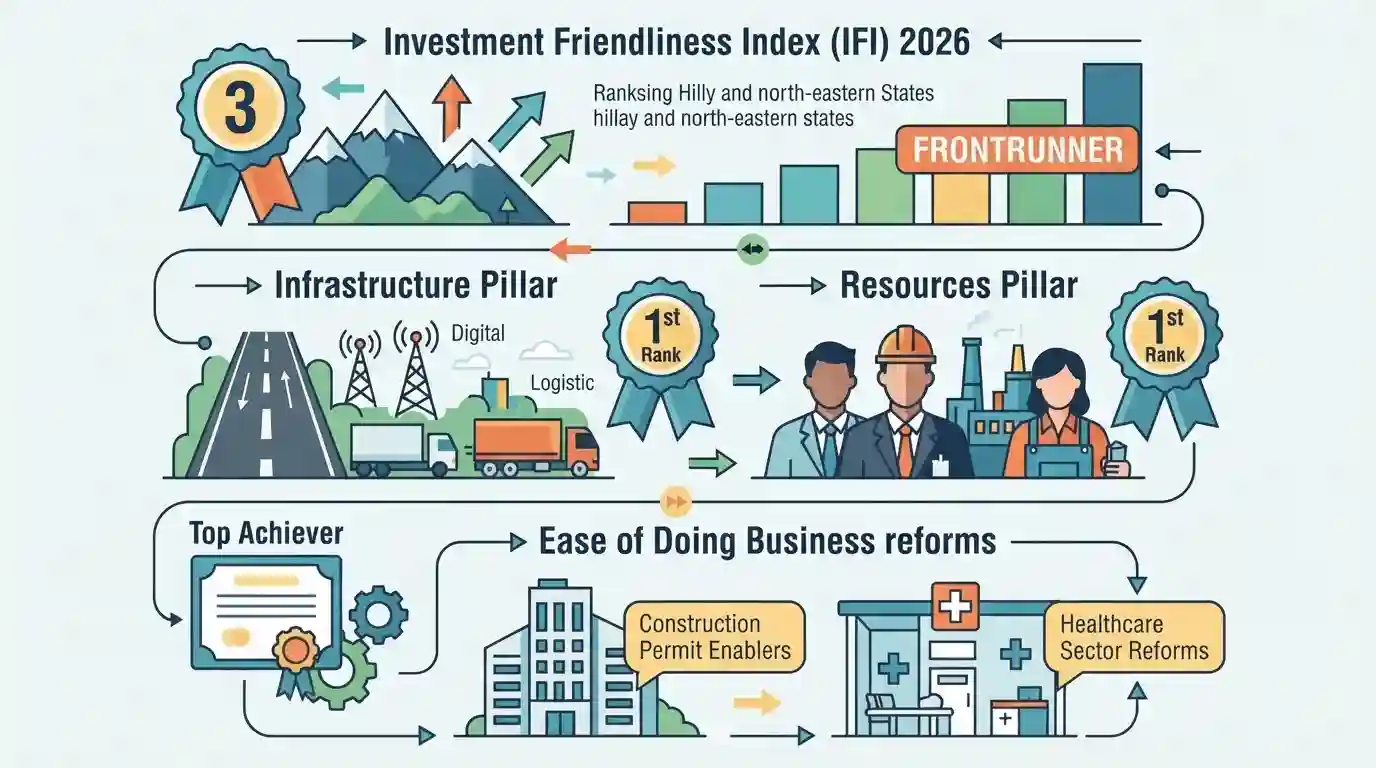
Himachal Pradesh has been ranked third among Hilly and North-Eastern States in the Investment Friendliness Index (IFI) 2026, released by NITI Aayog. Placed in the 'Frontrunner' category, the state excelled significantly in the Infrastructure and Resources Pillars, ranking first in both due to robust logistics, digital connectivity, high labour force participation, and significant women workforce involvement. The state's focus on implementing the Business Reforms Action Plan (BRAP) and upgrading its State Single Window System helped it secure 'Top Achiever' status in areas like Construction Permit Enablers and Healthcare/Services Sector Reforms.
Key Points
- Himachal Pradesh ranked 3rd among Hilly and North-Eastern States in NITI Aayog's Investment Friendliness Index (IFI) 2026, securing a spot in the 'Frontrunner' category.
- The State ranked 1st in the Infrastructure Pillar, driven by improvements in logistics, digital connectivity, and power availability.
- Himachal Pradesh also ranked 1st in the Resources Pillar, owing to high labour force participation, strong human resource indicators, and high women workforce participation.
- The state was classified as a 'Top Achiever' for Construction Permit Enablers, Healthcare Sector Reforms, and Services Sector Reforms under the Business Reforms Action Plan (BRAP).
Important Terms
Investment Friendliness Index (IFI) 2026

A NITI Aayog framework introduced in 2026 to assess the investment readiness of Indian States and UTs across eight pillars, including infrastructure and business climate, to foster competitive federalism.
UPSC context
Relevant for GS Paper 3 (Economic Development). Tests knowledge of cooperative/competitive federalism and state-level investment barometers.
Business Reforms Action Plan (BRAP)
An initiative by the DPIIT that assesses and classifies Indian states based on their implementation of targeted regulatory reforms designed to improve the ease of doing business.
UPSC context
Crucial for GS Paper 3 (Investment Models). Highlights state-level compliance reduction efforts and competitive governance for attracting investments.
State Single Window System
A centralized digital portal for investors to apply for, track, and obtain all necessary government approvals and licenses in one place, streamlining bureaucratic processes and eliminating redundant offline paperwork.
UPSC context
Essential for GS Paper 2 (e-Governance) and GS Paper 3 (Investment). Demonstrates the use of technology to ensure transparency and administrative efficiency.
NITI Aayog
The premier public policy think tank of the Government of India, established to catalyze economic development and foster cooperative and competitive federalism through continuous state-level engagement and index-based benchmarking.
UPSC context
Fundamental for GS Paper 2 (Non-Constitutional Bodies) and GS Paper 3 (Planning). Evaluates the shift from centralized planning to decentralized policy formulation.
Prelims Trap
The Investment Friendliness Index (IFI) is launched jointly by DPIIT and the World Bank.
The IFI is released by NITI Aayog. Do not confuse it with the Business Reforms Action Plan (BRAP), which is spearheaded by DPIIT.
Static Concepts Connected
What is the Business Reforms Action Plan (BRAP)?
- Nodal Agency: Formulated by the Department for Promotion of Industry and Internal Trade (DPIIT) to improve ease of doing business.
- Assessed Categories: Replaces absolute rankings with feedback-based categories like Top Achievers, Achievers, Promising, and Aspirers.
- Core Objective: Fosters competitive federalism by encouraging states to streamline regulatory processes and single-window clearances.
How does competitive federalism drive economic reforms?
- Index-driven Ranking: NITI Aayog and ministries rank states on parameters like export preparedness, innovation, and investment friendliness.
- Peer Learning: Encourages states to adopt best practices from frontrunners, improving ease of doing business nationwide.
Cross-Topic Patterns
Hill states: Fragile ecology vs Industrialization
Balancing infrastructure-led investment models in ecologically fragile hilly states with environmental safeguards, carrying capacity limitations, and disaster resilience.
Gender parity as economic infrastructure
Himachal's top resource rank highlights how high female labour force participation serves as a direct driver of regional economic competitiveness.

Expect a comparative question distinguishing NITI Aayog's competitive federalism indices from DPIIT's Business Reforms Action Plan (BRAP).
Linked PYQs · 4
Linked PYQs · 4
- 2023HPAS_PRELIMSGS1
Which organisation releases the SDG India-Index, which comprehensively documents the progress made by India's States and Union Territories towards implementing the 2030 SDG targets ?
- 2018HPAS_PRELIMSGS1
NITI Aayog's Action Agenda for enhancing digital connectivity is based on : (I) Developing software for services that can be provided digitally (II) Enhancing digital infrastructure (III) Empowering citizens digitally Select the correct answer using the codes given below :
- 2024HPAS_PRELIMSGS1
For the year 2022-23, match the Industry sub-sector in Himachal Pradesh with the percentage of workers employed in them : | List I (Industry Sub-sector) | List II (Percentage of workers employed) | |---|---| | (a) Mining and Quarrying | (i) 2 | | (b) Manufacturing | (ii) 41 | | (c) Electricity and Other Utilities | (iii) 50 | | (d) Construction | (iv) 7 | Choose the correct option : Code: (a) (b) (c) (d)
- 2023HPAS_PRELIMSGS1
Consider the following statements : (1) The sex ratio in the state is 972 females per 1000 males, which is higher than the national average of 940 females per 1000 males. (2) Service is the primary occupation of people in Himachal Pradesh, with over 90% of the population dependent on it for their livelihood. (3) Himachal Pradesh has a per capita income of Rs. 3,58,369, which is higher than the national average. (4) The state has a high Human Development Index (HDI) of 0.707, which is higher than the national average of 0.640. Choose the correct answer from the options given below :
