Polar Satellite Launch Vehicle Failures and Corrective Measures
Source:The Hindu ↗
Why It Matters
The PSLV is the backbone of India's space program and its commercial satellite launch offerings. Consecutive failures raise concerns about technical reliability at a time when India is actively pushing to privatize its space sector and capture a larger share of the global commercial space market. Understanding launch vehicle stages and ISRO's corrective mechanisms is crucial for GS-3 Science and Technology.
Summary
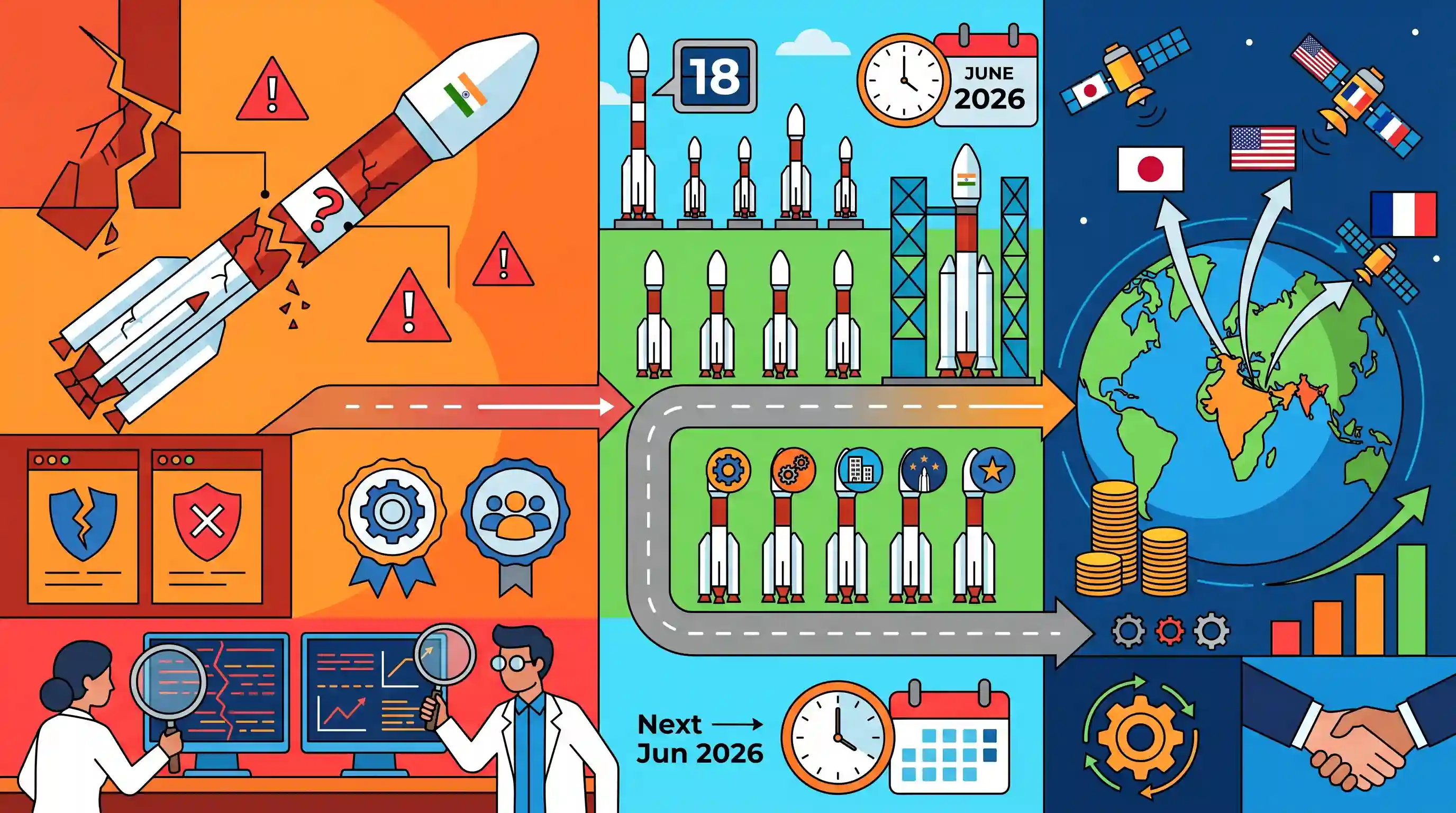
ISRO's reliable workhorse, the Polar Satellite Launch Vehicle (PSLV), is currently under investigation following two consecutive mission failures (C-61 and C-62) caused by issues in its third stage. A minister confirmed that alongside the internal Failure Analysis Committee, a third-party appraisal is underway, with the next launch targeted for June 2026. Despite these setbacks, ISRO remains confident in its launch roadmap, planning 18 missions this year—including six for Indian private space companies. Furthermore, ISRO's commercial arm continues to attract global clients, with major launches scheduled next year for Japan, the US, and France, underscoring the growing significance of India's space economy.
Key Points
- ISRO's PSLV C-62 mission failed in January 2026 due to the non-ignition of its third stage, marking the second consecutive PSLV failure after C-61 in May 2025.
- An investigation is currently ongoing, involving a Failure Analysis Committee and a third-party appraisal to identify and rectify the technical issues.
- Despite the recent setbacks, ISRO plans to resume PSLV launches by June 2026.
- ISRO retains a robust launch manifest, with 18 launches scheduled for the year, including six from private Indian players.
- Highlighting India's commercial space capabilities, ISRO has secured contracts for three major foreign launches next year for Japan, the US, and France.
Important Terms
Polar Satellite Launch Vehicle (PSLV)

India's 3rd-generation, 4-stage "workhorse" launch vehicle using alternating solid and liquid stages. It is primarily designed to deliver remote-sensing satellites into Sun-Synchronous Polar Orbits.
UPSC context
GS3 Space Technology; tests knowledge of launch vehicle architecture, payload capacities, and history of indigenous milestones.
Failure Analysis Committee (FAC)
An expert body constituted by ISRO after a mission failure to analyze telemetry data, identify technical root causes, and recommend corrective design or procedural changes.
UPSC context
GS3 Science & Technology; relevant for institutional mechanisms ensuring mission reliability and technical accountability in high-stakes projects.
NewSpace India Limited (NSIL)
A Central Public Sector Enterprise serving as ISRO's commercial arm, mandated to handle satellite building, launch services, and technology transfer to the private industry.
UPSC context
GS3 Space/Economy; covers commercialization of space, demand-driven models, and the role of PSUs in the space sector.
IN-SPACe
An independent nodal agency under the Department of Space that acts as a single-window regulator to promote and authorize private sector participation in Indian space activities.
UPSC context
GS3 Space Tech/Governance; essential for understanding space sector reforms and the regulatory framework for private "NewSpace" startups.
Space Economy
The total economic value of all activities involving space research, infrastructure, and commercial applications, targeted to reach $44 billion for India by 2033.
UPSC context
GS3 Indian Economy; focuses on growth drivers, global market share targets, and the impact of space reforms on GDP.
ISRO
India's national space agency under the Department of Space, responsible for advanced R&D, planetary exploration, and developing indigenous space technologies for national development.
UPSC context
GS3 Science & Technology; foundational entity for questions on technological self-reliance and national strategic capabilities.
Prelims Trap
"PSLV's third stage utilizes a cryogenic engine to carry heavier payloads into orbit."
PSLV is a 4-stage rocket (Solid-Liquid-Solid-Liquid). The third stage is a solid rocket motor. Cryogenic engines are used exclusively in GSLV/LVM3 upper stages.
Static Concepts Connected
How do the stages and orbital destinations of PSLV and GSLV differ?
- PSLV Stages: 4-stage vehicle alternating solid and liquid (Solid-Liquid-Solid-Liquid); relies entirely on earth-storable propellants with no cryogenic stage.
- GSLV Stages: 3-stage vehicle using solid, liquid, and a cryogenic upper stage to provide greater thrust for heavier lifts.
- Primary Use: PSLV primarily targets Low Earth (LEO) and Sun-Synchronous Polar Orbits; GSLV targets Geosynchronous Transfer Orbits (GTO).
What is the regulatory and commercial architecture of India's modernized space sector?
- NSIL: Corporate arm (PSU) under DoS managing commercial launches, technology transfer, and foreign satellite contracts.
- IN-SPACe: Autonomous nodal agency acting as a single-window regulator, authorization body, and promoter for private space entities.
Cross-Topic Patterns
FDI in Space + Private Launches
Six private launches validate India's recent liberalization of Space FDI (up to 100% in components/manufacturing), merging S&T milestones with economic deregulation.
Space Diplomacy + Strategic Partnerships
Commercial launches for the US, France, and Japan double as strategic soft-power tools, tying ISRO's economic ambitions directly to India's Indo-Pacific and bilateral IR objectives.

Multi-statement Prelims Q in 2026 likely merging PSLV structural stages (solid vs liquid) with the specific mandates of NSIL and IN-SPACe.
Linked PYQs · 2
Linked PYQs · 2
- 2018PrelimsGS1
With reference to India's satellite launch vehicles, consider the following statements: 1. PSLVs launch the satellites useful for Earth resources monitoring whereas GSLVs are designed mainly to launch communication satellites. 2. Satellites launched by PSLV appear to remain permanently fixed in the same position in the sky, as viewed from a particular location on Earth. 3. GSLV Mk III is a four-staged launch vehicle with the first and third stages using solid rocket motors; and the second and fourth stages using liquid rocket engines. Which of the statements given above is/are correct?
- 2016MainsGS3
Discuss India's achievements in the field of Space Science and Technology. How the application of this technology has helped India in its socio-economic development?
