Urban Malaria Vectors and National Disease Elimination Targets
Source:The Hindu ↗
Why It Matters
Understanding the intersection of urban ecology, invasive species, and public health is crucial for GS-2 (Issues relating to Health) and GS-3 (Science & Environment). It highlights how changing environmental factors and urbanization directly impact national disease elimination targets.
Summary
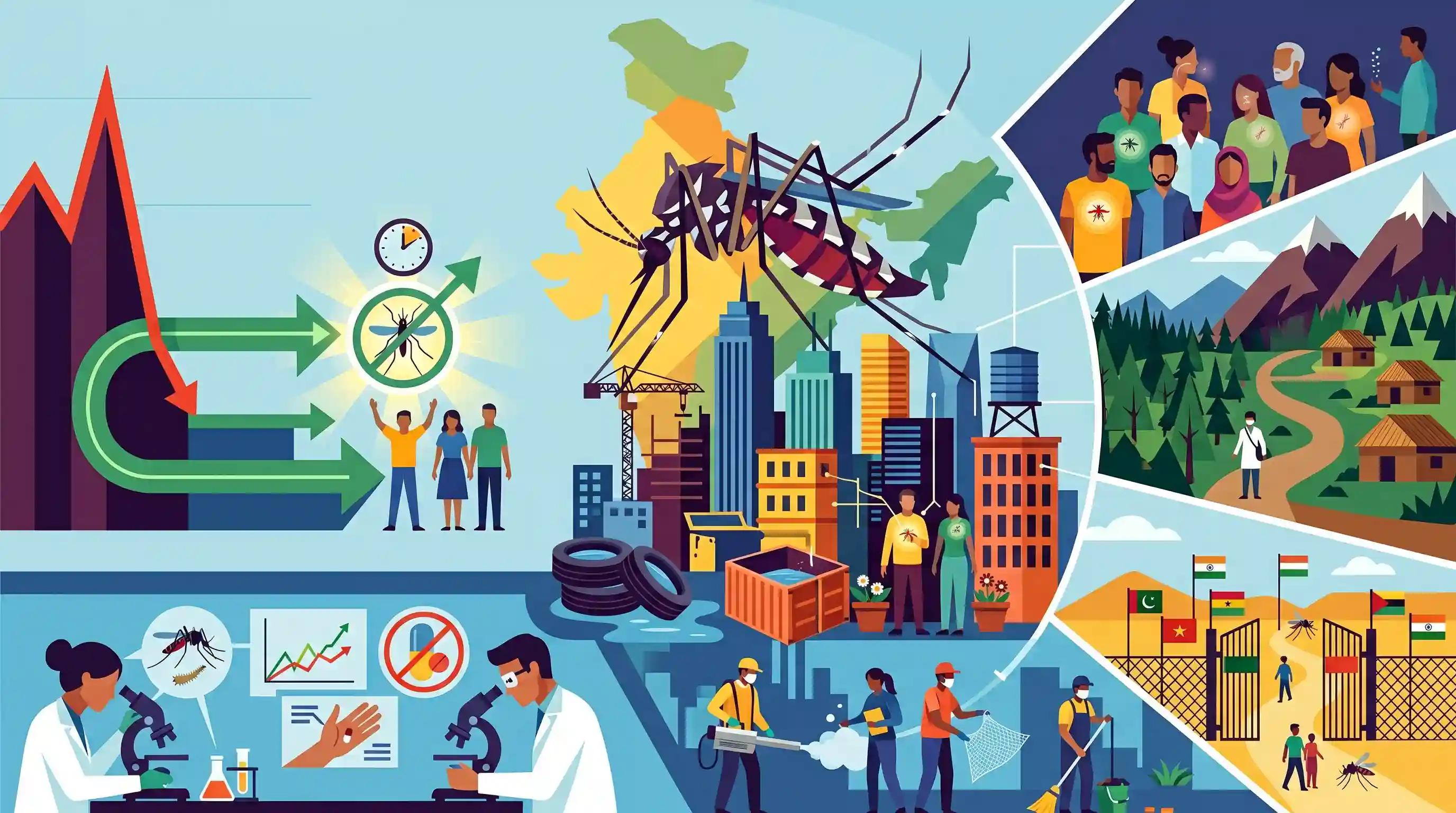
India's ambitious target to eliminate malaria by 2030 is facing significant hurdles due to the rise of urban malaria, driven by the invasive mosquito species *Anopheles stephensi*. According to the Health Ministry's Malaria Elimination Technical Report 2025, while India has successfully entered the pre-elimination phase with dramatic reductions in cases and deaths since 2015, complex challenges remain. These include asymptomatic infections, difficult terrain in high-burden states (Odisha, Tripura, Mizoram), and cross-border transmission from neighboring countries. The report underscores the need for robust operational research focusing on vector behavior, drug resistance, and targeted urban health interventions.
Key Points
- India is targeting zero indigenous malaria cases by 2027 and total elimination by 2030, aligned with the WHO global strategy.
- The spread of an invasive mosquito species, Anopheles stephensi, which thrives in urban environments by breeding in artificial containers, threatens these targets.
- Despite a 78% decline in malaria deaths and an 80% reduction in cases between 2015 and 2024, challenges like asymptomatic infections and cross-border transmission persist.
- Operational research is urgently needed to address changing vector bionomics, asymptomatic carriers, and emerging resistance to antimalarial drugs and insecticides.
Important Terms
Anopheles stephensi

An urban-adapted malaria vector that breeds in man-made containers; it is an invasive species threatening elimination goals in densely populated cities.
UPSC context
GS Paper III (Science/Environment): Knowledge of disease vectors and public health challenges related to urbanization.
National Centre for Vector Borne Diseases Control (NCVBDC)
The nodal agency under the Ministry of Health and Family Welfare (India) responsible for the prevention and control of vector-borne diseases like malaria and dengue.
UPSC context
GS Paper II (Governance): Understanding institutional frameworks for managing public health programs.
National Framework for Malaria Elimination (NFME) 2016-2030
India's strategic roadmap (2016-2030) aiming for zero indigenous malaria cases by 2027 and total national elimination by 2030.
UPSC context
GS Paper II (Social Justice/Health): Government schemes and alignment with global health targets.
Urban Malaria Scheme (UMS)
Launched in 1971, this scheme focuses on larval control and source reduction in urban areas to tackle malaria transmission in high-density settings.
UPSC context
GS Paper II/III: Urbanization challenges and specialized public health infrastructure.
Annual Parasite Incidence (API)
The primary metric used to monitor malaria burden, calculated as the number of confirmed cases per 1,000 population per year.
UPSC context
GS Paper III (Science): Technical health indicators and their role in policy categorization.
Asymptomatic Malaria
Infections where individuals carry parasites without showing symptoms, acting as "silent reservoirs" that sustain transmission and hinder elimination.
UPSC context
GS Paper III (Science/Health): Biological barriers to disease eradication.
Prelims Trap
Anopheles mosquitoes exclusively breed in natural rural habitats and do not cause urban outbreaks.
Aspirants often associate urban breeding in artificial containers solely with Aedes aegypti (dengue). Anopheles stephensi is an exception, driving 'urban malaria'.
Static Concepts Connected
How do the primary vectors and pathogens of Dengue and Malaria differ?
- Pathogen type: Dengue is a viral infection (Flavivirus), whereas Malaria is caused by a protozoan parasite (Plasmodium).
- Biting habits: Aedes mosquitoes primarily bite during daytime, while Anopheles mosquitoes are predominantly active from dusk to dawn.
- Breeding grounds: While Aedes is famously urban, Anopheles stephensi is an anomaly among Anopheles by also preferring clean water in urban artificial containers.
What are the timeline targets of the National Framework for Malaria Elimination?
- 2027 Target: Achieve zero indigenous (local) cases of malaria across all states and UTs in India.
- 2030 Target: Complete elimination and sustain zero incidence to secure WHO malaria-free certification.
- WHO Criteria: A country must prove the complete interruption of local transmission for at least three consecutive years to get certified.
Cross-Topic Patterns
Urban heat islands & vector habitats
Warming cities and erratic monsoons allow traditional vectors to colonize urban micro-climates, linking climate adaptation directly to urban public health policy.
Bio-invasions threatening human health
UPSC frequently tests agricultural invasive species. The geographic spread of Anopheles stephensi links the ecological concept of invasive alien species to epidemiological crises.

Expect a multi-statement question contrasting Aedes aegypti and Anopheles stephensi breeding habits and the 2027/2030 malaria targets.
Linked PYQs · 5
Linked PYQs · 5
- 2010PrelimsGS1
Widespread resistance of malarial parasite to drugs like chloroquine has prompted attempts to develop a malarial vaccine to combat malaria. Why is it difficult to develop an effective malaria vaccine?
- 2023PrelimsGS1
'Wolbachia method' is sometimes talked about with reference to which one of the following?
- 2023PrelimsGS1
'Invasive Species Specialist Group' (that develops Global Invasive Species Database) belongs to which one of the following organizations?
- 2012PrelimsGS1
Which of the following can be threats to the biodiversity of a geographical area? 1. Global warming 2. Fragmentation of habitat 3. Invasion of alien species 4. Promotion of vegetarianism Select the correct answer using the codes given below:
- 2014MainsGS3
Can overuse and free availability of antibiotics without Doctor's prescription, be contributors to the emergence of drug-resistant diseases in India? What are the available mechanisms for monitoring and control? Critically discuss the various issues involved.
