Ladakh Statehood Demands and Sixth Schedule Safeguards for Land
Source:The Hindu ↗
Why It Matters
The ongoing protests in Ladakh represent a crucial intersection of constitutional law (Sixth Schedule, UT vs Statehood), environmental preservation, and internal security in a border region. UPSC frequently tests the mechanics of the Sixth Schedule and the governance consequences of the 2019 J&K Reorganization Act.
Summary
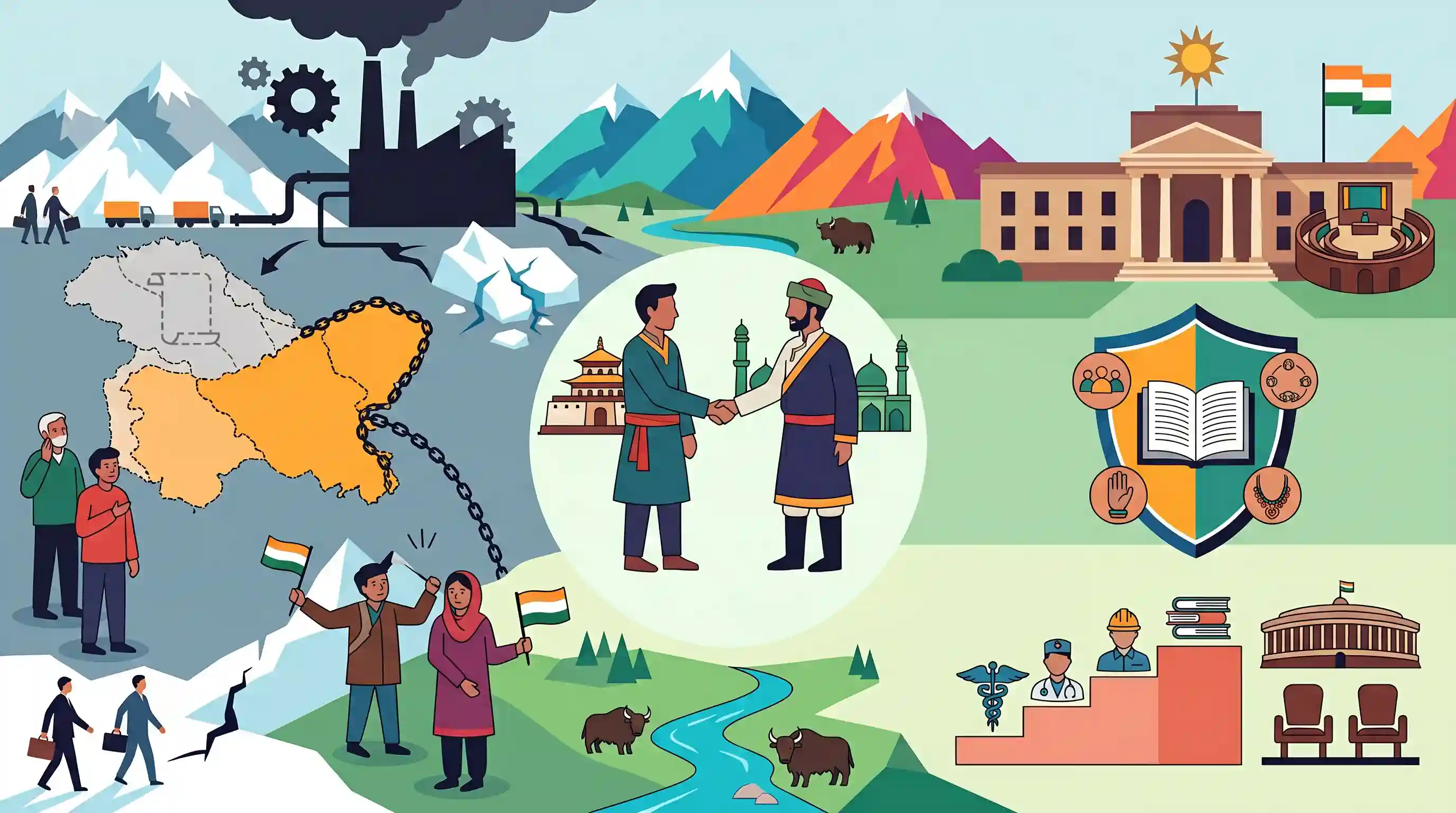
The article features an interview with Cherring Dorjay Lakruk, a prominent leader of the Leh Apex Body (LAB), detailing the ongoing agitation in Ladakh. Following the abrogation of Article 370 in 2019 and Ladakh's transition to a Union Territory without a legislature, locals have grown increasingly concerned about their political and land rights. The LAB, in unprecedented coordination with the Kargil Democratic Alliance (KDA), is demanding full statehood, inclusion in the Sixth Schedule of the Constitution, dedicated job reservations, and two parliamentary seats. The central fear driving the protests is that without robust constitutional safeguards, 'big industries and outsiders' will encroach upon tribal lands, dilute local demographics, and irreparably damage the fragile Himalayan ecosystem.
Key Points
- Ladakh leaders are leading widespread protests demanding full statehood and inclusion in the Sixth Schedule of the Constitution.
- There is deep-seated anxiety that the current Union Territory status leaves local land, jobs, and the fragile Himalayan ecosystem vulnerable to exploitation by large industries and outsiders.
- The movement has united the Buddhist-majority Leh (via LAB) and Muslim-majority Kargil (via KDA) on a common political platform.
- The underlying catalyst for these demands is the abrogation of Article 370 and the subsequent passage of the J&K Reorganization Act, 2019, which made Ladakh a UT without a legislature.
Important Terms
Sixth Schedule of the Indian Constitution

Constitutional provision (Article 244) allowing for Autonomous District Councils in tribal areas. It grants legislative, executive, and judicial powers to protect local customs, land, and resources from external encroachment.
UPSC context
GS Paper II/Polity: Tests knowledge of tribal governance, Article 244, and asymmetrical federalism in India.
Article 370
A former temporary provision that granted special autonomous status to Jammu and Kashmir, allowing it a separate constitution. It was effectively abrogated in 2019 to ensure full legal integration with India.
UPSC context
GS Paper II/Polity: Critical for understanding historical underpinnings, special status, and evolution of the Indian Constitution.
Jammu and Kashmir Reorganization Act, 2019
The 2019 Act that bifurcated the state of Jammu and Kashmir into two Union Territories: Jammu & Kashmir (with a legislature) and Ladakh (without a legislature).
UPSC context
GS Paper II/Federalism: Covers reorganization of states (Article 3) and administrative structures of Union Territories.
Leh Apex Body (LAB)
An umbrella organization of socio-political and religious groups in Leh, Ladakh. It spearheads demands for statehood, constitutional safeguards under the Sixth Schedule, and local recruitment protections.
UPSC context
GS Paper II/Governance: Illustrates the role of civil society and pressure groups in shaping federal policy and regional rights.
Kargil Democratic Alliance (KDA)
A coalition representing Kargil's socio-political interests. It collaborates with the Leh Apex Body to demand democratic representation and protection of Ladakh's fragile ecosystem and tribal identity.
UPSC context
GS Paper II/Polity: Relevant for regional aspirations, inter-regional coordination, and the "representation deficit" in Union Territories.
Prelims Trap
"Ladakh's Autonomous Hill Development Councils (LAHDCs) currently derive their legislative powers from the Sixth Schedule."
LAHDCs are statutory bodies created under a 1995 State Act, not the Constitution. The Sixth Schedule currently applies exclusively to Assam, Meghalaya, Tripura, and Mizoram.
Static Concepts Connected
What differentiates the Sixth Schedule from the Fifth Schedule?
- Geographic Applicability: The 6th Schedule applies exclusively to tribal areas in Assam, Meghalaya, Tripura, and Mizoram (AMTM), whereas the 5th Schedule covers scheduled areas in other states.
- Autonomy Level: 6th Schedule creates Autonomous District Councils (ADCs) with wide legislative, judicial, and executive powers. 5th Schedule relies on Tribes Advisory Councils with purely advisory roles.
- Governor's Role: In 5th Schedule areas, the Governor has sweeping powers to modify/exempt laws. In 6th Schedule areas, ADCs independently legislate on land, forest, and local customs.
What is the constitutional framework governing Union Territories without legislatures?
- Article 239: Administration is vested directly in the President, acting through an appointed Administrator (e.g., Lt. Governor), with no local democratic representation.
- No Assembly: Unlike Article 239A (Puducherry) or 239AA (Delhi), Ladakh lacks a local assembly, meaning it cannot enact laws on State List subjects.
- Parliamentary Supremacy: Parliament retains supreme and exclusive power to make laws on any subject across all three lists for UTs without a legislature.
Cross-Topic Patterns
Autonomy vs. ILP protections
While Ladakh demands 6th Schedule status, adjacent demands often include the Inner Line Permit (ILP) to legally restrict outsider entry, a theme repeatedly tested in North-East administrative contexts.
Glacial ecology and carrying capacity
Ladakh's agitation connects political autonomy directly to environmental survival. Unregulated industrialization threatens the cold desert's carrying capacity, echoing Himalayan ecology and Joshimath subsidence themes in GS-3.

Expect a Prelims question contrasting statutory LAHDCs with 6th Schedule ADCs, or a Mains GS-2 on UT statehood and tribal rights.
Linked PYQs · 2
Linked PYQs · 2
- 2015PrelimsGS1
The provisions in Fifth Schedule and Sixth Schedule in the Constitution of India are made in order to
- 2025MainsGS2
Discuss the nature of Jammu and Kashmir Legislative Assembly after the Jammu and Kashmir Reorganization Act, 2019. Briefly describe the powers and functions of the Assembly of the Union Territory of Jammu and Kashmir.
