Climate change impact on industrial production and economic data
Source:The Hindu ↗
Why It Matters
This editorial bridges the gap between macroeconomic indicators (IIP, GDP) and climate change, a highly relevant interdisciplinary topic for GS3. It highlights the need for institutional reform in economic data reporting to reflect the tangible impacts of climate events, essential for robust policymaking.
Summary
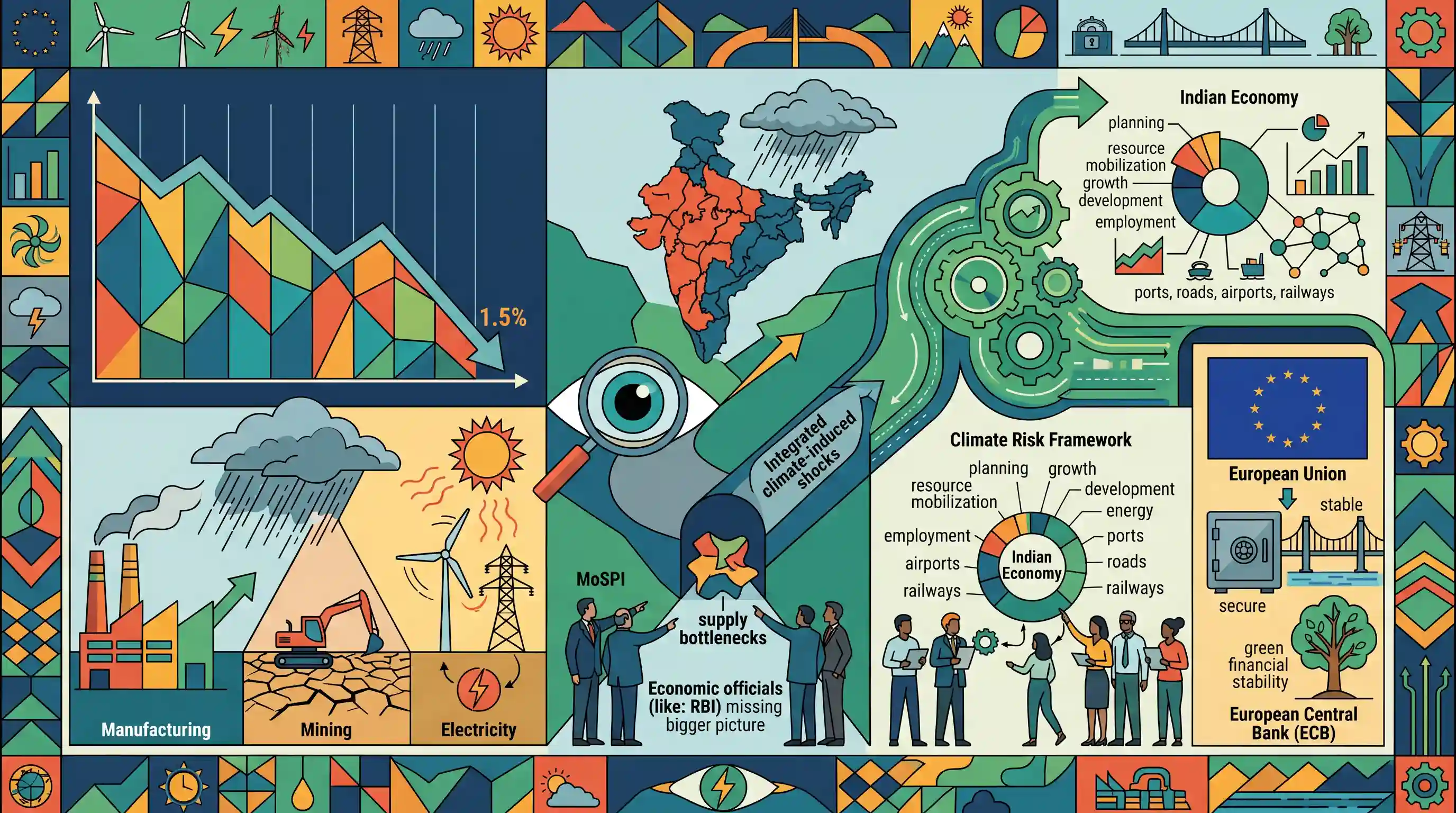
An editorial analyzing the 10-month low in India's Index of Industrial Production (IIP) growth (1.5% in June), attributing the slowdown in mining and electricity sectors to erratic monsoon patterns and climate disruptions. It highlights a critical gap in India's macroeconomic reporting by agencies like MoSPI and the RBI, which often cite supply bottlenecks rather than acknowledging climate-induced economic shocks. The piece advocates for integrating climate risk frameworks directly into economic data analysis, similar to practices adopted by European central banks.
Key Points
- India's Index of Industrial Production (IIP) growth slowed to a 10-month low of 1.5% in June, primarily due to sharp contractions in mining (-8.7%) and electricity output (-2.6%).
- The contraction was heavily influenced by climate events, specifically the early, erratic onset of the southwest monsoon which caused severe waterlogging in major mining belts and disrupted power distribution networks.
- Despite disruptions in core sectors, robust growth in capital and infrastructure goods indicates that industrial momentum remains heavily reliant on government capital expenditure.
- Unlike central banks in Europe that map climate risks to output, Indian agencies like MoSPI and RBI rarely attribute production volatility explicitly to climate-related disruptions in their main macroeconomic data releases.
- The editorial urges a systemic shift in India's macroeconomic framework to formally integrate climate risk assessments into routine economic reporting, moving beyond just referencing it in Financial Stability Reports.
Important Terms
Index of Industrial Production (IIP)

A monthly indicator measuring volume changes in India’s industrial production across mining, manufacturing, and electricity. It uses 2011-12 as the base year to track short-term industrial growth.
UPSC context
GS-3: Indian Economy; tests understanding of industrial performance indicators and their role in quarterly GDP estimations.
MoSPI
The nodal ministry for India’s official statistics, overseeing the National Statistical Office (NSO). It coordinates the collection and dissemination of critical macroeconomic data like GDP and IIP.
UPSC context
GS-3: Governance/Economy; vital for understanding the institutional framework behind national accounts and evidence-based policymaking.
Reserve Bank of India (RBI)
India’s central bank responsible for monetary policy and financial stability. It recently proposed a disclosure framework for climate-related financial risks to bolster the resilience of the banking sector.
UPSC context
GS-3: Banking/Economy; tests knowledge of monetary regulation and the evolving intersection of financial stability and climate risk.
Climate-related Financial Risks
Financial losses stemming from climate change, split into physical risks (e.g., erratic monsoons) and transition risks (e.g., costs of moving to a low-carbon economy).
UPSC context
GS-3: Environment/Economy; essential for analyzing financial sector sustainability and disaster-resilient economic planning.
European Central Bank (ECB)
The Eurozone's central bank, recognized for pioneering the integration of climate change into monetary policy via climate stress tests and 'greening' its corporate bond portfolios.
UPSC context
GS-3: Economy; serves as a global comparative model for central banking reforms to tackle environmental economic shocks.
Bank of England
The UK’s central bank, which was among the first to mandate climate-related financial disclosures and conduct stress tests on the financial system's resilience to climate scenarios.
UPSC context
GS-3: Global Economy; useful for comparative analysis of international best practices in managing systemic climate risks.
Prelims Trap
Electricity holds a higher weightage than Mining in the Index of Industrial Production (IIP).
In the IIP (base 2011-12), Manufacturing is ~77.6%, Mining is ~14.3%, and Electricity is ~7.9%. Aspirants often wrongly assume electricity holds a higher weight than mining.
Static Concepts Connected
What are the core structural features of the Index of Industrial Production (IIP)?
- Publishing Agency: Compiled and published monthly by the National Statistical Office (NSO) under the Ministry of Statistics and Programme Implementation (MoSPI).
- Base Year: The current base year for IIP calculations is 2011-12, shifted from the earlier 2004-05 base.
- Sectoral Weights: Manufacturing holds the largest weight (~77.6%), followed by Mining (~14.3%) and Electricity (~7.9%).
- Core Industries Link: The Eight Core Industries (published by DPIIT) comprise 40.27% of the total weight of items included in the IIP.
What is the difference between physical and transition climate risks?
- Physical Risks: Direct economic damages from climate events, such as unseasonal floods halting mining operations or cyclones damaging power grids and infrastructure.
- Transition Risks: Macroeconomic costs and stranded assets resulting from policy shifts, carbon taxes, and technology changes required to shift toward a low-carbon economy.
Cross-Topic Patterns
Climate Risks & Monetary Policy
Frequent climate shocks create volatile food and fuel prices (climateflation). This challenges the RBI's flexible inflation targeting framework, requiring distinct mapping from standard supply shocks.
Capex reliance & Private Investment
Industrial growth relies heavily on government Capex, raising questions about when private 'crowding in' will occur and how climate disruptions might delay private capital formation.

A multi-statement Prelims question merging IIP sector weights, RBI's climate risk recognition, and core sector data is highly likely in 2026.
Linked PYQs · 3
Linked PYQs · 3
- 2015PrelimsGS1
In the 'Index of Eight Core Industries', which one of the following is given the highest weight?
- 2025MainsGS3
Mineral resources are fundamental to the country's economy and these are exploited by mining. Why is mining considered an environmental hazard? Explain the remedial measures required to reduce the environmental hazard due to mining.
- 2022PrelimsGS1
In India, which one of the following is responsible for maintaining price stability by controlling inflation?
