Climate Disruptions Impact Industrial Output and Economic Growth
Source:The Hindu ↗
Why It Matters
Highlights the crucial intersection of environmental issues and economic stability, emphasizing the systemic risks climate change poses to Indian industrial sectors and the need for updated macroeconomic modeling.
Summary
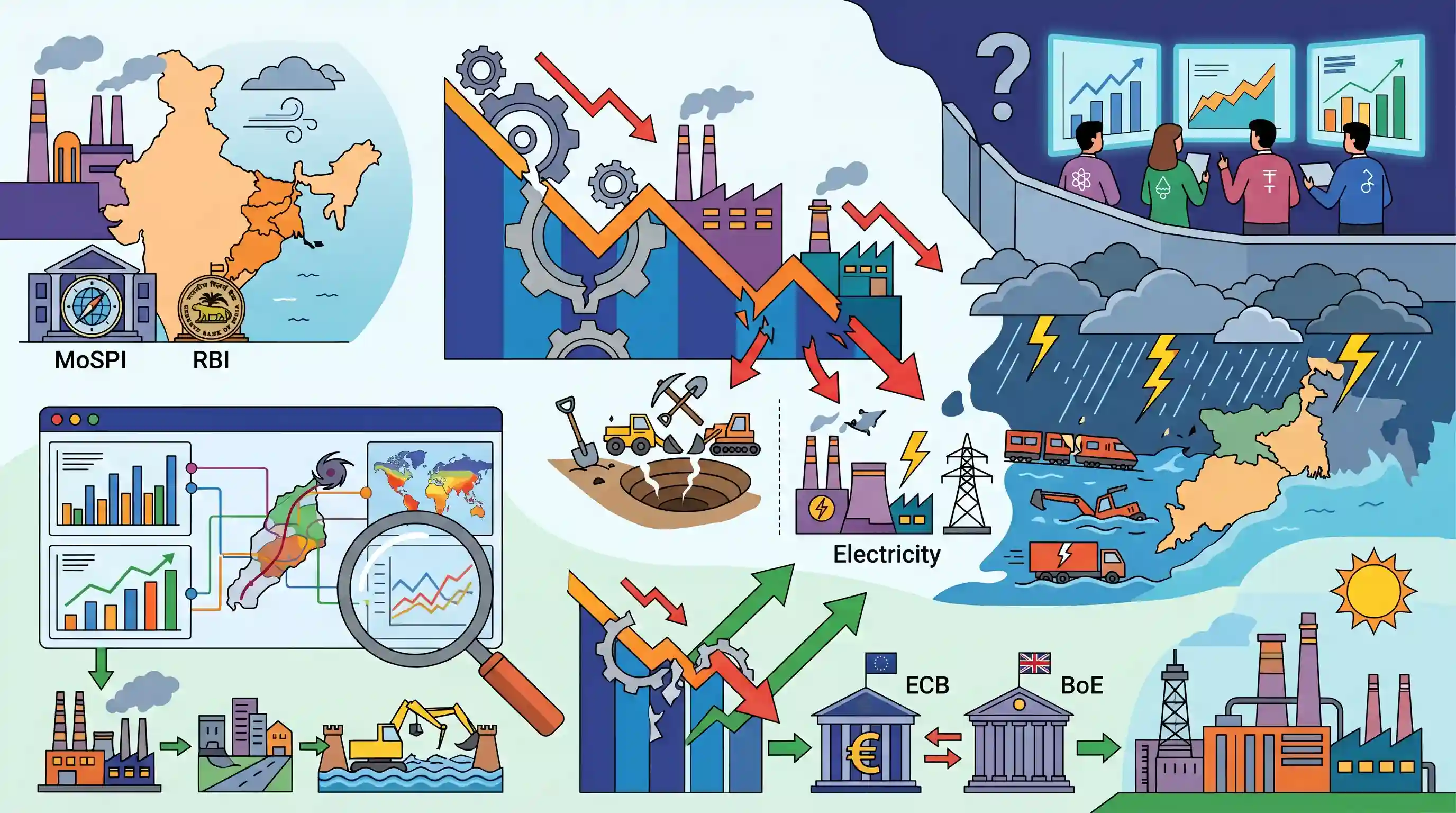
The article highlights a contraction in India's Index of Industrial Production (IIP) for June, dropping to a 10-month low of 1.5%. This decline was largely driven by contractions in mining and electricity generation caused by extreme weather and erratic monsoon patterns that disrupted supply chains and power distribution in states like Odisha, Jharkhand, and West Bengal. Despite these clear links, official macroeconomic reporting by agencies like MoSPI and RBI still relies on conventional economic explanations, neglecting the direct impact of climate events on economic disruption. The editorial urges India to integrate climate attribution frameworks into standard economic analysis, following the example of global institutions like the European Central Bank and the Bank of England, to enhance resilience against systemic climate risks.
Key Points
- India's Index of Industrial Production (IIP) growth fell to a 10-month low of 1.5% in June, primarily dragged down by significant contractions in the mining (-8.7%) and electricity (-2.6%) sectors.
- The industrial slowdown was directly linked to the erratic southwest monsoon, which caused waterlogging in mining regions (Odisha, Jharkhand, West Bengal) and damaged power infrastructure.
- Current macroeconomic reporting in India by agencies like MoSPI and RBI relies heavily on conventional economic metrics, neglecting the explicit correlation between climate events and economic disruption.
- Integrating climate attribution frameworks into economic analysis is essential for building resilience, mirroring the practices of global institutions like the ECB and Bank of England.
- The article argues for a systemic shift toward climate-integrated macroeconomic modeling to better understand vulnerabilities and plan resilient economic strategies.
Important Terms
Index of Industrial Production (IIP)

A composite monthly indicator measuring short-term changes in production volume across Mining, Manufacturing, and Electricity sectors with 2011-12 as the base year.
UPSC context
GS-III (Indian Economy); crucial for assessing industrial growth and informing RBI's monetary policy decisions.
Ministry of Statistics and Programme Implementation (MoSPI)
The nodal agency for official statistics in India, overseeing the National Statistical Office (NSO) to compile key data like IIP and CPI.
UPSC context
GS-II (Governance); provides the data backbone for evidence-based policymaking and national accounts.
Reserve Bank of India (RBI)
India's central bank responsible for monetary policy, regulating the banking system, and maintaining price stability to support economic growth.
UPSC context
GS-III (Economy); manages systemic liquidity and uses industrial data to adjust interest rates.
Climate Attribution
The scientific process of quantifying how human-induced climate change alters the frequency and intensity of specific extreme weather events.
UPSC context
GS-III (Environment); relevant for disaster risk management and integrating climate risks into economic forecasting.
Systemic Climate Risk
The potential for widespread economic or financial instability stemming from climate-related physical hazards or the transition to a low-carbon economy.
UPSC context
GS-III (Economy/Environment); tests understanding of how environmental shocks can disrupt supply chains and destabilize markets.
National Statistical Office (NSO)
The statistical agency under MoSPI responsible for conducting large-scale surveys and publishing official datasets including IIP and national GDP.
UPSC context
GS-II (Governance); the primary data-collecting body whose methodologies determine the accuracy of national economic indicators.
Prelims Trap
The Index of Industrial Production (IIP) accounts for climate disruptions by adjusting base metrics for physical climate risks.
MoSPI's IIP is a pure volumetric index of production. It currently relies strictly on conventional metrics and does not officially integrate "climate attribution frameworks", which is exactly what the editorial is demanding.
Static Concepts Connected
How is the Index of Industrial Production (IIP) structured?
- Publisher: Compiled and published monthly by the National Statistical Office (NSO) under the Ministry of Statistics and Programme Implementation (MoSPI).
- Sectoral Weights: Manufacturing holds the dominant weight (77.6%), followed by Mining (14.4%) and Electricity (8.0%).
- Core Linkage: The Index of Eight Core Industries comprises roughly 40.27% of the total weight of items included in the IIP.
What are 'Physical' and 'Transition' climate risks in economics?
- Physical Risks: Economic costs and financial losses resulting from the increasing severity and frequency of extreme climate change-related weather events (e.g., floods halting mining).
- Transition Risks: Financial risks arising from the process of adjustment towards a lower-carbon economy, such as policy shifts, carbon taxes, or stranded fossil fuel assets.
Cross-Topic Patterns
Climate Risks + Central Bank Mandates
Links climate change to banking stability via RBI's participation in the Network for Greening the Financial System (NGFS) and its draft disclosure frameworks for regulated entities.
Monsoon Geography + Core Sector Output
Shows how irregular spatial distribution of the southwest monsoon directly disrupts resource extraction in the Chota Nagpur plateau, bridging GS1 Geography with GS3 Economy.

Expect a 2026 Prelims multi-statement question linking IIP component weights with RBI’s evolving climate risk disclosure frameworks.
Linked PYQs · 4
Linked PYQs · 4
- 2015PrelimsGS1
In the 'Index of Eight Core Industries', which one of the following is given the highest weight?
- 2012PrelimsGS1
In India, in the overall Index of Industrial Production, the Indices of Eight Core Industries have a combined weight of 37.90%. Which of the following are among those Eight Core Industries? 1. Cement 2. Fertilizers 3. Natural gas 4. Refinery products 5. Textiles Select the correct answer using the codes given below:
- 2023MainsGS3
Faster economic growth requires increased share of the manufacturing sector in GDP, particularly of MSMEs. Comment on the present policies of the Government in this regard.
- 2019MainsGS3
Vulnerability is an essential element for defining disaster impacts and its threat to people. How and in what ways can vulnerability to disasters be characterized? Discuss different types of vulnerability with reference to disasters.
