Taliban Internet Shutdown Paralyzes Critical Infrastructure
Source:Indian Express ↗
Why It Matters
This event illustrates the weaponization of internet access by authoritarian regimes. For UPSC aspirants, it highlights the significance of digital rights as an enabler for socio-economic development and fundamental human rights (like women's education), while also underscoring the ongoing geopolitical and humanitarian complexities in Afghanistan under Taliban rule.
Summary
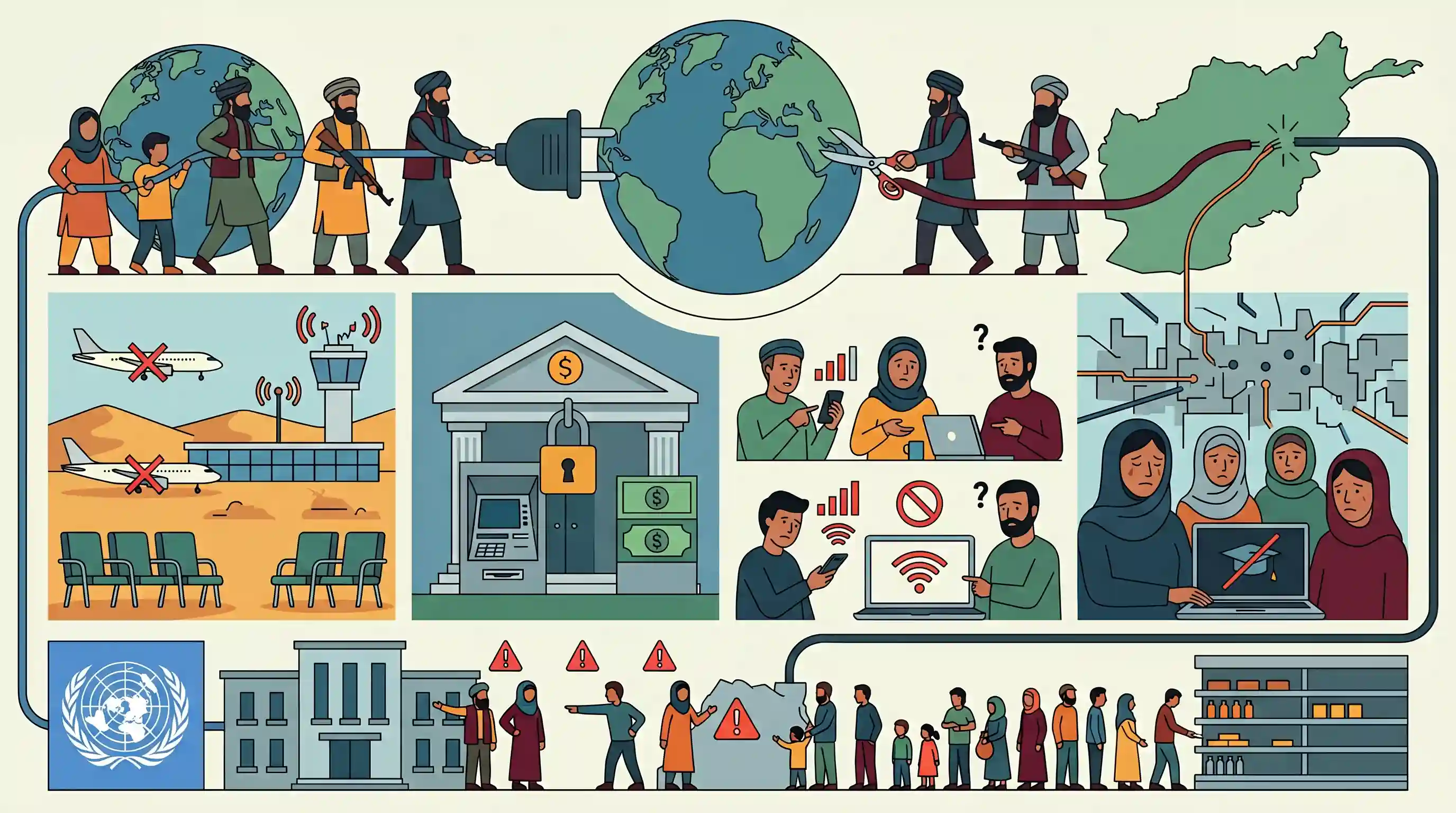
The Taliban government has imposed a nationwide internet shutdown in Afghanistan to reportedly restrict "evils," bringing vital services like flights, banking, and communications to a standstill. Kabul airport has been left deserted with flight cancellations mounting. The blackout severely impacts vulnerable populations, notably Afghan women, who relied on the internet as a final avenue for online education. The United Nations has strongly condemned the move, warning that cutting the nation off from global connectivity will exacerbate the country’s dire economic instability and humanitarian crisis.
Key Points
- The Taliban government has enforced a nationwide internet blackout in Afghanistan, aiming to restrict "evils," but severely impacting daily life and critical infrastructure.
- Kabul airport operations have virtually halted, with tracking systems showing flights as cancelled or having unknown statuses.
- The shutdown has heavily impacted banking and payment systems, cutting the country off socially and economically.
- The internet was one of the last lifelines for Afghan women seeking online education; the blackout directly worsens human rights conditions.
- The UN has warned that this action isolates Afghanistan, damages economic stability, and worsens an already severe humanitarian crisis, calling for immediate restoration.
Important Terms
Taliban

An Islamist militant group and the de facto government of Afghanistan since August 2021. They enforce a strict interpretation of Sharia law, severely restricting civil liberties.
UPSC context
GS Paper II (International Relations); critical for India’s security and "Neighborhood First" policy regarding regional stability and counter-terrorism.
Internet Shutdown
The intentional disruption of internet or electronic communications by government authorities to control information flow, often citing security or public order.
UPSC context
GS Paper II (Governance/Digital Rights); relates to Article 19 (Freedom of Speech) and the Supreme Court’s Anuradha Bhasin judgment.
United Nations (UN)
An international organization founded in 1945 to maintain global peace and security. In Afghanistan, it operates through missions like UNAMA for humanitarian coordination.
UPSC context
GS Paper II (International Institutions); evaluates the effectiveness of global bodies in crisis management and human rights protection.
Digital Rights
Human rights that allow individuals to access, use, and publish digital media, including the right to privacy and freedom of expression online.
UPSC context
GS Paper II/III (Governance/Security); explores the intersection of technology and fundamental rights in an increasingly connected world.
Humanitarian Crisis
A severe situation threatening the health, safety, and well-being of a large population, usually requiring urgent international aid and intervention.
UPSC context
GS Paper II (International Relations); focuses on global aid mechanisms, social justice, and India's role in providing regional assistance.
Prelims Trap
The Right to Internet Access is an explicitly defined absolute Fundamental Right under Article 21.
The Constitution does not explicitly mention it. The Supreme Court inferred it as a fundamental right under Articles 19 and 21, and it remains subject to reasonable restrictions.
Static Concepts Connected
What is the legal and judicial framework for internet shutdowns in India?
- Telecommunications Act 2023: Suspension of telecom and internet services is now governed by this Act, replacing older rules under the colonial-era Indian Telegraph Act, 1885.
- Anuradha Bhasin Case (2020): The Supreme Court ruled indefinite shutdowns unconstitutional. Freedom of speech and trade via the internet are protected under Articles 19(1)(a) and 19(1)(g).
- Proportionality Test: Any suspension must satisfy the test of proportionality, cannot be indefinite, and is subject to periodic review and judicial scrutiny.
What is India's current diplomatic approach towards Afghanistan?
- Pragmatic Engagement: India does not officially recognize the Taliban regime but maintains a 'technical mission' in Kabul to facilitate humanitarian aid and medical assistance.
- Strategic Concerns: Primary objectives include preventing Afghan soil from being used by anti-India terror groups and safeguarding past investments like the Salma Dam and Parliament building.
Cross-Topic Patterns
Internet shutdowns: India vs Global scrutiny
While the UN condemns Afghanistan's blackout, India frequently faces global scrutiny for having the highest number of internet shutdowns globally, usually invoked for law and order under strict rules.
Digital divide and Right to Education
The denial of online education to Afghan women mirrors previous debates on the digital divide acting as a barrier to the Right to Education (Article 21A).

Expect a Prelims question linking the Telecommunications Act 2023, Anuradha Bhasin guidelines, and Article 19 reasonable restrictions.
Linked PYQs · 2
Linked PYQs · 2
- 2021MainsGS2
Has digital illiteracy, particularly in rural areas, coupled with lack of Information and Communication Technology (ICT) accessibility hindered socio-economic development? Examine with justification.
- 2022PrelimsGS1
Consider the following countries: 1. Azerbaijan 2. Kyrgyzstan 3. Tajikistan 4. Turkmenistan 5. Uzbekistan Which of the above have borders with Afghanistan ?
