International Youth Day and Local Governance Role in SDGs
Source:Indian Express ↗
Why It Matters
The intersection of youth engagement and local governance aligns with UPSC topics like the demographic dividend, the localization of SDGs, and the empowerment of urban/rural local bodies. Understanding this dynamic is crucial for drafting Mains answers involving human capital and decentralized planning.
Summary
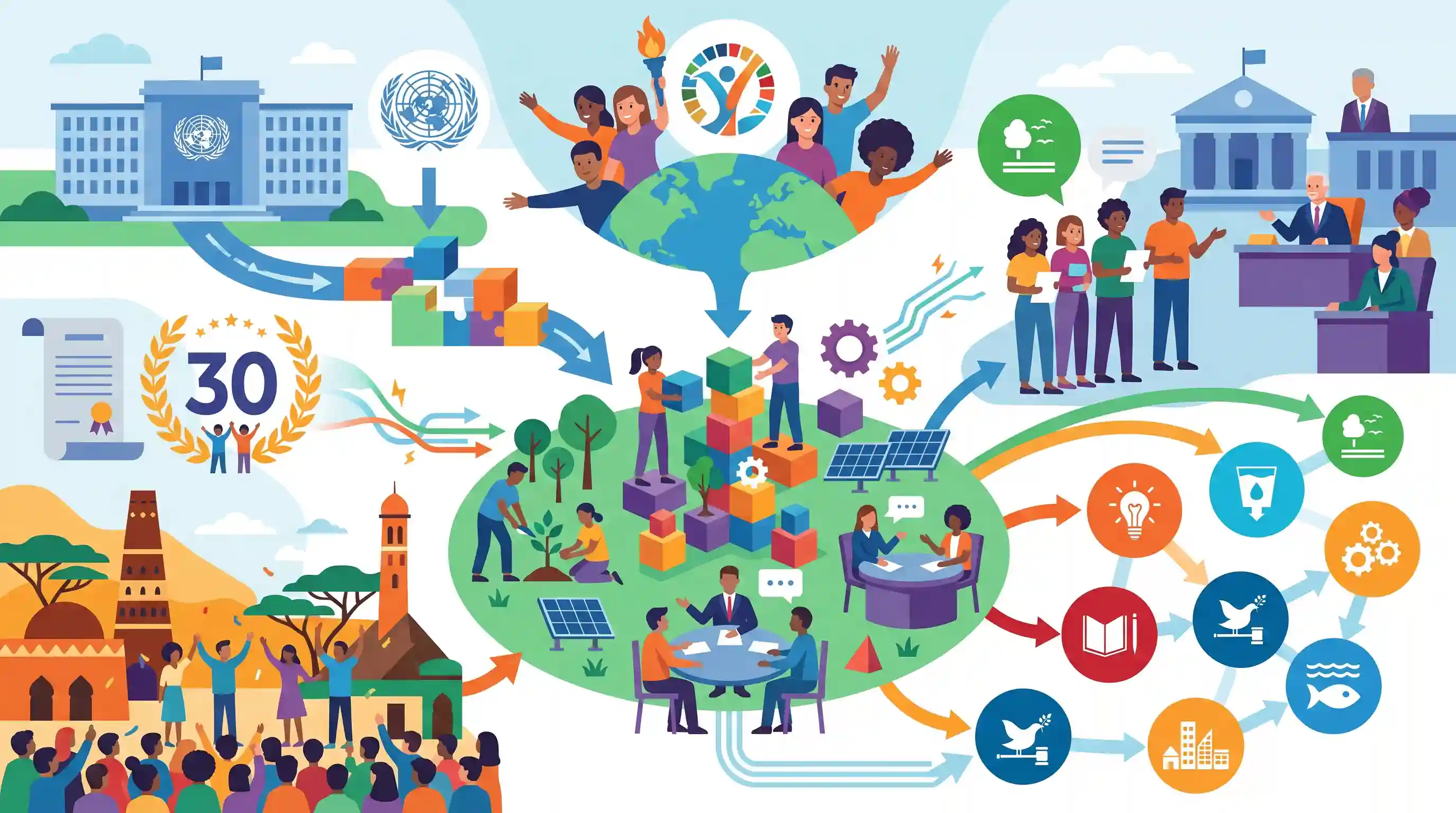
International Youth Day is observed globally on August 12. The 2025 edition, with its theme "Local Youth Actions for the SDGs and Beyond", emphasizes the critical role of young people in accelerating Sustainable Development Goals (SDGs) through active participation in municipal and regional decision-making. Highlighting the 30th anniversary of the World Programme of Action for Youth, the principal celebrations are organized in Nairobi, Kenya, in collaboration with UN-Habitat. From a civil services perspective, the theme reinforces the necessity of integrating youth empowerment (demographic dividend) with local governance to achieve decentralized and sustainable development.
Key Points
- International Youth Day 2025 is scheduled for August 12 with the theme 'Local Youth Actions for the SDGs and Beyond'.
- The 2025 observance highlights the pivotal role of youth participation in local planning and decision-making to accelerate SDG implementation.
- Main celebrations will be anchored in Nairobi, Kenya, in partnership with UN-Habitat.
- This year marks the 30th anniversary of the World Programme of Action for Youth.
Important Terms
Sustainable Development Goals (SDGs)

A collection of 17 interlinked global objectives adopted by the UN in 2015, designed to serve as a 'blueprint for peace and prosperity' by 2030.
UPSC context
GS Paper 2 & 3; crucial for topics on poverty, inequality, and sustainable development.
UN-Habitat
The United Nations programme for human settlements and sustainable urban development, mandated to promote socially and environmentally sustainable towns and cities.
UPSC context
GS Paper 2; international institutions and their role in urban governance and housing.
World Programme of Action for Youth (WPAY)
A global blueprint adopted by the UN General Assembly in 1995 to improve the wellbeing and empowerment of youth across 15 priority areas.
UPSC context
GS Paper 2; policy frameworks for vulnerable/specific demographic sections like the youth.
Demographic Dividend
The economic growth potential that can result from shifts in a population’s age structure, particularly when the working-age population outnumbers dependents.
UPSC context
GS Paper 1 & 3; essential for population studies, human resources, and economic development.
United Nations General Assembly (UNGA)
The principal deliberative, policymaking, and representative organ of the United Nations, where all member states have an equal vote.
UPSC context
GS Paper 2; fundamental component of International Relations and global institutional structure.
International Youth Day
An annual observance on August 12 to bring youth issues to the attention of the international community and celebrate their potential as partners.
UPSC context
GS Paper 2; awareness of international days and their themes related to social empowerment.
Decentralized Development
The process of distributing or dispersing functions, powers, people, or things away from a central location or authority to local bodies.
UPSC context
GS Paper 2; tests knowledge of local governance (Panchayati Raj/Municipalities) and grassroots participation.
Prelims Trap
The World Programme of Action for Youth was adopted alongside the Sustainable Development Goals in 2015.
WPAY was actually adopted in 1995 (30th anniversary in 2025), long before the SDGs. UPSC often tricks aspirants by conflating timelines of distinct UN frameworks.
Static Concepts Connected
How does India operationalize the 'Localisation of SDGs'?
- Nodal Agency: The Ministry of Panchayati Raj (MoPR) spearheads this by mapping the 17 global SDGs into 9 broad thematic areas for villages.
- Planning Tool: Gram Panchayat Development Plans (GPDPs) align local fund allocation and implementation directly with these 9 localized SDG themes.
- Oversight: NITI Aayog tracks progress at state/UT levels via the SDG India Index, while grassroots localization remains the MoPR's domain.
What are the core facts about UN-Habitat for Prelims?
- Headquarters: Located in Nairobi, Kenya (alongside UNEP), making it one of the few major UN headquarters in the Global South.
- Core Mandate: Created by UNGA to promote socially and environmentally sustainable towns and cities, and to provide adequate shelter for all.
- Flagship Report: It publishes the 'World Cities Report', a fact frequently tested in UPSC match-the-following report-to-agency questions.
Cross-Topic Patterns
SDG 11 + Demographic Dividend
UN-Habitat's involvement shifts the demographic dividend debate from mere employment generation to youth-led urban planning and sustainable municipal governance.
73rd/74th Amendment + Global Goals
Global SDG targets rely heavily on India's decentralized institutions, making the capacity building of local bodies a recurring GS2 mains theme.

Expect a 2026 Prelims statement combining UN-Habitat's mandate, its Nairobi HQ, and India's 9 localized SDG themes for Panchayats.
Linked PYQs · 4
Linked PYQs · 4
- 2016MainsGS2
Demographic Dividend in India will remain only theoretical unless our manpower becomes more educated, aware, skilled and creative." What measures have been taken by the government to enhance the capacity of our population to be more productive and employable?
- 2023MainsGS2
The crucial aspect of development process has been the inadequate attention paid to Human Resource Development in India. Suggest measures that can address this inadequacy.
- 2014MainsGS3
While we flaunt India's demographic dividend, we ignore the dropping rates of employability. What are we missing while doing so? Where will the jobs that India desperately needs come from? Explain.
- 2024MainsGS2
Analyse the role of local bodies in providing good governance at local level and bring out the pros and cons merging the rural local bodies with the urban local bodies.
