International Yoga Day Promotes Global Health and Cultural Diplomacy
Source:Indian Express ↗
Why It Matters
International Yoga Day is a prime example of India's successful soft power projection and cultural diplomacy at the United Nations. It demonstrates how ancient Indian traditions are institutionalized globally to address contemporary issues like mental health and sustainable living, a common theme in both GS1 (Art & Culture) and GS2 (International Relations).
Summary
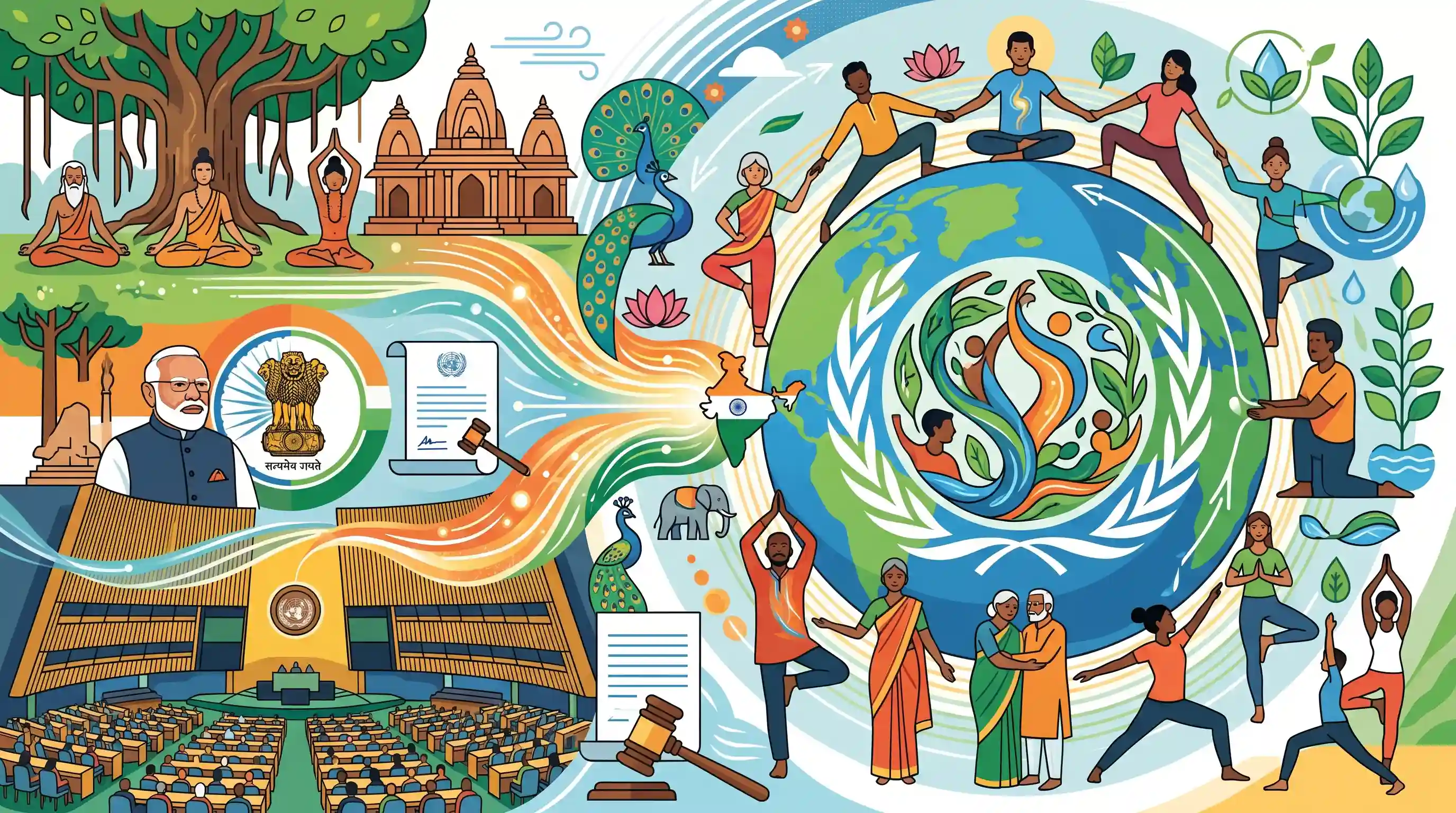
The 11th International Yoga Day, to be celebrated on June 21, 2025, will focus on the theme 'Yoga for One Earth, One Health', designated by the UN. Proposed by Prime Minister Narendra Modi in 2014 and adopted by the UN General Assembly, the day highlights the ancient Indian practice's role in harmonizing mind, body, and environment. It underscores the principle of 'Vasudhaiva Kutumbakam', showcasing Yoga as a potent instrument of India's cultural diplomacy and soft power, bridging personal well-being with global and planetary health.
Key Points
- International Yoga Day is celebrated annually on June 21. The year 2025 marks its 11th edition.
- The 2025 theme is 'Yoga for One Earth, One Health', emphasizing the deep interconnection between individual wellness and planetary sustainability.
- The concept originated from Indian Prime Minister Narendra Modi's proposal at the UN General Assembly in September 2014, leading to its unanimous adoption in December 2014.
- The day acts as a major platform for India's cultural diplomacy and 'soft power', successfully projecting the ancient Indian philosophy of 'Vasudhaiva Kutumbakam' (the world is one family) on the global stage.
Important Terms
Soft Power

A nation's ability to influence others through attraction and persuasion—using culture, political values, and foreign policies—rather than coercion (hard power) or payments.
UPSC context
GS Paper 2: International Relations; crucial for analyzing India's global influence and 'Yoga Diplomacy' as a strategic asset.
Cultural Diplomacy
A subset of public diplomacy involving the exchange of ideas, art, and language to foster mutual understanding and support a nation's foreign policy objectives.
UPSC context
GS Paper 2: International Relations; explores how India uses civilizational heritage to build bilateral ties and regional cooperation.
Vasudhaiva Kutumbakam
An ancient Sanskrit phrase from the Maha Upanishad meaning 'the world is one family,' serving as a foundational philosophy for India's inclusive global outlook.
UPSC context
GS Paper 1: Indian Culture; GS Paper 2: IR; reflects India’s ethical leadership and G20 vision of universal interconnectedness.
UN General Assembly
The main deliberative, policymaking, and representative organ of the UN; it adopted Resolution 69/131 in 2014 to establish the International Day of Yoga.
UPSC context
GS Paper 2: Important International Institutions; tests knowledge of multilateral diplomacy and India's leadership in global resolutions.
International Day of Yoga (IDY)
Celebrated annually on June 21 (Summer Solstice), this day highlights Yoga's holistic health benefits; the 2025 theme is 'Yoga for One Earth, One Health.'
UPSC context
GS Paper 1: Salient features of Indian Culture; showcases the globalization of Indian traditions and their health-policy relevance.
Prelims Trap
Yoga was recognized globally when UNESCO established the International Day of Yoga in 2014.
The International Day of Yoga was established by the UN General Assembly (UNGA), not UNESCO. UNESCO separately recognized Yoga as an Intangible Cultural Heritage later in 2016.
Static Concepts Connected
What is the geographical significance of June 21 (Summer Solstice)?
- Tropic of Cancer: The Earth's Northern Hemisphere reaches its maximum tilt towards the sun, placing the sun directly overhead at the Tropic of Cancer (23.5° N).
- Maximum Daylight: It marks the longest period of daylight and the shortest night of the year in the Northern Hemisphere.
- Arctic Circle: Places located north of the Arctic Circle experience 24 hours of continuous daylight (Midnight Sun) on this day.
What is the textual origin and meaning of 'Vasudhaiva Kutumbakam'?
- Maha Upanishad: The phrase is engraved in the entrance hall of the Parliament of India but originally originates from the ancient Sanskrit text, the Maha Upanishad (Chapter 6).
- Core Philosophy: It translates to 'The World Is One Family', representing a philosophical framework that treats all living beings—human and ecological—as a single interconnected collective.
Cross-Topic Patterns
Soft Power to Global Health Diplomacy
Yoga diplomacy is increasingly paired with institutional health initiatives, notably the establishment of the WHO Global Centre for Traditional Medicine in Jamnagar, Gujarat, shifting from soft power to hard institutional health leadership.
G20 Continuity & 'One Health' Approach
The 2025 Yoga theme explicitly mirrors India's 2023 G20 theme ('One Earth, One Family') and integrates the ecological 'One Health' approach, linking human wellness to planetary sustainability and zoonotic disease prevention.

Expect a multi-statement Prelims question pairing the textual origin of 'Vasudhaiva Kutumbakam' with India's UNESCO Intangible Heritage.
Linked PYQs · 2
Linked PYQs · 2
- 2015MainsGS2
Terrorist activities and mutual distrust have clouded India-Pakistan relations. To what extent the use of soft power like sports and cultural exchanges could help generate goodwill between the two countries? Discuss with suitable examples.
- 2020MainsGS1
Indian philosophy and tradition played a significant role in conceiving and shaping the monuments and their art in India. Discuss.
