RSS Chief Stresses Voluntary International Trade And Economic Swadeshi
Source:The Hindu ↗
Why It Matters
The statements touch upon highly relevant UPSC themes across multiple papers: global protectionism and its impact on India's macroeconomic stability (GS3), the persistent challenge of caste-based social exclusion (GS1), India's cultural diplomacy and neighborhood relations (GS2), and the ethical foundations of civic duty and social tolerance (GS4).
Summary
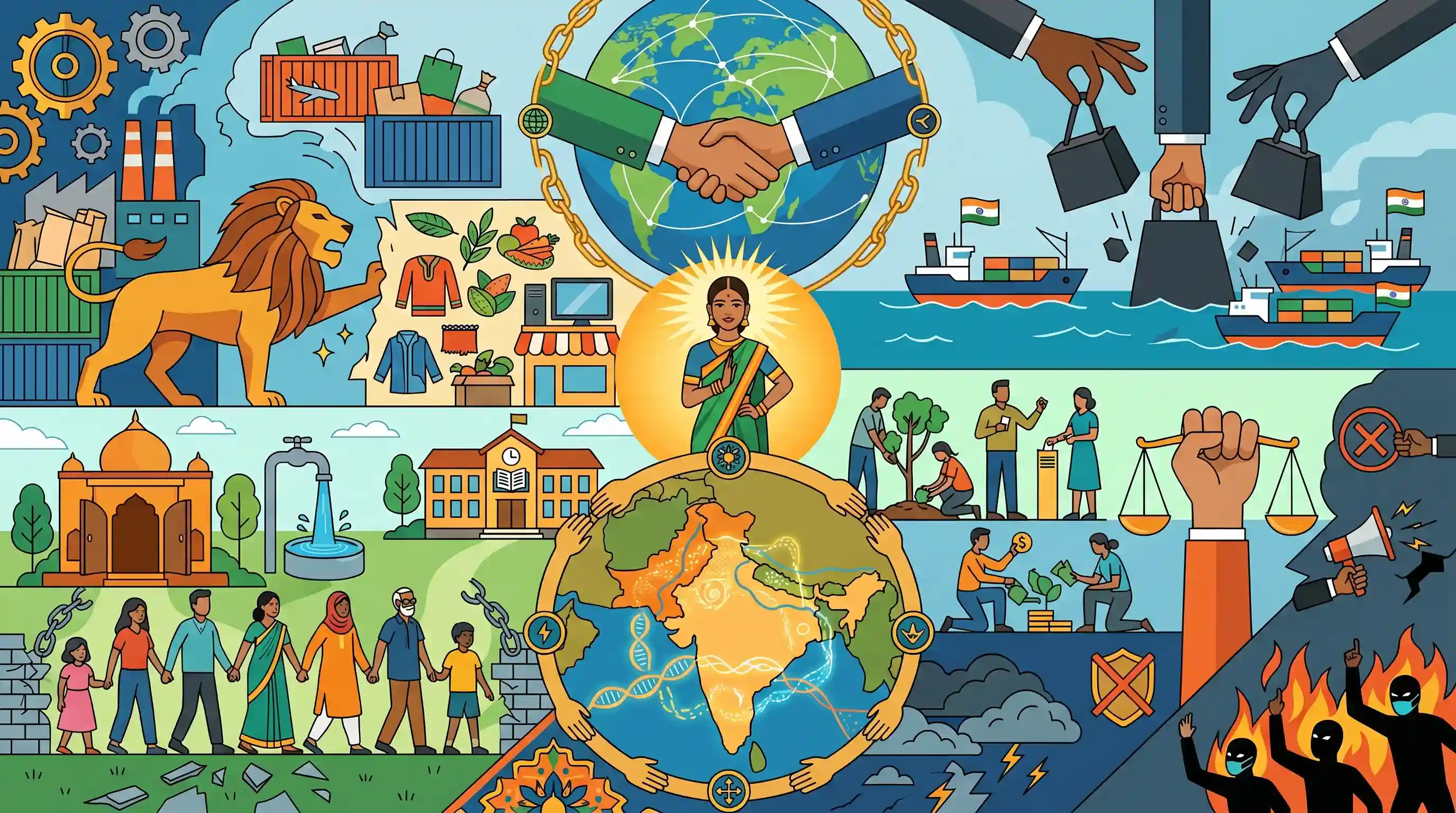
Rashtriya Swayamsevak Sangh (RSS) chief Mohan Bhagwat emphasized that international trade should be based on voluntary cooperation rather than coercion, in a veiled reference to the recent US tariff impositions on India. Advocating for economic self-reliance ('Swadeshi'), he urged citizens to prioritize domestic goods. On social issues, Bhagwat stressed the need to completely eradicate caste discrimination, demanding equal access to public resources like temples and water for all communities. Touching upon geopolitics, he described neighboring countries as sharing India's cultural DNA ('Akhand Bharat'), arguing that their stability is crucial. He also highlighted the importance of civic duties and cautioned against the polarizing effects of 'cancel culture' and extremism on social harmony.
Key Points
- RSS chief Mohan Bhagwat stated that international trade must be voluntary and consensus-driven, criticizing pressure tactics in the wake of recent US tariff hikes.
- He strongly advocated for 'Swadeshi' (self-reliance), urging Indians to consume locally manufactured goods to boost the domestic economy.
- Bhagwat called for the complete eradication of caste discrimination, emphasizing that all castes should have equal access to temples, water sources, and cremation grounds.
- Highlighting the concept of 'Akhand Bharat', he noted that India shares cultural DNA with neighboring countries, making their peace and stability essential for the region.
- He warned against the socially divisive impacts of 'cancel culture' and extremism, stressing the importance of civic sense, discipline, and avoiding provocation for nation-building.
Important Terms
Protectionism

Economic policy of shielding domestic industries from foreign competition through tariffs, quotas, or subsidies. It aims to protect local jobs and infant industries but can trigger trade wars.
UPSC context
Relevant for GS Paper III (Economy) regarding trade policy and GS Paper II (International Relations) concerning global trade disputes.
Atmanirbhar Bharat
A mission launched in 2020 to make India a self-reliant global manufacturing hub. It emphasizes 'Vocal for Local' while integrating into global supply chains rather than seeking isolation.
UPSC context
Crucial for GS Paper III (Economic Development) and essays on India's growth strategy and self-sufficiency.
Neighborhood First Policy
India's diplomatic priority to foster stable, friendly, and mutually beneficial relations with its immediate neighbors through connectivity, economic integration, and non-reciprocal developmental assistance.
UPSC context
Core topic for GS Paper II (International Relations) regarding India and its neighborhood relations.
Swadeshi
Historical and modern philosophy of economic nationalism advocating the use of indigenous products. It evolved from a 1905 anti-colonial protest to a modern pursuit of self-sufficiency.
UPSC context
Tested in GS Paper I (Modern History) and GS Paper III (Economic policy comparisons).
Fundamental Duties
Enshrined in Article 51A, these 11 non-justiciable obligations (e.g., promoting harmony, protecting public property) remind citizens to balance their rights with responsibilities toward the nation.
UPSC context
Key area for GS Paper II (Polity/Constitution) regarding the relationship between the state and citizens.
Eradication of Caste Discrimination
A constitutional mandate (Articles 15, 17) to eliminate social hierarchies and untouchability. It ensures equal access to public resources and representation for historically marginalized communities.
UPSC context
Vital for GS Paper I (Social Issues) and GS Paper II (Governance/Social Justice).
Prelims Trap
Equal access to wells and water tanks is guaranteed exclusively under Article 17 (Abolition of Untouchability).
Access to wells and tanks is explicitly protected under Article 15(2), not just Article 17. Furthermore, temple entry is governed by Article 25(2)(b).
Static Concepts Connected
Which Constitutional Articles mandate equal access to public spaces and religious institutions?
- Article 15(2): Prohibits discrimination on grounds of religion, race, caste, sex, or place of birth regarding access to shops, public restaurants, wells, and bathing ghats.
- Article 17: Abolishes "Untouchability" and forbids its practice in any form, making any disability arising out of it a punishable offense.
- Article 25(2)(b): Empowers the State to throw open Hindu religious institutions of a public character to all classes and sections of Hindus.
What are the key WTO mechanisms to address coercive unilateral tariffs?
- Dispute Settlement: Affected nations can approach the WTO's Dispute Settlement Body (DSB) against unilateral tariff hikes that violate bound rates or Most-Favored-Nation (MFN) principles.
- Retaliatory Tariffs: If the DSB rules in favor of a complainant and the offending nation fails to comply, the complainant can impose authorized retaliatory tariffs.
- Safeguard Measures: A temporary restriction on imports of a product to protect a specific domestic industry from a sudden, unforeseen import surge.
Cross-Topic Patterns
Swadeshi to PLI Transition
The historical 'Swadeshi' ethos integrates into modern 'Atmanirbhar Bharat' via PLI schemes, shifting India from mere defensive import substitution to building globally competitive, resilient supply chains.
Civilizational IR & Neighborhood First
The civilizational 'cultural DNA' framework translates into India's Neighborhood First policy and Gujral Doctrine, emphasizing asymmetric, non-reciprocal support to secure regional stability.
Cancel Culture & Fundamental Duties
The rise of digital extremism and 'cancel culture' makes Article 51A(e)—the fundamental duty to promote harmony and brotherhood transcending diversities—highly relevant for Mains Ethics.

Expect a Polity prelims question pairing Article 15(2) (access to water) and Article 25(2)(b) (temple entry) as distinct from Article 17.
Linked PYQs · 5
Linked PYQs · 5
- 2025MainsGS3
What are the challenges before the Indian economy when the world is moving away from free trade and multilateralism to protectionism and bilateralism? How can these challenges be met?
- 2018MainsGS3
How would the recent phenomena of protectionism and currency manipulations in world trade affect macroeconomic stability of India?
- 2018MainsGS1
Caste system is assuming new identities and associational forms. Hence, caste system cannot be eradicated in India." Comment.
- 2015MainsGS1
Debate the issue of whether and how contemporary movements for assertion of Dalit identity work towards annihilation of caste.
- 2024MainsGS1
Despite comprehensive policies for equity and social justice, underprivileged sections are not yet getting the full benefits of affirmative action envisaged by the Constitution. Comment.
