Uttar Pradesh Tiger Conservation and Bagh Mitra Initiative
Source:newsonair ↗
Why It Matters
Awareness of specific state-level environmental initiatives (like the Bagh Mitra program) and geographical facts regarding Tiger Reserves in Uttar Pradesh is critical for UPPSC Prelims. The expansion of reserves and population data from the 2022 census represent direct factual targets for UP-specific current affairs and geography questions.
Summary
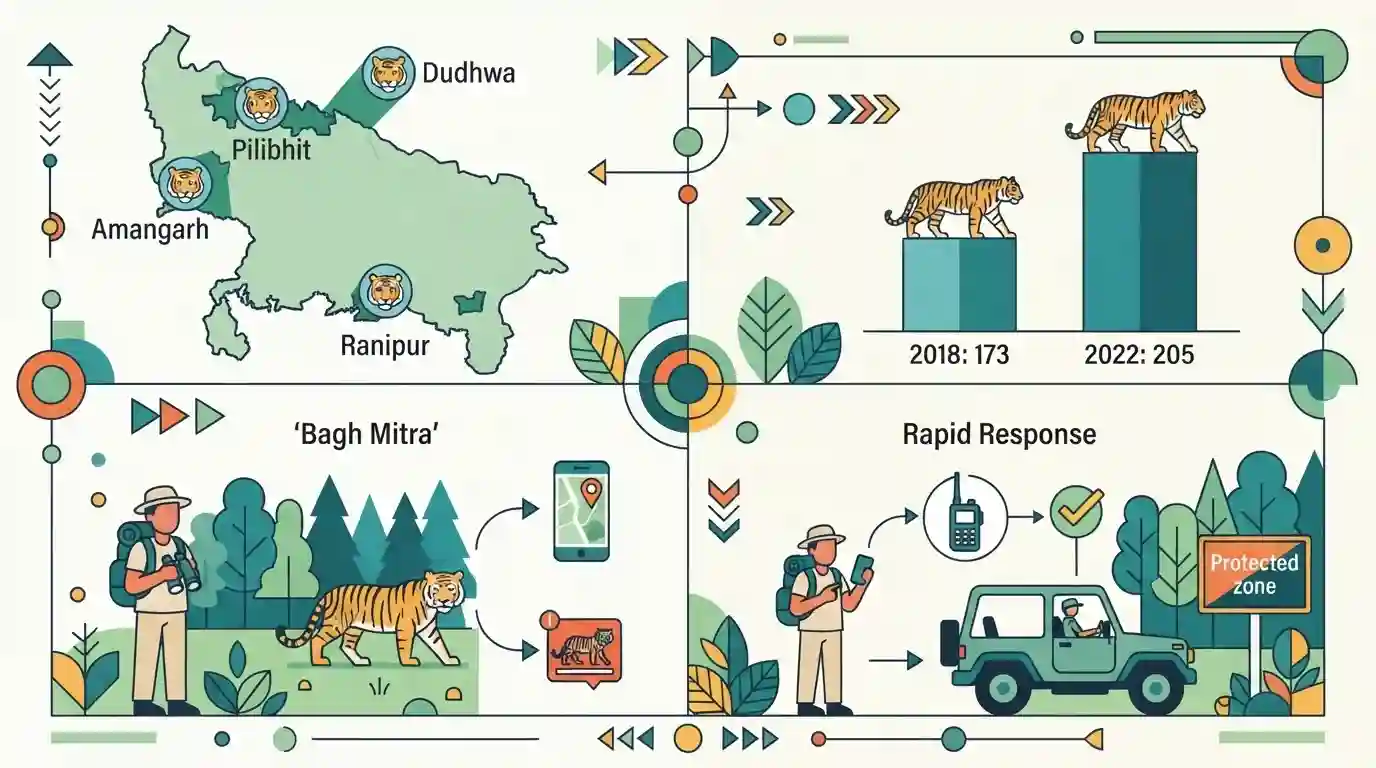
Uttar Pradesh marked International Tiger Day by highlighting its conservation successes, notably the rise in its tiger population from 173 in 2018 to 205 in 2022. The state now hosts four tiger reserves—Dudhwa, Pilibhit, Amangarh, and the newly established Ranipur Tiger Reserve in Chitrakoot. To address the rising instances of human-wildlife conflict as populations grow, the state has expanded its 'Bagh Mitra' initiative. Originally launched in Pilibhit, it trains local villagers living near forests to monitor and report big cat sightings. The effort was bolstered in late 2023 with the launch of a dedicated app, facilitating rapid communication between villagers and forest officials.
Key Points
- Uttar Pradesh commemorated International Tiger Day on July 29 with state-wide programs, hosting the main event at the Ranipur Tiger Reserve in Chitrakoot.
- The state's tiger population has grown significantly, rising from 173 in the 2018 census to 205 in the 2022 census.
- Uttar Pradesh currently has four designated tiger reserves: Dudhwa, Pilibhit, Amangarh, and the newly established Ranipur.
- The 'Bagh Mitra' initiative, initially launched in Pilibhit in 2019, enlists and trains villagers living within five kilometers of forest boundaries to help mitigate human-wildlife conflict.
- In October 2023, the state launched the 'Bagh Mitra' app, enabling these local volunteers to report tiger or leopard sightings in residential areas directly to officials via WhatsApp for rapid response.
Important Terms
Bagh Mitra initiative

A community-led program in Uttar Pradesh, launched in 2019 in Pilibhit, that trains local volunteers to monitor tiger movements, report sightings, and minimize human-wildlife conflict near forest boundaries.
UPSC context
GS Paper III (Environment); tests community-led conservation models, human-wildlife conflict mitigation, and regional forest governance.
Bagh Mitra app
A dedicated mobile application launched in 2023 in Uttar Pradesh that enables trained local volunteers to report tiger sightings, upload photos, and share real-time GPS locations with forest officials.
UPSC context
GS Paper III (IT & Environment); tests usage of digital technology, early-warning applications, and e-governance in mitigating environmental conflicts.
Ranipur Tiger Reserve
Located in UP's Chitrakoot district, this is the state's fourth tiger reserve and India’s 53rd, serving as the first protected tiger habitat in the Bundelkhand region.
UPSC context
GS Paper III & Prelims Geography; tests knowledge of key national parks, regional biomes, and territorial wildlife sanctuaries.
Pilibhit Tiger Reserve
A crucial protected area in UP's Terai Arc Landscape that received the prestigious global TX2 award for doubling its wild tiger population within a four-year period.
UPSC context
GS Paper III (Conservation); tests understanding of transboundary ecological corridors, international conservation standards, and successful species restoration.
Project Tiger
India's flagship centrally sponsored wildlife conservation program launched in 1973, administered by the NTCA, aimed at ensuring a viable population of Bengal tigers in their natural habitats.
UPSC context
GS Paper III (Environment); tests statutory policies, historical wildlife protection frameworks, core-buffer strategies, and active national ecosystem management.
Prelims Trap
Amangarh Tiger Reserve is located in Uttarakhand as it is part of the Corbett Tiger Reserve landscape.
Amangarh is politically in Uttar Pradesh (Bijnor district) and managed by UP, even though it ecologically serves as the buffer zone to Uttarakhand's Jim Corbett National Park.
Static Concepts Connected
What is the legal framework for declaring Tiger Reserves in India?
- Statutory backing: Section 38V of the Wild Life (Protection) Act, 1972 governs the notification of tiger reserves by state governments.
- NTCA approval: State governments declare these reserves only after receiving formal approval and recommendations from the National Tiger Conservation Authority (NTCA).
- Core-Buffer zoning: Divided into core/critical tiger habitats (strictly protected) and buffer/peripheral areas (allowing sustainable community co-existence).
What are the ecological features of the Ranipur Tiger Reserve landscape?
- Vindhyan terrain: It is situated in the Chitrakoot district within the Vindhyan hill range, featuring dry deciduous thorny vegetation.
- Corridor connectivity: It forms a critical corridor for tiger movement from the adjoining Panna Tiger Reserve in Madhya Pradesh.
Cross-Topic Patterns
Community governance and wildlife co-existence
Connecting community-led initiatives like 'Bagh Mitra' with Community Forest Rights under FRA 2006 highlights how decentralized local participation reduces human-wildlife conflicts.
River-linking impacts on tiger habitats
The Ken-Betwa Link Project's impact on Panna Tiger Reserve highlights the critical ecological role of Ranipur as an essential northern dispersal corridor.

Ranipur TR's proximity to Panna and the Ken-Betwa link makes it prime for a geographic corridor and river-linking question in 2026.
Linked PYQs · 4
Linked PYQs · 4
- 2022UPPSC_PRELIMSGS1
Dudhwa National Park is located in which of the following districts of Uttar Pradesh?
- 2020UPPSC_PRELIMSGS1
Arrange the following events in chronological order of their commencement : I. Project Tiger II. Project Elephant III. Wildlife Protect Act IV. Biological Diversity Act Select the correct answer using the codes given below.
- 2020UPPSC_PRELIMSGS1
With reference to the detailed report of Tiger Census 2018 released by Government of India in July 2020, which of the following Statement(s) is/are correct ? 1. India has 70% of total global tiger's population. 2. Nearly 30% of India's tigers live outside tiger reserve. Select the correct answer from the codes given below. Codes :
- 2019UPPSC_PRELIMSGS1
Arrange the following events in chronological order of their commencement and select correct answer from the codes given below: I. Wild Life (Protection) Act II. Biological Diversity Act III. Project Tiger IV. Project Elephant
